On Friday, President Trump’s war council convened at Camp David amidst growing tensions in the Middle East. Iran showcased new missile capabilities, while Saudi airstrikes targeted Sanaa, and Ansar Allah claimed a missile strike on Riyadh.
Team Trump’s ‘Highly Unusual’ Meeting at Camp David
In a surprise session termed “highly unusual” by Axios, Team Trump gathered at Camp David. This marked a rare assembly since a similar meeting in June 2025, just before Israel engaged in conflict with Iran.
The meeting was led by Vice President Vance and included prominent figures such as Secretary of State Marco Rubio, Defense Secretary Pete Hegseth, Treasury Secretary Scott Bessent, CIA Director John Ratcliffe, Joint Chiefs of Staff Chair General Dain Caine, and Special Envoy Steve Witkoff.
Responding to inquiries about the meeting’s purpose, Trump remarked, “If I told you, it would make big news. But you will see; it’s going very well. Iran is not faring well.”
Meanwhile, Trump faced backlash from media sources like CNN, which scrutinized his efforts on Truth Social to alter the narrative surrounding the duration of the war, asserting that his assertion about a “four-week” conflict only referred to the timeframe needed to dismantle Iran’s nuclear capabilities. Notably, the White House previously claimed to have “obliterated” these facilities in a single night of airstrikes in mid-2025.
On the op-ed page of the New York Times, Nicholas Kristof cautioned that “Iran Could Choose to Escalate the War,” presenting a critical account of Trump’s administration’s failures in the ongoing conflict:
Diesel prices have surged to $9.99 a gallon in some California locations, the maximum displayable amount. The United States has spent over $43 billion on the war, which could have funded a year of free college education for every American family earning under $125,000. Due to rising prices spurred by the conflict, the average American household incurs about $1,000 in costs, according to economist Mark Zandi. Moreover, we have depleted military resources, caused casualties on both sides, raised questions about potential war crimes, exposed vulnerabilities within U.S. defenses, and diminished military credibility in regions as distant as East Asia.
Interestingly, Kristof completely omits mentioning Israel’s involvement in initiating the conflict while coinciding with Trump’s goal of preventing Iran from developing nuclear weapons. He raises concerns about the “extremist” nature of Iran’s government.
In further coverage, NBC examined how Trump’s strikes against the Houthis forecast challenges in the Iran conflict:
The 52-day initiative, dubbed Operation Rough Rider, exemplified some of the difficulties Trump is currently facing with Iran: The weaker adversary managed to employ cost-effective drones and anti-ship missiles, highlighting the limitations of U.S. aerial and naval strength while threatening the global economy.
Both conflicts aimed for a swift aerial strike; however, airpower alone was insufficient for rapid results. While the Houthis and Iranians suffered damage, they continued to launch drone and missile attacks against the mightiest military in the world.
In recent war news, The Guardian featured images of young sailors aboard the USS George Washington, currently the sole aircraft carrier in CENTCOM’s operational area, as the George H.W. Bush was spotted in the Indian Ocean, seemingly en route to Thailand for a port visit.
Additionally, Reuters reported on a Portuguese prosecutor investigating the legality of U.S. military operations at Lajes Air Base in the Azores during the Iran conflict.
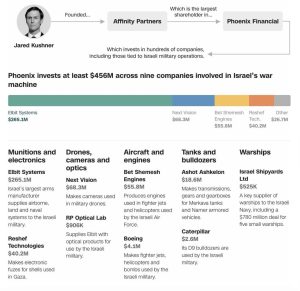
A CNN article exposed that Jared Kushner’s investment firm, Affinity Partners, holds a 7.4% stake in Phoenix Financial, which boasts nearly half a billion dollars in investments related to the Israeli military:
Why Negotiations Are Stalled
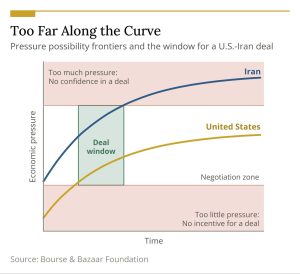
Analyst Esfandyar Batmanghelidj has proposed a model to explain the challenges the U.S. and Iran encounter in pursuing a peace agreement:
Here’s a model to help think through why the US and Iran are struggling to reach a deal to end the war. Since the outset of the fighting, both sides have primarily resorted to economic pressure to compel the other toward a perceived “fair” settlement. However, the dynamics of that pressure manifest differently for each nation. Iran requires significantly greater levels of pressure to entertain a diplomatic resolution with the Trump administration. Yet, there exists a threshold on Iran’s pressure curve when pursuing a deal becomes less feasible.
To summarize, Iran has advanced too far along its curve. The repercussions of “maximum pressure,” sanctions, and the ongoing war have eroded hope for a viable agreement. Iran is now seeking a temporary arrangement, hoping the U.S. will alleviate the pressure, allowing the two nations to reopen negotiations. Unfortunately, it appears the Trump administration doesn’t grasp this model, as they neither acknowledge the diminishing returns on increased economic strain nor its detrimental effect on negotiation prospects.
— Esfandyar Batmanghelidj (@yarbatman) October 3, 2026
Meanwhile, Iran has not remained idle.
Iran’s New Missiles and Massive Mobilization
According to the United Kingdom Maritime Trade Operations (UKMTO), Iran has targeted at least eight tankers in the Strait of Hormuz within the past five days without any U.S. retaliation, despite an announced policy of “a tanker for a tanker” initiated in early September. It appears the U.S. seeks to avoid a repeat of previous violent exchanges following its last actions against Iranian tankers.
Bloomberg has reported on the experiences of a tanker captain navigating the Strait under U.S. protection:
The U.S. has coordinated with shippers since early summer to devise routes and avert Iranian mines. American forces have facilitated safe passage for thousands of ships through the Strait of Hormuz in recent months. “We remain committed to our mission and will continue collaboration with U.S. partners, regional nations, and the shipping sector to enhance maritime traffic flow,” stated U.S. Central Command.
The captain often received updates about military support overhead. On one occasion, he observed both a jet and a helicopter watching over his vessel. While gas carriers—less numerous than oil tankers—have taken extra precautions, at least eight LNG vessels successfully crossed the Strait in the past two weeks, assured by U.S. protection.
Iran maintains its own blacklist of tankers trading with the U.S., with estimates suggesting a one in twenty chance of being targeted while transiting Hormuz, all while monitored by U.S. military forces. The captain’s latest contract was significantly shorter than usual, given the challenging nature of the voyage, but he still received a multiplied salary for his effort.
Bloomberg previously reported that one shipowner incentivized its crew with an additional six months of pay to navigate Hormuz, a considerable amount for lower-income seafarers from countries such as the Philippines and India. With two million barrels of oil onboard, American forces have closely monitored the captain’s tanker, which is part of a stringent surveillance protocol requiring regular check-ins.
After witnessing a blast ahead, the captain was informed by the U.S. Navy that other vessels were managing to continue their journeys, and he should proceed as well. On another occasion, his vessel fell under attack, but fortunately, there was no damage or injuries reported, underscoring the many close calls encountered.
Brigadier General Ali Belali, an aerospace advisor to the IRGC, revealed to Fars about a new “Persian Gulf” missile currently being tested, designed to strike moving warships at a range of 400-500 km using optical guidance.
This follows prior statements from IRGC spokesperson Brigadier General Hossein Mohebbi and Major General Mohsen Rezaei, Secretary of Iran’s Supreme National Security Council, about a recent test striking the USS George Washington aircraft carrier on September 5, 2026.
Alastair Crooke reported in his late September overview that Iran is mobilizing one million individuals into battalions of 1,000, which suggests the move is not simply for defense against a U.S. expeditionary force. This buildup could instill concern among neighboring states like Bahrain and Kuwait. There have been reports suggesting Iran intends to seize Bahrain if the Emirate supports an American assault.
A report from Iranian IRIB TV claims that China has ceased providing satellite imagery to Iran for targeting after a Wall Street Journal report accused them of involvement in such operations.
Now, let’s examine Saudi Arabia’s conflict with Ansar Allah in Yemen.
Saudi Arabia and Ansar Allah Trading Shots
Alastair Crooke’s overview also addresses the strategic predicament facing Muhammad bin Salman (MbS):
The Gulf’s colonial framework is disintegrating, with Saudi Arabia at its core. MbS is unable to negotiate with Iran due to Saudi Arabia’s deep entrenchment within U.S. technology, intelligence, and financial structures. Consequently, these elements essentially govern the state on his behalf. The ramifications of this arrangement are profound amid the U.S. war against Iran, leading to significant declines in Saudi oil sales and impending financial crises. Attempting to liquidate shares and U.S. Treasuries has proven challenging, with Gulf allies hesitant to buy Saudi assets, fearing the stability of the Saudi state itself.
Reuters reports that Saudi Arabia is preparing “an offensive against Iran-backed Houthi militants in Yemen,” examining options for securing the Red Sea shipping route or launching an assault across multiple fronts. This operation will be executed by Yemeni forces on the ground with oversight from Riyadh, supplemented by Saudi airstrikes.
However, Axios’ Barak Ravid reports that the U.S. has denied Saudi requests for support in this operation, asserting that U.S. assistance could be reconsidered only if complications arise.
In the meantime, the Institute for the Study of War (ISW) has documented at least 13 airstrikes by Saudi or Yemeni forces on Ansar Allah’s capital, Sanaa, as well as 71 strikes in and around the contested city of Taiz (Yemen’s third-largest city).
According to MintPress News, Israel has been providing Saudi Arabia with targeting intelligence.
Ansar Allah quickly retaliated against strikes on Sanaa by claiming to have launched missile assaults on Aramco facilities in Riyadh, following reports from Reuters of a significant fire at these sites that were likely the result of Houthi attacks.
Multiple reports indicate that Saudi Arabia has not activated civil defense alerts during missile strikes targeting its cities.
Commenting on this, Brett Erickson stated:
As I have pointed out several times over the past week, it is confirmed that Saudi Arabia’s Early Warning alerts are not being issued by Civil Defense. Intelligence firm Clearwater Intelligence has verified Ansar Allah strikes on Yanbu recently, and Reuters has provided imagery confirming strikes on Saudi Aramco facilities in the capital of Riyadh yesterday. The extent of censorship across the entire Middle East complicates the search for an accurate understanding of the current strategic and economic landscape.
An Ansar Allah account claimed footage of the recent missile strike on Riyadh:
مالم تنقله قنوات العربية والحدث وقناة الجزيرة الحقيرة العبرية من الاستهداف الصاروخي اليمني المبارك اليوم على اراااامكو. نعرضه لكم لاتقصرو إعادة النشر https://t.co/HRg1DY3tQu
— بركان المسيرة (@AlnsarAllah10) October 3, 2026
Translation: “What Al Arabiya, Al Hadath, and the despicable Hebrew Al Jazeera didn’t show of today’s blessed Yemeni missile strike on Aramco. We show it to you—don’t hesitate to share.”
Aramco in Riyadh is burning. https://t.co/jNINauv8HR
— barry with the NED (@bonzerbarry) October 3, 2026
Concerning the fighting around Taiz, ISW provided a map:
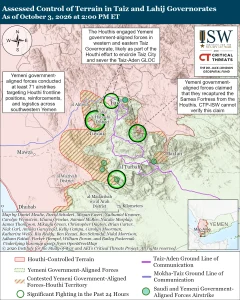
Barry from NED also provided insights mapping the ongoing battles:
Ansar Allah has made significant advances on the southwest front of Taiz. There’s pressure on Al Turbah from both sides (now only about 18km across). They are also closing in on the Al-Safiya Junction, potentially controlling access to the last route out of Taiz at three separate points.
— barry with the NED (@bonzerbarry) October 4, 2026
And About That Flydubai Incident
FORBIDDEN STUDIOS PRESENTS: WHEN PILOT IS FIGHTING, PLUMBER IS FLYING
One plane. One sword. One plumbing emergency.
The biggest Bollywood action psyop of the year has arrived. https://t.co/fnhtgPr0gE— Forbidden HQ 🐇 (@WearForbidden) October 2, 2026
Around the Tubes
Support my work at NatWilsonTurner.com.