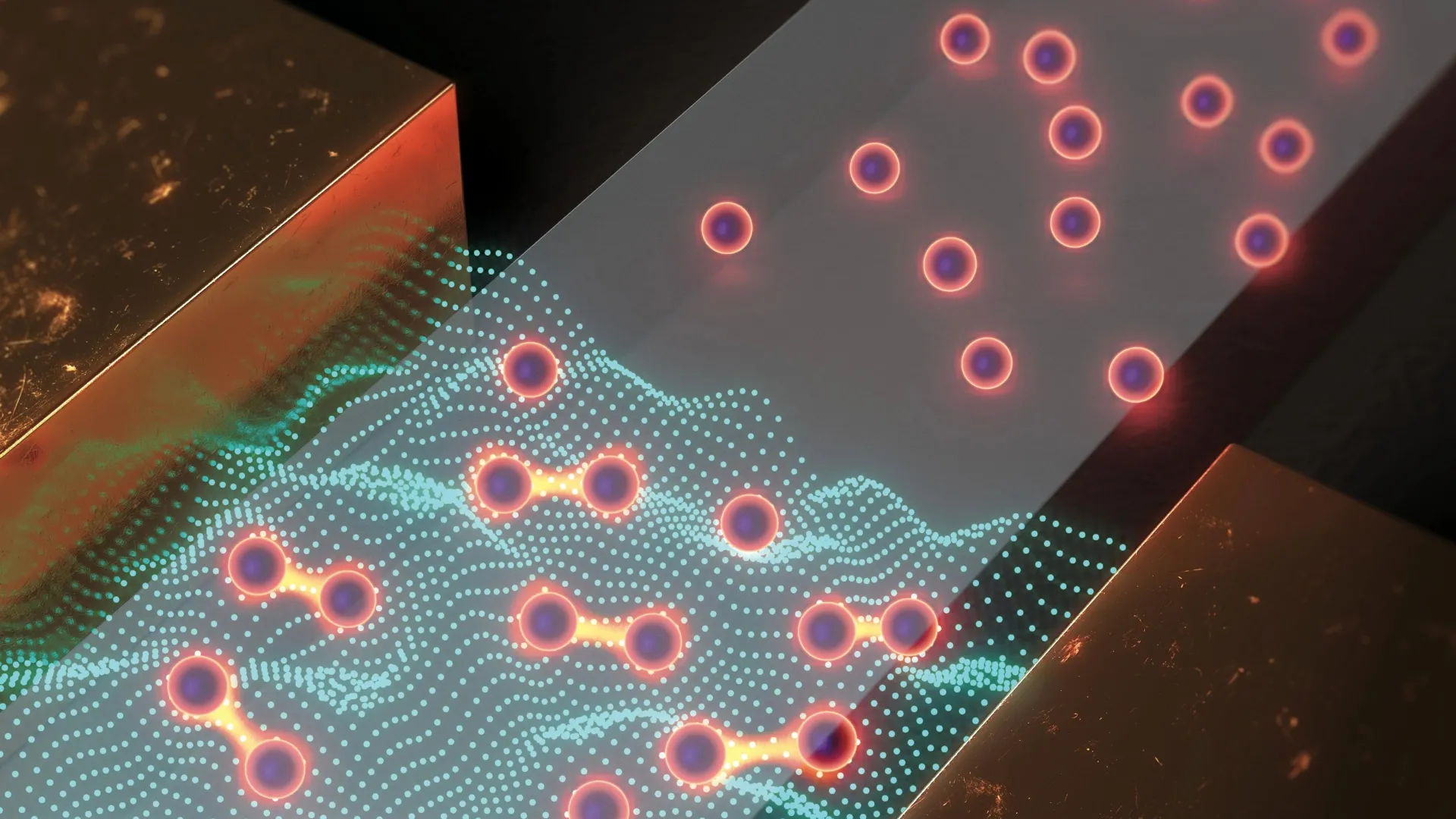
The recent study published in Nature by researchers from the University of Science and Technology of China and collaborators has unveiled a groundbreaking development in superconductivity through the manipulation of quantum vacuum fluctuations. Here are the key points:
Key Findings
- Quantum Fluctuations Enhance Superconductivity: The research indicates that quantum fluctuations present in a vacuum can significantly increase the superconducting properties of materials, particularly NbSe2 (niobium diselenide).
Theoretical Background
- Understanding Vacuum: In quantum physics, a vacuum is not simply empty space; it is filled with virtual particles that perpetually emerge and vanish, creating fluctuations that can influence physical systems.
- Vacuumronics Concept: This newly introduced concept focuses on using engineered vacuum environments to control electronic and photonic behaviors in materials.
Experimental Approach
- Terahertz Split-Ring Resonator: The team designed a terahertz dark cavity to amplify vacuum fluctuations significantly. They placed NbSe2 within this cavity to measure its superconducting behavior.
- Significant Results: They observed a notable increase in the superconducting critical temperature by up to 5.4% and enhancements in critical current and magnetic field.
Control Experiments
- The researchers conducted various control experiments altering the geometry and properties of the cavity, ruling out traditional explanations for the observed enhancements, such as strain or degradation effects.
Theoretical Model
- Ginzburg-Landau Framework: The research team proposed a model suggesting that virtual photons exchanged between the dark cavity and the superconducting state lower the energy of the superconducting state, thereby enhancing stability and superconductivity.
Implications
- Reframing Vacuum’s Role: This study challenges the conventional understanding of the vacuum as a passive background, proposing that engineered vacuums can actively influence the physical properties of materials.
- Potential Applications: The ability to control quantum states through vacuum manipulation opens up prospective avenues for advancements in superconductors and other quantum materials.
Conclusion
This pioneering research indicates a promising new methodology for enhancing and controlling superconductivity through quantum fluctuations, potentially transforming future applications in quantum technologies.


