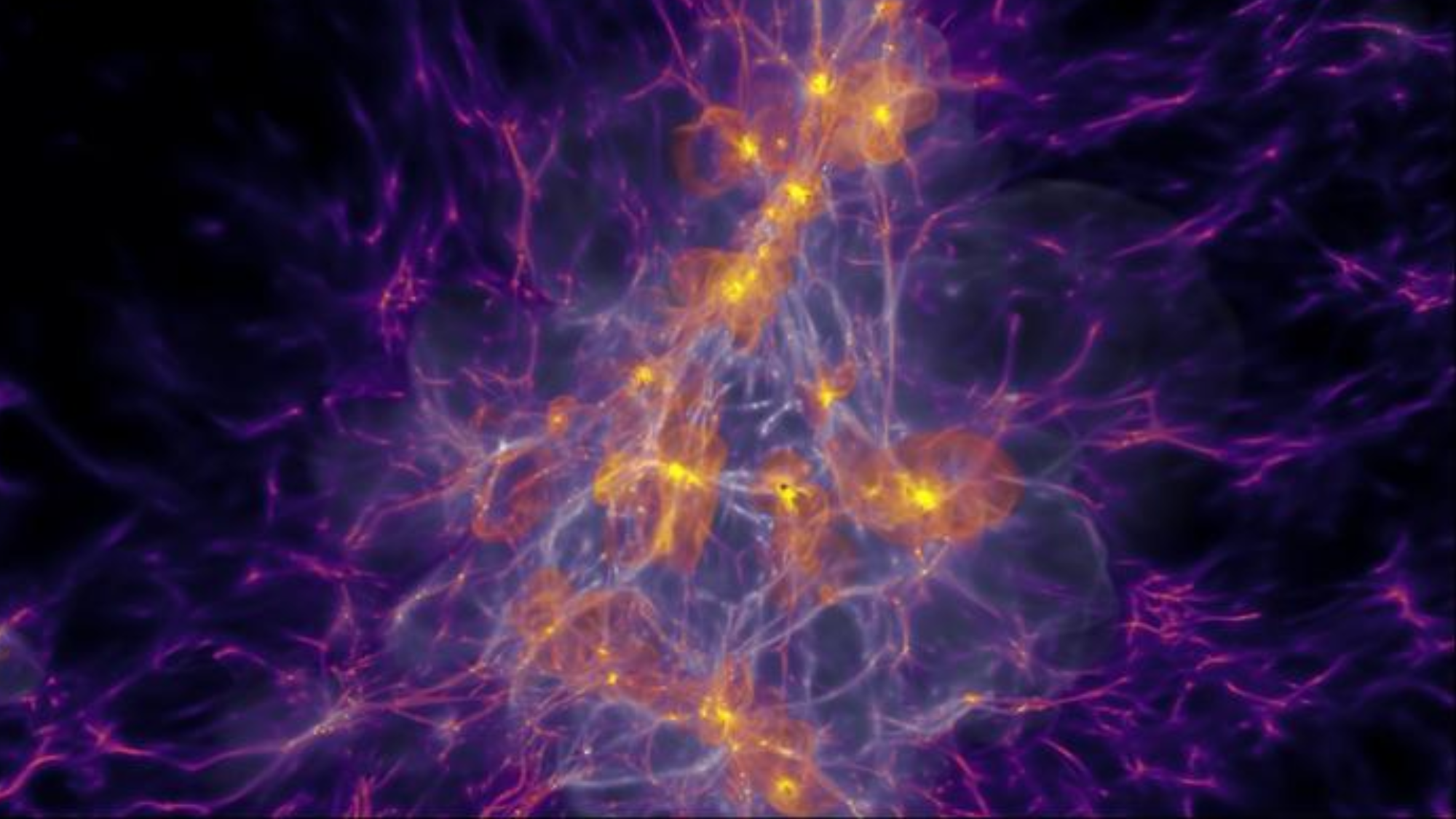
MEGATRON: A Game-Changer in Cosmology
Scientists are harnessing a powerful simulation called MEGATRON to revolutionize our understanding of the universe’s first stars. Running from 2023 until 2030, this project utilizes data from the James Webb Space Telescope (JWST), combining advanced cosmological simulations with intricate models of radiation, chemistry, and galaxy formation. The focus is on Population III (POP III) stars, the initial stars that emerged during the cosmic dark ages.
A Quest for Cosmic Origins
POP III stars were primarily made of hydrogen and helium, the universe’s earliest elements. Throughout their lifecycles, they forged heavier elements, distributing nitrogen, carbon, and oxygen into the cosmos upon their supernova deaths. These elements became the foundation for future stars, planets, and potentially life itself.
Martin Rey from the University of Bath emphasized the importance of understanding these stars: “To understand where those elements came from, we need to understand how the first stars formed and enriched their surroundings.” MEGATRON enables researchers to align simulation data with observations from JWST and ancient stars’ chemical fingerprints.
Early Findings
Initial results from MEGATRON highlight the interaction between starlight, gas, and newly created elements, serving as a link between observational data of early galaxies from the JWST and the remnants of those early times in our Milky Way. Rey noted that while the JWST offers a glimpse into the infant cosmos, “stellar archaeology” allows us to study remnants of that era within our own galaxy.
This unification of data can reconstruct the properties of POP III stars, shedding light on how they enriched their surroundings with metals.
Simulating Cosmological Evolution
MEGATRON simulates a young galaxy similar in mass to the Milky Way, tracking gas movement, starlight passage, and chemical concentration changes over billions of years. These findings suggest that some cosmological models may not fully account for the significant role that star radiation and gas chemical effects play in cosmic evolution.
By providing detailed reconstructions, MEGATRON reveals structures in gas that simpler models fail to capture, potentially improving predictions for ongoing and future astronomical observations.
Continued Research
As the JWST unveils more about early galaxies and ongoing large-scale surveys gather intricate details on ancient stars, the MEGATRON team aims to forge stronger ties between observations and theoretical models. Rey declared that MEGATRON “provides a common physical framework” to bridge JWST’s insights and the stellar fossil record, allowing for unprecedented testing of competing models about the first stars.
The ongoing research has been disseminated in the Open Journal of Astrophysics, with more findings to anticipate.


