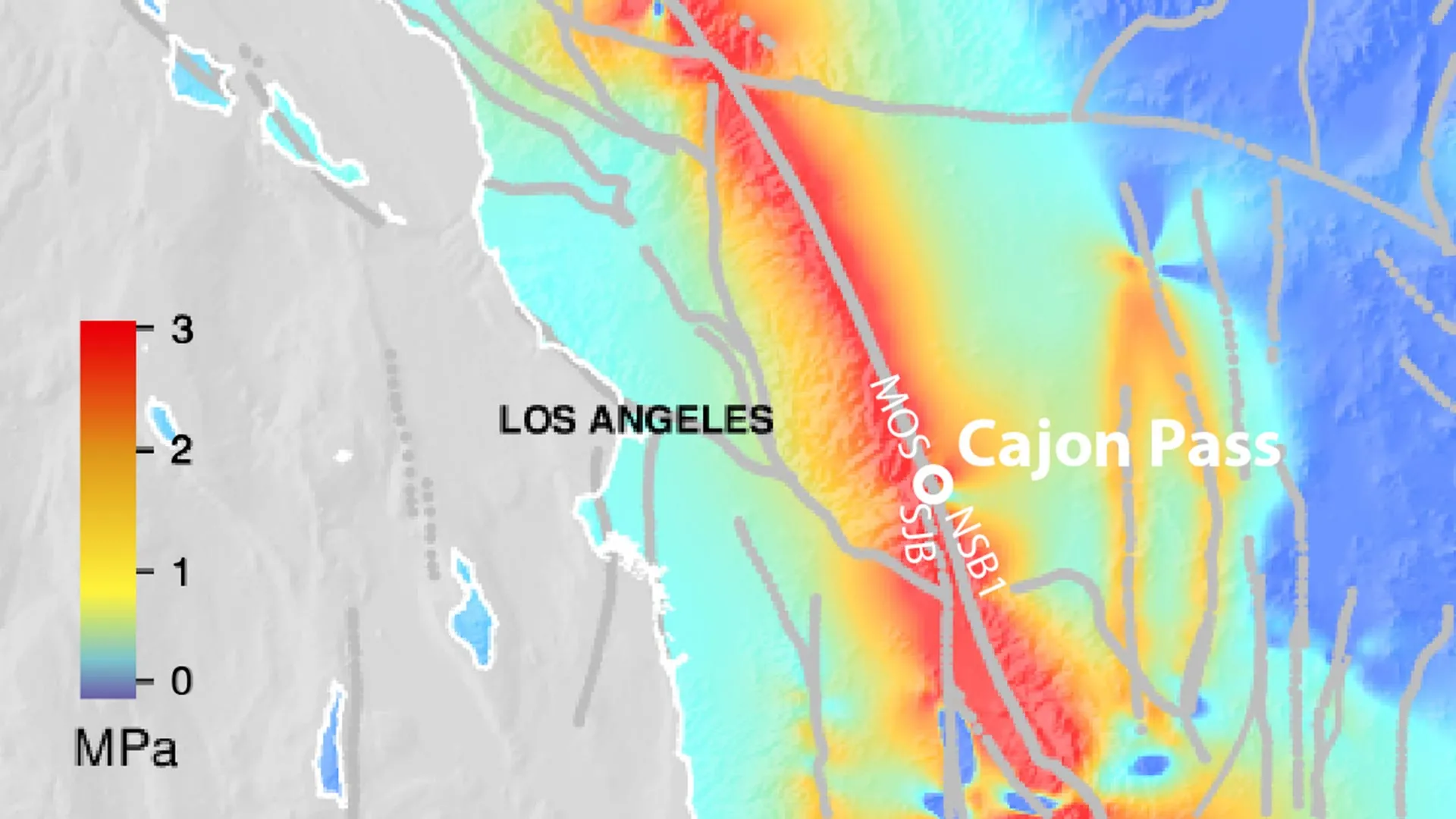
The article discusses the seismic risks in Southern California, specifically focusing on the San Andreas and San Jacinto fault systems, with particular emphasis on Cajon Pass as a critical fault junction. Here are the key points summarized:
### Fault Systems and Earthquake Risk
– Southern California is home to highly active fault networks; earthquakes occur when stress accumulates and is released.
– The San Andreas and San Jacinto faults play a crucial role in accommodating tectonic motion.
### Historical Context
– The region hasn’t seen a major earthquake since the 1857 Fort Tejon quake, leading to a buildup of tectonic stress that raises questions about future earthquakes.
### Recent Research
– A study led by Dr. Liliane Burkhard examined 1,000 years of earthquake activity around Cajon Pass.
– The study’s findings indicate that stress levels in some parts of the fault system are now at the highest recorded in the last millennium.
### Cajon Pass: The “Earthquake Gate”
– Cajon Pass can either halt a rupture or allow one to continue across the faults, influenced by surrounding stress conditions.
– Historical earthquakes demonstrate both scenarios: the 1857 rupture stopped at Cajon Pass, whereas the 1812 Wrightwood earthquake crossed both systems.
### Significant Stress Levels
– Current stress levels are concerning, particularly on the San Jacinto-Bernardino section (3.6 MPa) and the Mojave South section of the San Andreas fault (2.8 MPa).
– The model suggests that simultaneous high stress on both faults could increase the likelihood of a crossing rupture.
### Potential Consequences
– A joint rupture could have devastating impacts on densely populated regions like greater Los Angeles and San Bernardino.
– Cajon Pass is a vital transportation and infrastructure corridor, emphasizing the need for effective emergency planning.
### Cautions on Predictions
– High stress does not equate to an immediate earthquake threat; timing remains unpredictable.
– The study aims to improve understanding of plausible earthquake scenarios, aiding in hazard assessment and preparedness.
This research highlights the ongoing geological tensions in Southern California, the importance of infrastructure resilience, and the need for continued vigilance and planning in light of seismic risks.


