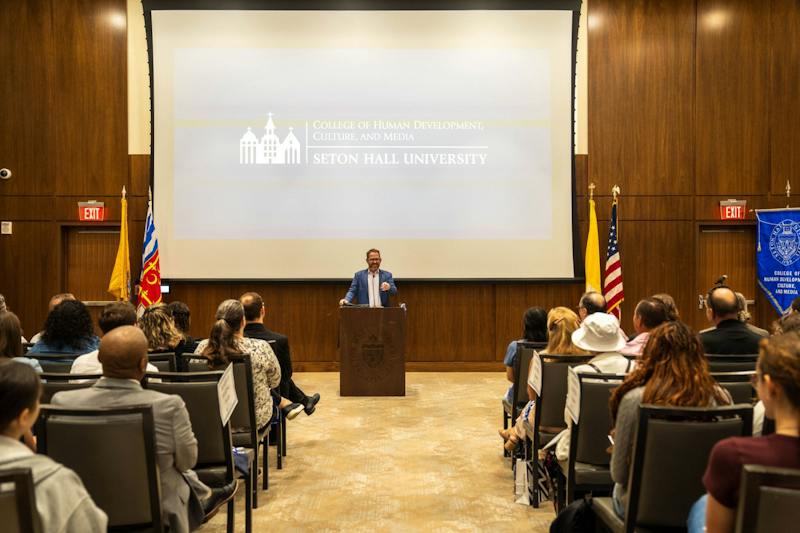
As universities nationwide navigate the implications of AI, Seton Hall’s College of Human Development, Culture and Media (CHDCM) is proactively incorporating AI and advanced technologies like Adobe Creative Cloud into its curriculum.
The primary aim is to equip students with familiarity in tools relevant to their future careers. However, some students have raised concerns regarding AI, particularly its impact on art and design—areas central to CHDCM’s programs. This dialogue was amplified after the college’s annual convocation on September 10, where attendees received stickers believed to feature AI-generated images.
Paige Hunsicker, a junior majoring in visual and sound media, expressed her discontent: “It doesn’t look like us at all,” referring to the unnatural features of the sticker designs.
Bryan Crable, founding dean of CHDCM, mentioned that the integration of emerging technologies was motivated by feedback from SHU alumni about preparing students for a workforce increasingly influenced by AI. He noted, “Alums often ask how we’re preparing students to effectively engage with AI and related tools in their careers,” asserting that faculty are fostering discussions on the opportunities and ethical implications of modern communication technologies.
In creating promotional materials like the laptop stickers, Crable highlighted the collaboration with professional designers along with leveraging emerging technologies integrated across the university. The stickers are part of a collection for CHDCM events that students can accumulate for a chance to earn a prize from the dean.
Crable stated that the integration of AI tools is not meant to replace creativity but rather modernize academic experiences. He asserted, “The CHDCM does not view these tools as substitutes for human creativity or artistic judgment, and our practices reflect that commitment.” The college aims to adequately prepare students for a dynamic job landscape, focusing on ethical and responsible use of digital tools.
Faculty in CHDCM’s Art, Design and Interactive Multimedia (ADIM) program echoed these sentiments. Michael Buckley, an assistant professor, emphasized the importance of preparing students for industries utilizing AI while preserving their creative integrity. He noted, “It would be a disservice if we didn’t show students the ropes without undermining their creativity.”
Christine Lhowe, an associate professor, echoed this perspective, positioning AI as a valuable asset for brainstorming and inspiration rather than a replacement for human artistry. She advised that AI could handle more tedious tasks, allowing students to concentrate on foundational learning and portfolio development. Lhowe compared the situation to historical shifts in design technology, asserting, “I see AI as kind of similar in that I am educating students on it as being a tool.”
However, the reception of the stickers was mixed. Kelsey Wright, a sophomore, expressed “immediate disappointment,” taking issue with what she believed was an AI-generated design. Landis Cramer, a junior, remarked that generative AI undermines the essence of art, which he believes should be rooted in self-expression.
Conversely, some students see potential in AI for enhancing design processes. Charlotte Segreto, a sophomore studying biology, noted its ability to optimize workflows and shift the roles of professional designers towards creative direction rather than manual tasks.
Despite mixed reviews, Crable reaffirmed that the CHDCM Sticker Series will persist throughout the academic year, and he announced a student sticker design contest to further engage students in the creative process.
Michela DiLorenzo is the head editor of The Setonian’s News section.