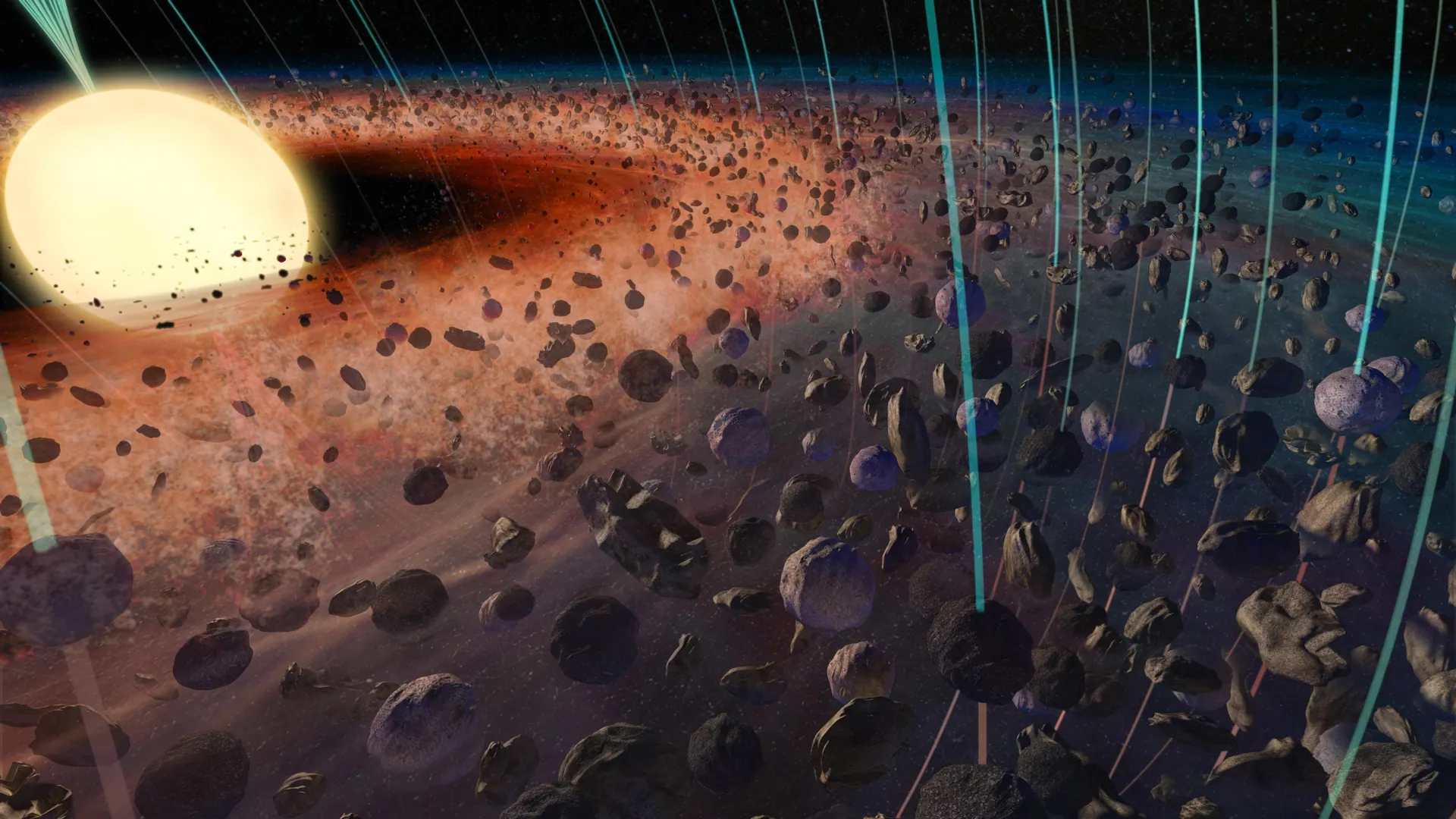
The article discusses new research from MIT suggesting that magnetism played a significant role in the early formation of the solar system, alongside gravity. Here’s a summary:
Key Points:
-
Solar System Formation:
- Approximately 4.6 billion years ago, the solar system originated from a vast cloud of gas and dust known as the solar nebula, which eventually collapsed to form the sun and planets.
-
Role of Magnetism:
- Traditionally, gravity has been viewed as the primary force driving this transformation. However, new findings indicate that magnetic fields may have also influenced the process.
- Researchers studied ancient magnetic fields preserved in meteorites, particularly calcium-aluminum-rich inclusions (CAIs) found in a meteorite from Antarctica, dating back to the solar system’s first 200,000 years.
-
Evidence of Magnetic Fields:
- The magnetic signatures indicate that a robust magnetic field existed in the solar nebula stage, possibly stronger than Earth’s current magnetic field.
- This magnetic field could have assisted in moving primordial materials inward as the sun formed.
-
Research Findings:
- The evidence, reported in the Proceedings of the National Academy of Sciences, includes contributions from several researchers and institutions.
- The study was led by Cauê Borlina, highlighting the debate about the role of magnetism during the earliest stage of solar system formation.
-
Meteorite Analysis:
- Focused on the meteorite DOM 08006, which has maintained a primitive composition, researchers found tiny magnetic minerals and traces of ancient magnetism.
- They estimated the early solar magnetic field to be between 150 to 600 microteslas, significantly stronger than Earth’s.
-
Implications:
- This research suggests that understanding the formation of the sun and planets requires considering magnetic fields, in addition to gravitational forces.
In summary, the new insights into the role of magnetism enhance our understanding of solar system formation and highlight the complexity of the processes involved. This research was supported in part by NASA.


