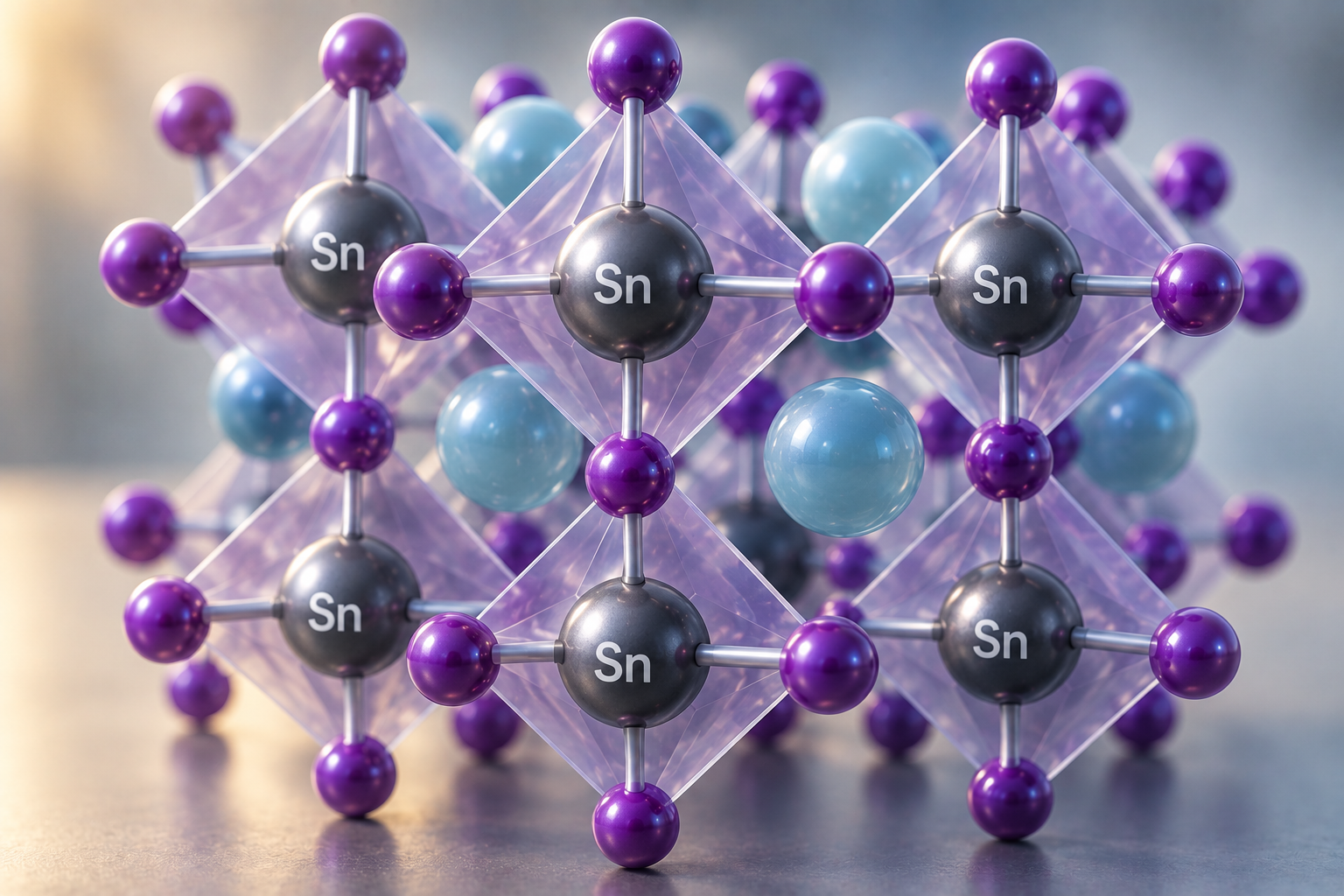
Researchers have discovered why tin-based perovskites can retain energy from sunlight for longer periods, making them promising candidates for high-efficiency solar cells. Conventional solar cells struggle to capture all the energy in sunlight, as excited charge carriers quickly lose excess energy as heat.
Hot-carrier solar cells aim to retrieve this lost energy, but charge carriers typically cool down in picoseconds. In contrast, tin-based perovskites can keep their charge carriers hot for nanoseconds. A study from the University of Groningen and TU Wien revealed two key mechanisms that contribute to this extended energy retention.
-
Band Filling: As excited charge carriers occupy lower-energy states, the availability for new carriers to occupy those states diminishes, slowing further energy loss. This effect is pronounced in tin-based perovskites due to their low effective carrier mass.
-
Vibrational Energy Transfer: In perovskites, vibrational energy within the crystal lattice can be transferred back to the charge carriers, further delaying cooling.
Computer simulations showed that, for a tin perovskite model, the cooling time increased dramatically from 4 picoseconds to approximately 470 picoseconds. This aligns with previous experimental data, indicating that these mechanisms could explain the slower cooling observed in tin perovskites.
The study emphasizes the low effective carrier mass, soft crystal structure, and material purity as critical qualities for future materials that aim to slow carrier cooling. Although this research does not yet yield a working hot-carrier solar cell, it underscores the potential of tin-based perovskites in developing more efficient solar technologies.
For more on advancements in tin technologies, check out Tin Valley and the linked paper here.


