Interstellar Weather: A Step Forward
Recent observations from the James Webb Space Telescope (JWST) have brought astronomers closer to forecasting weather on worlds beyond our solar system.
Understanding Atmospheric Patterns
For effective weather forecasting on distant planets, scientists must comprehend the atmospheric drivers and recognize weather patterns. A new study focused on SIMP 0136, a brown dwarf located about 20 light-years from Earth, reveals that its atmospheric variability can be primarily attributed to temperature differences and cloud structure changes.
Brown Dwarfs vs. Exoplanets
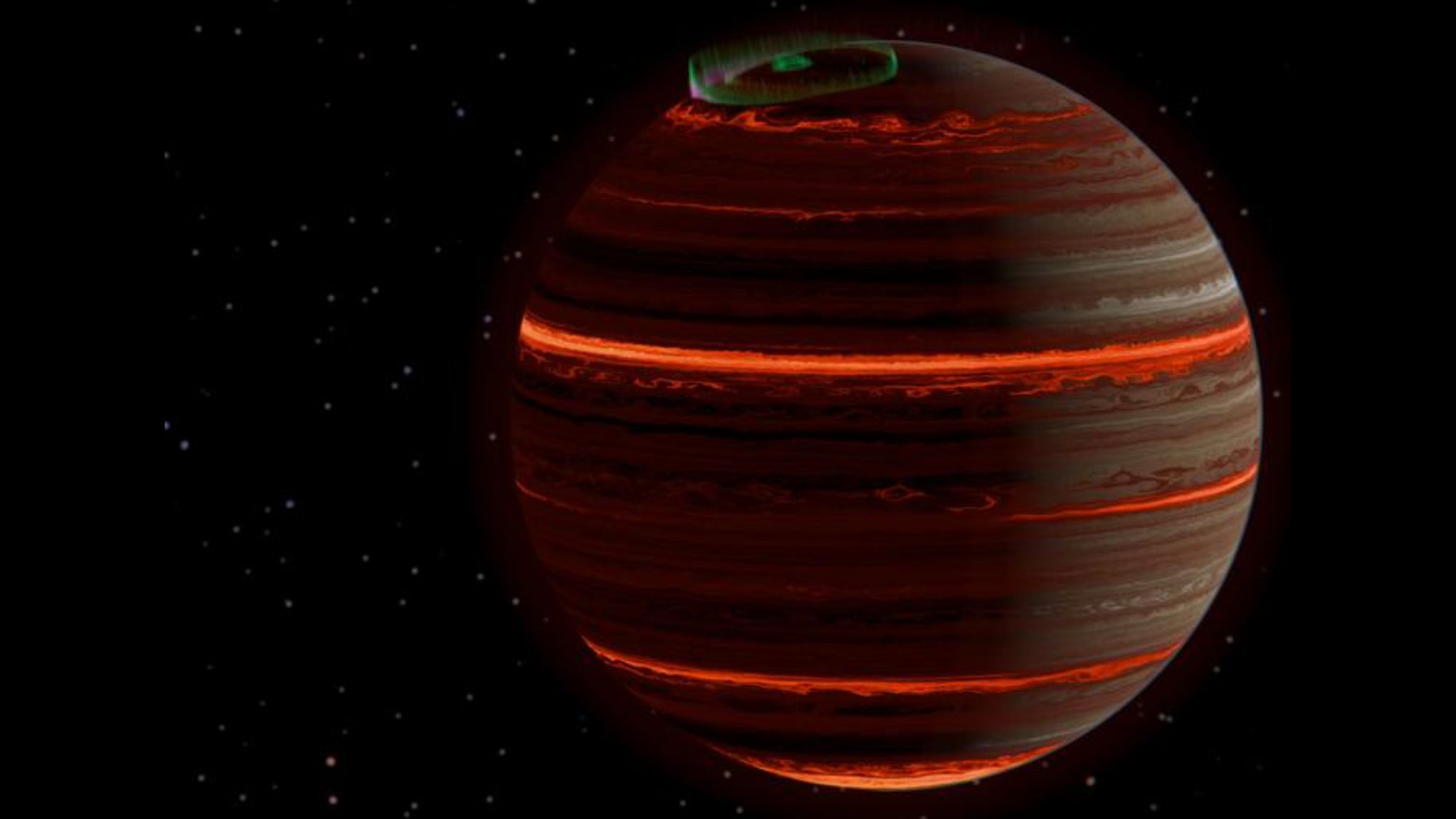
SIMP 0136, classified as a brown dwarf, occupies a niche between planets and stars—too massive for the latter but not capable of sustaining hydrogen fusion. Observing such objects allows researchers to explore atmospheric conditions akin to larger exoplanets.
Analyzing Atmosphere Variations
The study employed principal component analysis to sift through brightness variations of SIMP 0136 as it rotated. This approach identified three distinct weather states, revealing that certain regions were hotter with thinner clouds while others were cooler with denser cloud cover.
Patterns Over Time
The research indicated that the dynamics driving these atmospheric patterns remained consistent over multiple rotations, providing promising news for future atmospheric studies. Lead author Merle Schrader expressed optimism about identifying the persistent atmospheric drivers in this brown dwarf.
Looking Ahead
Though this method does not yet allow precise weather predictions for distant worlds, it paves the way for understanding diverse atmospheric systems across various celestial bodies. Co-author Johanna Vos believes that applying this technique to a range of brown dwarfs and exoplanets will enhance our understanding of their unique weather systems.
Publication
This research is detailed in the journal Astronomy & Astrophysics, published on September 16.
Final Thoughts
As scientists improve their understanding of atmospheric dynamics beyond our solar system, the dream of interstellar weather forecasting edges closer to reality.


