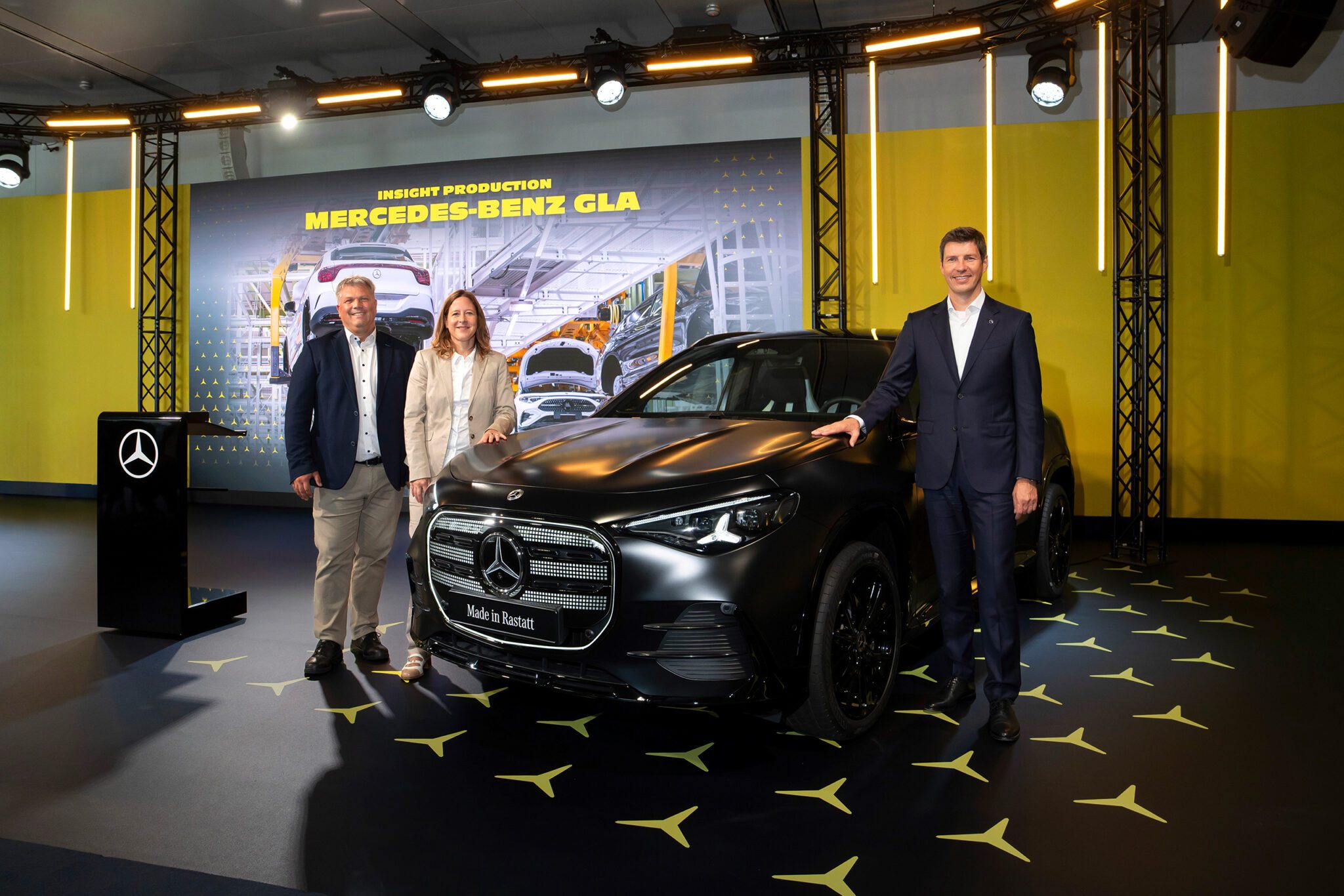
Mercedes-Benz has commenced series production of the new GLA at its Rastatt plant in Germany, integrating both fully electric variants and 48V hybrid models planned for 2026. This marks the addition of a second model to Rastatt’s new compact-vehicle generation, alongside the CLA.
Rastatt, employing approximately 7,000 people, uses a Digital First approach to manufacture hybrids and electric vehicles on a unified production line. The plant leverages the Mercedes-Benz Operating System (MB.OS), AI, and the MO360 production ecosystem to enhance its manufacturing capabilities.
To facilitate this production, Mercedes-Benz is investing a significant sum in converting Assembly Hall 4.1 for GLA production starting in 2027, employing digital twin simulations for efficient planning. Components like electric drives will be sourced from Untertürkheim, batteries from Accumotive in Kamenz, and body parts from Kuppenheim.
Michael Schiebe, a Board Member at Mercedes-Benz, emphasized the importance of this development in reinforcing Rastatt’s role within the global production network. He highlighted the integration of digital technologies that enable a more flexible production process.
Key Points:
-
Flexible production: By manufacturing both electric and hybrid GLA variants on the same line, Mercedes-Benz can adapt to varying demand without falling prey to stranded-capacity issues faced by competitors with dedicated EV lines.
-
Centralized battery production: In-house battery production through Accumotive aims to maintain cost control and supply security, positioning Mercedes-Benz favorably in a competitive market facing price pressures from Chinese manufacturers.