Understanding the complex dynamics of the ongoing Iran War can be challenging, especially given the rapidly changing circumstances surrounding oil supply and geopolitical tensions. Recent insights indicate that Iran is struggling to effectively regulate oil and shipping traffic through the Persian Gulf. With geopolitical stakes high and the global energy market in flux, this situation warrants closer examination.
Despite initial assumptions, Iran seems to be grappling with limitations on its ability to control oil exports and shipping from the Persian Gulf more than ever during the war. This observation contradicts numerous claims made by Iranian officials asserting their dominance over the Strait of Hormuz.
It’s essential to note that the situation does not provide the relief many might expect for global energy markets. There remains a significant shortfall in oil supply compared to pre-war levels. To illustrate, consider this analogy: if a person requires 2000 calories daily to survive and initially consumed only 800, then an increase to 1200 calories does not eliminate hunger but merely slows the rate of starvation.
Experts consensus indicates that currently, no Iranian oil is leaving the Persian Gulf. Ships would be visible via satellite monitoring had they managed to elude the U.S. blockade.
In slightly more optimistic news, China has resumed oil purchases. However, precise data comparing this resurgence to the overall oil flow from the Strait of Hormuz is lacking, making it difficult to determine if the world outside China benefits from this situation. Additionally, Saudi Arabia has adapted its shipping routes, reverting to the Gulf due to recent Ansar Allah attacks targeting oil shipments to the Red Sea. They claim their east-west pipeline will be operational in just days, yet it is crucial to recognize that there are two pipelines, one of which may take significantly longer to restore. Furthermore, the threat of renewed attacks from Ansar Allah necessitates caution.
While there may seem to be an improvement regarding oil supply, this does little to alleviate the prevailing diesel fuel shortage. Rory Johnson recently discussed with Mario Nawfal how only China currently possesses spare refining capacity. He suggested that a U.S. ban on diesel shipments would lead to a swift increase in domestic inventories within two weeks, potentially driving prices down but also prompting refiners to reduce output. Johnson argued that a more strategic approach would involve capping, rather than stopping, diesel exports.
From a slightly edited transcript of their conversation:
Rory: Over the past month and a half, we’ve observed a steady increase in the transit volumes through Hormuz. My latest estimates indicate this figure is around 11.98 million barrels per day.
Mario: Is that about half of what it was before the war?
Rory: It’s closer to 60%. Almost all of that is crude. One notable trend is that while crude is slowly recovering, refined products aren’t keeping pace. The increase in traffic through Hormuz has largely come from Saudi Arabia, which began shifting barrels from the Red Sea to the Gulf region. This trend surged following the Houthi maritime ban declaration, and Saudi Arabia is determined to continue this strategy.
Addressing the diesel situation:
Rory: The crude market is tight, but it’s the diesel market that is even tighter. The current prompt diesel contract sits at around $220 a barrel, with crack spreads at record highs of about $115 a barrel. To put that in context, before the war, diesel crack spreads ranged between $20 to $30 a barrel. Now, they are hitting nearly triple those elevated levels, a stark indication of how tight the market has become.
Mario: What were those numbers before the war?
Rory: Typically, diesel crack spreads averaged around $20 to $30 a barrel. Today, they are at about $115. The situation has been structurally tight since the crisis began in 2022.
Due to declining Russian supply, U.S. inventory draws and increased exports have contributed to diminished diesel availability in North America, further driving prices upward. Moving forward, the White House will face tough choices regarding fuel price control as they head into election season. One potential move could be limiting diesel exports rather than enforcing an outright ban, which would be detrimental to market stability.
Bloomberg’s energy reporter Javier Blas has expressed similar views:
Numerous pessimistic assessments about Saudi oil exports surface. Yet, yesterday, Riyadh exported nearly 6 million barrels via Hormuz—approximately half of what left the Persian Gulf. Satellite data confirms additional tankers were loaded at Ras Tanura and Juaymah.
— Javier Blas (@JavierBlas) September 17, 2026
An insightful discussion between Sal Mercogliano and Mario Nawfal delves into the state of shipping in the Middle East. They highlighted how the U.S. has improved its ability to extract oil from the Gulf, contrasting Iran’s decreasing effectiveness in preventing such transit. Despite Iran’s precision in carrying out long-distance strikes, the ongoing U.S. blockade has hindered their efforts; no ships have successfully ventured out since July. However, it’s noted that Iran’s recent attacks on Saudi ships have caused hesitance among seafarers, potentially impacting transit levels.
As the mainstream media grapples with the evolving status of maritime transits, recent reports reveal a drastic reduction in vessel activity:
Only three vessels transited through the Strait of Hormuz on Wednesday
Preliminary data shows a decrease from 12 vessels to just three, well below the average of about 17 ships over the past ten days.
Nevertheless:
Our satellite analysis reveals that bi-directional traffic of VLCC supertankers is currently ongoing in the Strait of Hormuz, with increasing volumes of crude oil, LNG, and LPG being exchanged via STS transfer in the Gulf… pic.twitter.com/DOmhxOtIzI
It’s also important to consider ongoing fluctuations in benchmark oil prices, which appear to be heavily influenced by market manipulation:
Russian Urals oil is trading at $121, while WTI and Brent prices remain around $100, raising questions about market integrity.
If manipulation halts abruptly, prices might surge, and speculators could be blamed. https://t.co/JgfyAvTiLQ
It’s important to remember that not all oil is equivalent, especially when considering transport routes. Saudi oil delivered via the Red Sea has primarily reached European markets, causing longer transit times and impacting immediate supply availability. Recent warnings from Saudi Arabia regarding potential loading delays further exacerbate the situation.
The rising energy costs have had a pronounced impact, especially in lower-income countries. The New York Times reported on the intensified unrest due to surging fuel prices:
The latest spike to over $100 per barrel has sparked protests worldwide, with demonstrators expressing their frustration in several countries. Long queues at fuel stations and grievances from laborers in Asia’s developing nations underscore the burden of increased fuel costs on fragile economies.
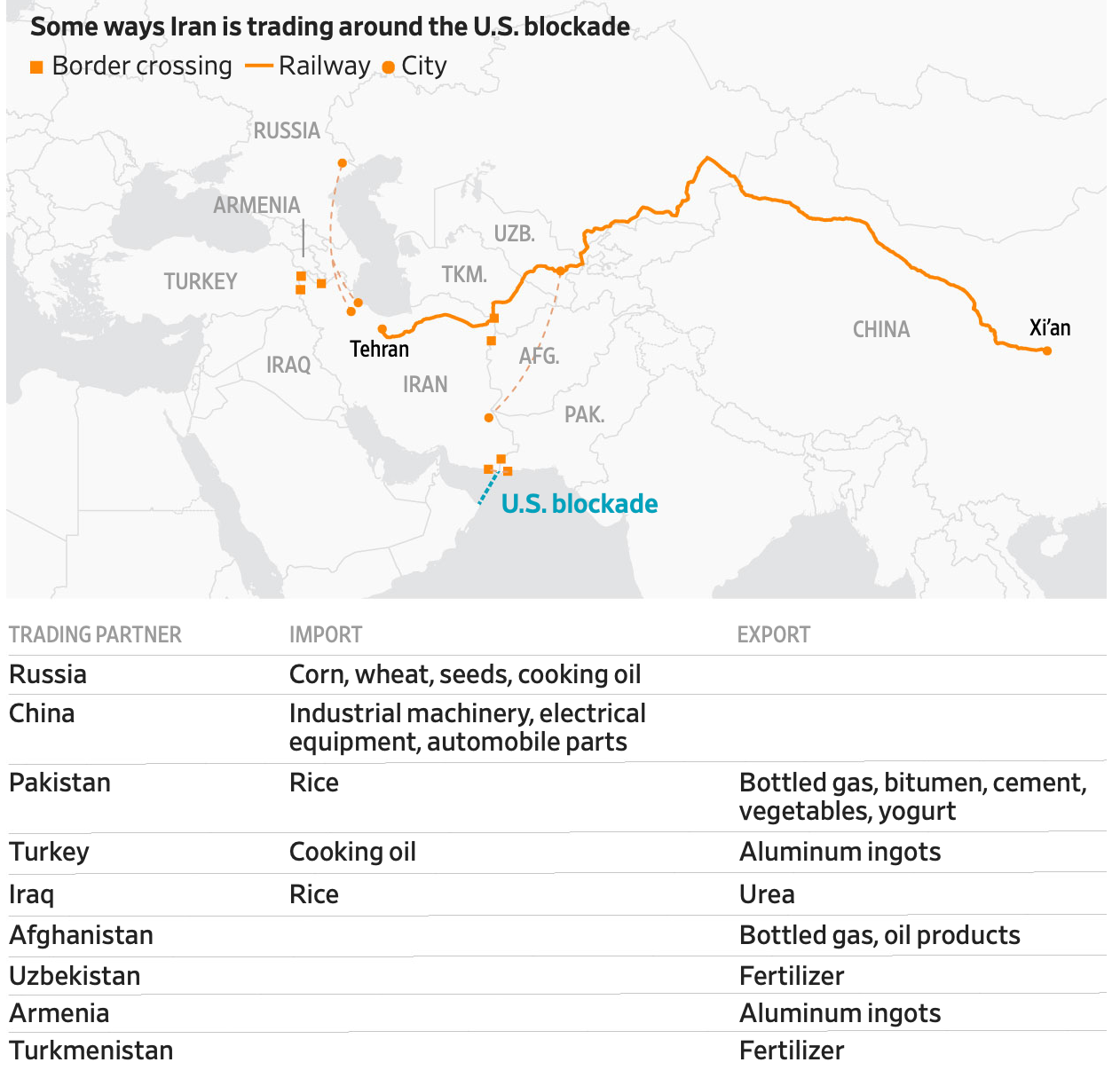
Consistent with earlier reports, the Wall Street Journal suggests Iran’s attempts to circumvent maritime blockades are faltering:
Efforts to increase overland trade have faced challenges as Iranian truck drivers encounter bureaucratic obstacles at borders, including with Pakistan, Turkey, and Afghanistan. These hurdles exacerbate the already strained trade situation.
Iran has sought to enhance trade through alternative routes. For instance, transit across the Caspian Sea has reportedly increased by 70% in the past five months. However, recent challenges, including closures at the Iraqi border, have compromised this strategy.
As Iran adjusts its logistics, the economic implications have been substantial. Rising transport costs contribute to soaring inflation, pushing food prices to new heights and placing additional stress on the Iranian administration.
In the context of ongoing military operations, the situation remains precarious. Despite attempts to solidify alliances and bolster defenses, the balance of power appears to be shifting, raising concerns over future stability in the region.
Ultimately, the complexities of the Iran War underscore the intricate interplay of geopolitics and global energy dynamics. The consequences are felt far beyond the Middle East, affecting economies and populations worldwide. As the situation evolves, vigilant observation and analysis will be essential to understand the long-term implications.