Yves here. Certain points merit repeated emphasis. It can be frustrating to observe informed commentators, such as former UAE advisor Steve Hanke, stumble with assertions that link increases in money supply directly to inflation. This notion was decisively debunked in the early 1980s during monetarist experiments conducted under Reagan and Thatcher. Evidence showed that changes in the money supply did not correlate with macroeconomic metrics. For decades, Japan has engaged in substantial money creation but has still grappled with persistent deflation.
By Richard Murphy, Emeritus Professor of Accounting Practice at Sheffield University Management School and a director of Tax Research LLP. Originally published at Funding the Future
Does an increase in money supply lead to inflation? We often hear claims that “money printing” inevitably drives up prices. However, this perspective overlooks the complexities of modern monetary systems and the true factors that contribute to inflation.
Money creation occurs when governments spend and when commercial banks issue loans. These activities take place daily. If merely creating money resulted in inflation, modern economies would continually experience soaring prices. This is simply not the case.
In the accompanying video, I delve into the origins of money, clarify why government spending does not automatically result in inflation, and discuss why substantial rounds of quantitative easing failed to generate the inflation critics expected.
The primary constraint on government spending is not the availability of money; rather, it hinges on the availability of tangible resources such as labor, skills, energy, materials, technology, and productive capacity.
Inflation can occur when demand outstrips an economy’s ability to supply goods. However, much of the inflation experienced in the UK has occurred due to external shocks, such as energy shortages, geopolitical conflicts, and disruptions caused by COVID-19.
Additionally, I will explore the effects of sterling, Brexit, and the financial crisis to illustrate that exchange rates cannot be solely understood by examining the amount of money in circulation.
To truly grasp inflation, one must understand the real economic landscape. Money is just one aspect of the broader narrative.
The audio version is available here.
This is the transcript:
Does an increase in money supply cause inflation? It’s a frequent assertion that what is often termed “money printing” will lead to rising prices. This, however, is not accurate. Money creation and inflation are distinct phenomena with little intrinsic connection. Understanding this relationship is essential.
The claim presupposes a fixed money supply, reminiscent of the gold standard era. This notion is inaccurate. There is no rigid limit on the money supply in the UK, the USA, or Europe. The money supply fluctuates daily as governments create money through spending and withdraw it through taxation.
Banks also contribute to money creation by lending. They do not simply lend out deposits; rather, their lending generates new money that enters circulation. Consequently, the only ways to have money circulating involve either government spending or bank lending.
Believing that money creation is anything unusual is misguided, as it is a constant aspect of daily economic activity.
Now, let’s discuss government actions: when it spends, the government indeed creates new money. Common belief holds that governments must either borrow or tax to facilitate spending. This is not substantiated by evidence, and its basis in double-entry bookkeeping is questionable.
Governments spend according to their legal budgets, requesting the Bank of England to make payments on their behalf. While the Bank then issues bonds and Treasury bills to balance the accounts, it is crucial to note that the government spends first and collects back later.
If money creation consistently resulted in inflation, all government spending would be inflationary. However, between 2010 and 2020, we experienced a decade of stable prices, even as the government injected hundreds of billions through quantitative easing. It is important to note that while taxes retracted some of this money from the economy, not all created funds were withdrawn, which had positive implications.
This allowed for modest inflation rates, acknowledged by many economists as beneficial, and facilitated economic growth alongside accommodating an expanding population.
Thus, government-created money cannot solely account for inflation. As discussed earlier, the government possesses tools to manage inflation through taxation, which keeps it in check.
Money creation and inflation are not intimately connected unless one accounts for other variables such as quantitative easing, quantitative tightening, and taxation. The correlation is too weak to warrant alarm.
Moreover, banks create money each time they issue a loan. They do not lend depositors’ savings since those funds belong to savers. Upon lending, they generate new money when a purchase occurs.
Yet, bank lending does not inherently lead to inflation. Simply creating money cannot explain rising prices; loans must be repaid, and the balance between these actions influences inflation, but additional factors come into play.
So, what truly drives inflation? Essentially, there are two main factors: first, external price shocks, which have largely defined inflation trends over the past five years. Most inflation spikes in our lifetimes can be traced back to these shocks, dating back to the 1970s when geopolitical unrest in the Middle East spiked inflation, including today’s surging oil prices due to regional conflicts.
These external shocks, whether caused by wars, COVID-related disruptions, or oil price fluctuations from OPEC’s actions, lead to increased relative prices. These complexities are beyond the control of the UK, making it nonsensical to attribute domestic money creation as a cause of inflation.
Conversely, inflation can occur solely within the UK economy due to excess demand for goods and services that cannot be met, leading to increased prices. However, such conditions have been rare for over two to three decades.
Demand-pull inflation—the result of economic overheating—can only manifest when the economy is operating at full capacity, with everyone employed, and still experiencing heightened consumer demand. In this scenario, scarce resources lead to upward price pressure. Yet, no recent memory of such conditions persists for most people, marking it as an extraordinarily rare occurrence. Unfortunately, the Bank of England often misattributes these economic behaviors.
In most scenarios, spending does not create inflation, particularly when sufficient resources remain available. For instance, the current economy has ample labor supply, particularly among the youth, allowing for increased employment without sparking inflation. This is applicable in many sectors since services comprise a significant portion of the UK economy today.
Therefore, spending does not inherently lead to inflation; it can prompt economic activity if resources are available for purchase. The government can employ those who are otherwise unemployed, constructing necessary infrastructure or undertaking renewable energy projects when there is capacity available.
Investing in infrastructure can enhance the economy’s productive capabilities and mitigate inflation risks. Hence, money creation can finance investments that alleviate future inflationary pressures, countering the prevailing narrative.
What about the value of the pound sterling? Many argue, “Creating more money would devalue the pound.” However, that is not the case. The UK has operated under the principles of modern monetary theory since 1971. This framework accurately depicts the dynamics of our monetary system.
Let’s examine the chart showcasing the value of the pound against the dollar and the euro, our two primary rival currencies over the 21st century.
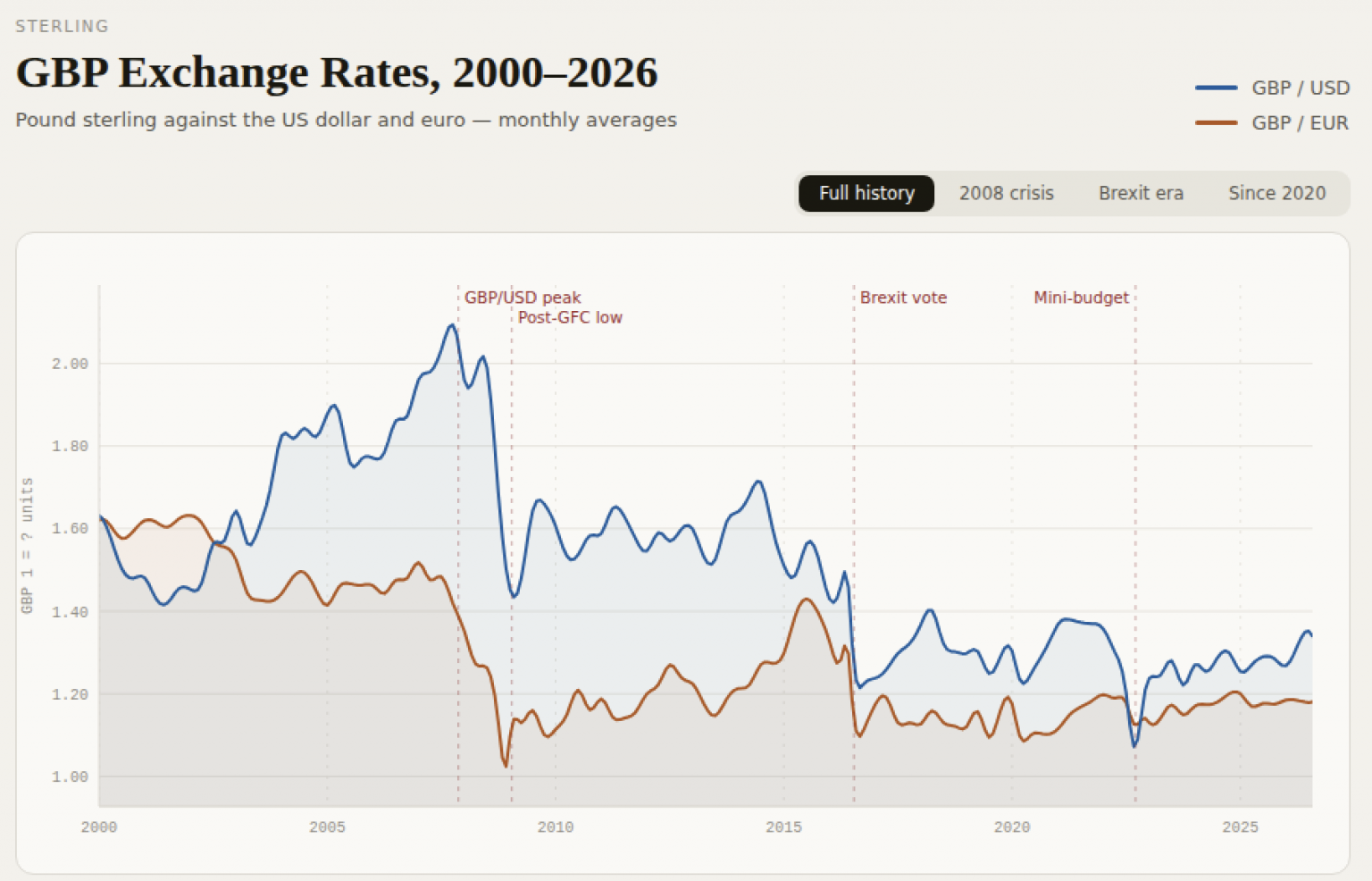
Focusing on the dollar—the world’s primary currency—shows that the pound’s value rose from 2004 to 2008 due to an influx of money following a financial boom in London. However, when that boom fell apart, the pound’s value subsequently declined, unrelated to money creation. In fact, the money supply decreased post-2008, yet the exchange rate fell drastically due to diminished demand for London’s financial products.
Following a period of stability from quantitative easing, the pound’s value waned again during 2016, correlating with Brexit—a political decision, not an economic one.
In 2022, Liz Truss’s political decisions also resulted in another decline, shown in the graph. Stability has since returned.
While fluctuations are inevitable, the fear that ongoing money creation will lead to chaos is unfounded. This reflects how the monetary system operates.
Ultimately, the real limitations in the economy are not monetary. The government can always generate more money, and banks are inclined to lend. What we face are shortages of labor, skills, energy, and materials—all essential components to meet demand for production. If these resources are lacking, inflation becomes a possibility. Hence, if the government aims to address inflation effectively, it must focus on expanding productive capacity.
A genuine anti-inflation strategy involves increasing the economy’s ability to absorb demand through enhanced supply. That’s the key takeaway here: money does not intrinsically drive inflation. Instead, a lack of industrial and production capacity does. This is the challenge we must confront.
In conclusion, the assertion that money creation is the root cause of inflation is unfounded. The inflation waves we have encountered in recent years stem primarily from factors wholly unrelated to our money supply. Recognizing this reality is crucial for understanding our economic landscape; it will help us appreciate how our monetary system is designed to manage inflation effectively, often through taxation rather than interest rates, especially in the face of external shocks. This understanding is vital for devising appropriate economic policies moving forward.