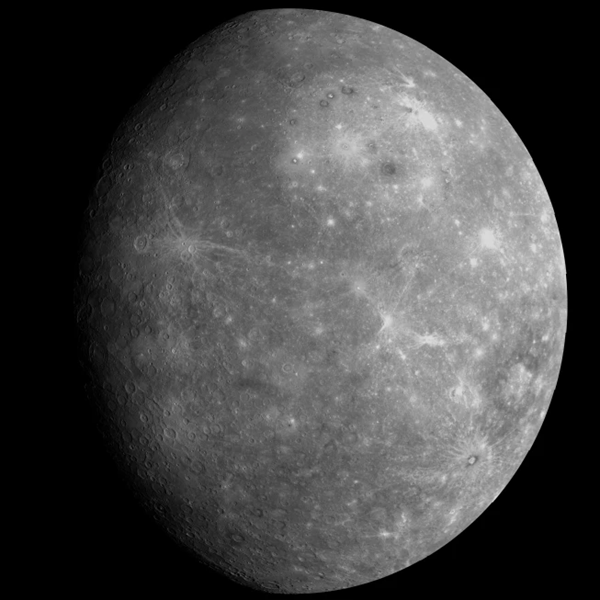
Mercury’s Shrinkage Surprises Scientists
A recent study reveals that Mercury, the smallest planet in our solar system, is shrinking at a rate 30% faster than previously estimated. This shrinkage is comparable to a grape shriveling into a raisin under the sun. Researchers at the German Aerospace Center’s Institute of Space Research have determined that Mercury may have lost up to 14 miles (23 kilometers) in diameter, a significant change for a planet that measures only about 3,000 miles (4,900 kilometers) across.
The study highlights that Mercury’s rough surface, constantly reshaped by impact craters, may conceal the true extent of this shrinkage. The groundbreaking findings are published in the journal Geophysical Research Letters.
This discovery comes shortly after the European and Japanese spacecraft BepiColombo advanced toward Mercury. This mission is set to enter orbit around the planet in November, where its laser instrument will confirm the ongoing internal cooling and shrinkage of Mercury. Scientists believe the actual contraction could be even more significant than current estimates, based on earlier measurements from NASA’s Messenger spacecraft.
Over the past 4.5 billion years, Mercury has been gradually shrinking due to the cooling of its oversized iron core, which tightens the surface like a girdle. Researchers, including lead author Gaku Nishiyama, compared geological maps showing contraction with newer surface roughness maps and found fewer shrinkage wrinkles in rough areas, possibly hidden by impact debris.
This fresh perspective on Mercury’s shrinkage may also offer insights into other contracting celestial bodies, and Nishiyama feels they are getting closer to understanding Mercury’s evolutionary history.


