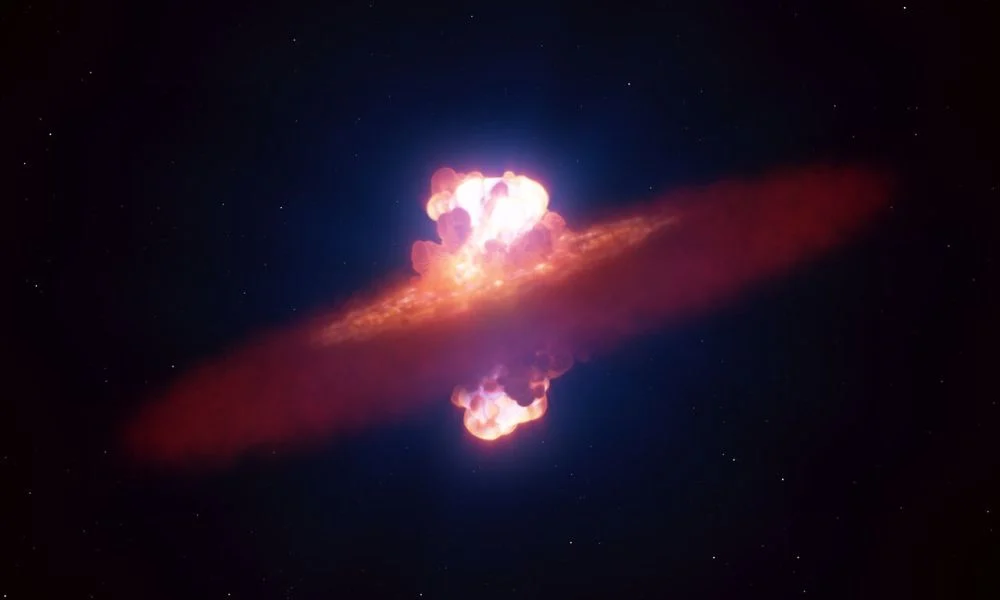
This article discusses a groundbreaking study spearheaded by the University of Queensland’s School of Mathematics and Physics (UQ-SMP), which has produced the largest-ever dataset of Type 1a supernovae, comprising 2,884 instances. These explosions, resulting from a binary star system’s dynamics, are crucial for measuring cosmic distances and understanding Dark Energy, the enigmatic force propelling the universe’s expansion.
Led by Ph.D. candidate Ryan Camilleri, the research team, which included international collaborators, integrated 30 years of astronomical observations with data from the Dark Energy Survey (DES) and other cosmological datasets. By reanalyzing older observations using modern techniques and addressing variables like cosmic dust and gravitational lensing, the study reveals that Dark Energy may not be constant as previously believed.
The findings challenge earlier assumptions within the Standard Model of Cosmology (ΛCDM) and align with emerging evidence that Dark Energy’s effects may vary over time, corroborated by other recent studies. This research not only propels our understanding of cosmic expansion but also hints at a deeper connection between gravity and quantum physics, potentially reshaping fundamental theoretical frameworks in modern astrophysics.
For further details, readers can access the published research papers through links provided in the article.


