“Forbidden” Merger of Black Holes Redefines Our Understanding
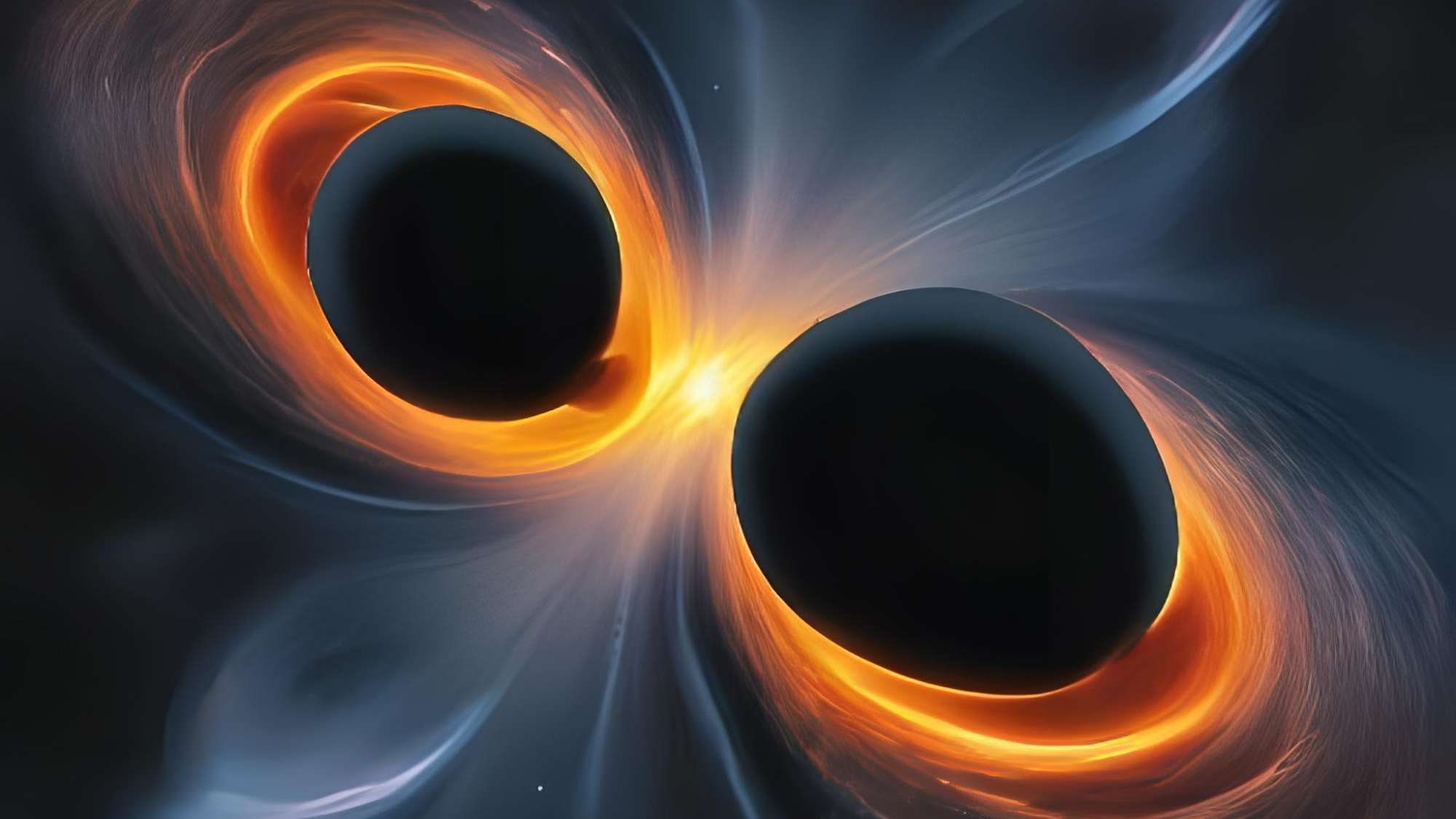
Recent research indicates that a significant merger between two black holes, initially considered impossible, may have occurred involving smaller masses than previously thought. The gravitational wave detector LIGO detected ripples in spacetime, dubbed GW231123, suggesting a collision of two black holes—one with 140 solar masses and another with 100 solar masses.
This discovery raised questions among astronomers since current models struggle to explain such massive black holes, especially those spinning rapidly. However, the study posits that the perceived high masses of these black holes could be an illusion created by gravitational lensing—a phenomenon where light’s path is warped by a massive foreground object.
Gravitational lensing, based on Einstein’s general relativity, states that massive objects curve spacetime, affecting light’s trajectory. This effect might also apply to gravitational waves, leading to the hypothesis that GW231123’s signal was magnified due to lensing, making the black holes appear larger than they are.
The research team utilized mathematical modeling and software to analyze gravitational lensing’s impact on the observed signal. If a compact object or cluster was involved in lensing, it could explain the apparent high masses without the need for extreme spins.
While the exact nature of the lens remains unknown, researchers believe it could be a rare individual compact object or a collection of lighter ones. Confirming GW231123 as the first instance of a lensed gravitational wave signal will necessitate upgrading LIGO’s sensitivity. This research emphasizes gravitational wave astronomy’s potential in studying extreme cosmic events, with findings published in the Astrophysical Journal Letters.