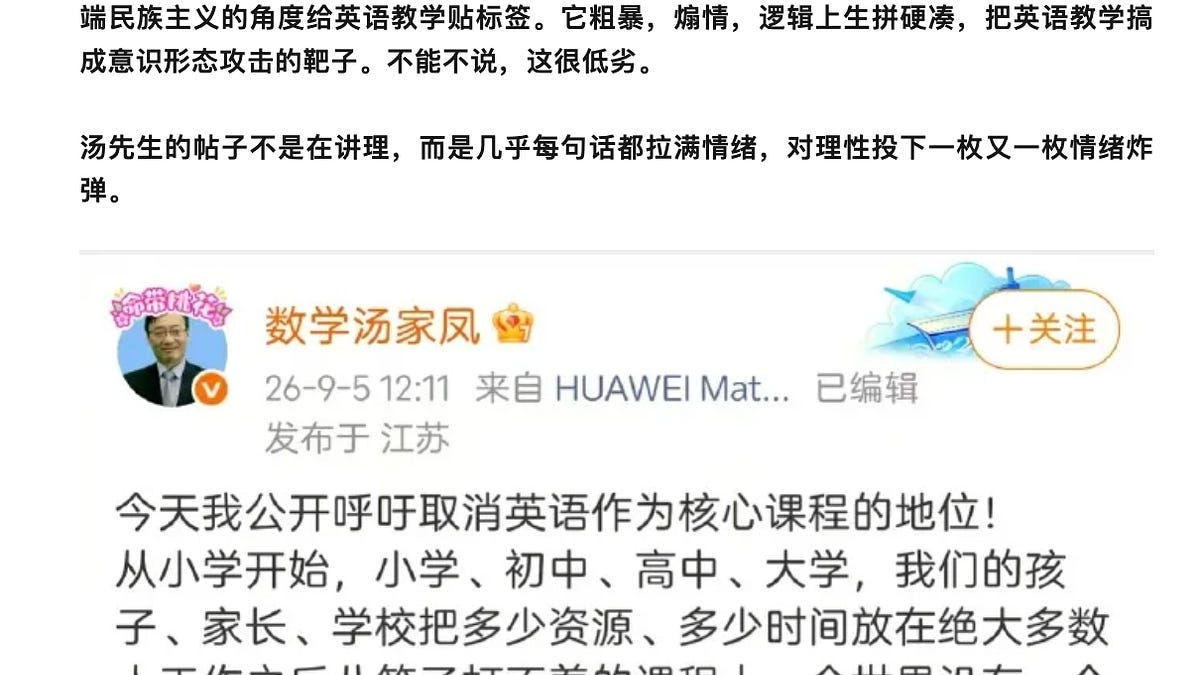
Tang Jiafeng, a prominent maths tutor in China, has reignited a debate over the significance of English in Chinese education. He suggests that English should be given less emphasis in schools, pointing out that most graduates will find little use for it. This viewpoint resonates with some who feel that too much time is dedicated to learning English when many Western students don’t study Chinese.
Hu Xijin, former editor of the Global Times, countered this perspective, initiating a robust exchange with individuals like Xiang Ligang, a commentator with nationalist views. This argument is not new; it periodically resurfaces, questioning the effectiveness of English instruction and its cultural significance.
Historically, learning English has been viewed as a means to access knowledge, technology, and international opportunities, particularly during China’s reform era. However, as China’s global standing has changed, some question the necessity of dedicating extensive efforts to mastering English, especially when China now ranks as a major economic power.
There’s an underlying tension between practicality and national pride. While many agree on the need for efficient English teaching, the debate often touches on broader issues of cultural loyalty and hierarchy. Moreover, if English were to be downplayed in public schools, it risks becoming a privilege for affluent families who can afford private tutoring, ultimately widening educational inequality.
Critics also argue that while many may not immediately require English, a nation with China’s aspirations needs citizens who can engage with global discourse. The current languages of knowledge and ideas are still predominantly in English, and shutting down access could limit future opportunities.
As China reflects on its historical context, including leaders like Jiang Zemin who embraced foreign languages, the debate emphasizes how national confidence impacts the perception of language learning. Some suggest that a balance can be found between valuing Chinese heritage and engaging with the world, which is crucial for a nation seeking to assert influence rather than retreat from it.
In conclusion, while the role of English in Chinese education might evolve, the complexities surrounding cultural identity and international engagement will continue to shape this dialogue. Understanding the nuances of these arguments is essential to navigate the future of education in China effectively.