GPS Disruption Due to Solar Storms
The Event
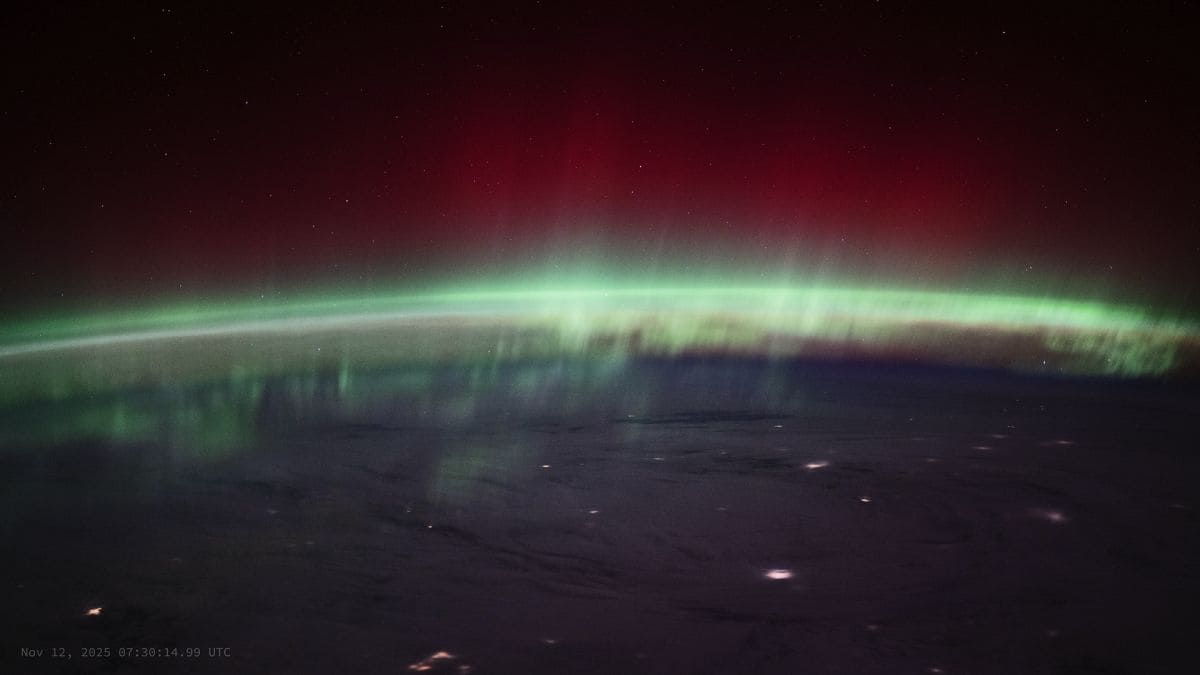
On November 11, 2025, a severe geomagnetic storm significantly affected GPS positioning across parts of the continental United States, causing inaccuracies exceeding 10 meters (33 feet) for several hours. While GPS did not fail, the degree of inaccuracy posed a risk to critical systems that rely on precise positioning.

Credit: Earth Science and Remote Sensing Unit/NASA Johnson Space Center
How It Happened
The phenomenon arose as the auroral oval expanded unusually far south, disrupting the typically stable mid-latitude ionosphere. This resulted in irregularities that caused GPS signals to fluctuate and position estimates to degrade.
Understanding Scintillation
GPS satellites send radio signals that must penetrate the ionosphere, a layer filled with charged particles. Changes in electron density in this region can cause scintillation, which distorts GPS signals. Historically, strong scintillation has been observed mostly near the poles or equator, making the widespread disruption during this storm notable.
Key Findings:
- Researchers utilized a variety of instruments, including GPS stations and aurora cameras, to reconstruct the storm’s behavior.
- Fluctuations in signal strength from the storm resulted in significant positioning errors, posing threats to sectors like precision agriculture and autonomous navigation.

Credit: Geophysical Research Letters
The Impact
While the GPS inaccuracies caused minimal issues for everyday users (mostly resulting in wrong turns), they can be catastrophic for technologies relying on accuracy, such as autonomous farming equipment. Previous storms, like the one in May 2024, resulted in even larger errors, highlighting the potential risks during critical operational periods.
Key Statistics from Research:
- On occasion, GPS errors have reached as much as 70 meters during previous storms.
- The November event showed strong, widespread scintillation, although it occurred outside the primary agricultural season.
Next Steps for Prediction
Despite advancements in monitoring solar activity, translating these warnings into reliable GPS performance predictions remains challenging due to the complex interplay of solar activity, Earth’s magnetic field, and rapid changes in the ionosphere.
Future Recommendations:
- Improved coordinated observations and modeling to enhance prediction accuracy.
- Greater awareness of the vulnerabilities of GPS during geomagnetic storms as industries increasingly rely on satellite positioning.
The study detailing these findings was published in Geophysical Research Letters, underscoring the need for ongoing research in mitigating the impacts of solar storms on everyday technologies.