Two Spacecraft Make Historic Move Toward Mercury
By Marcia Dunn, AP Aerospace Writer
Published: Sept. 6, 2026, 1:33 PM PT
CAPE CANAVERAL, Fla. — Two Mercury-bound spacecraft successfully separated from their mother ship last week, marking a significant step in their nearly decade-long journey to the solar system’s smallest and closest planet to the sun.
The European and Japanese spacecraft, part of the BepiColombo mission, confirmed their separation with a two-hour wait for radio signal confirmation transmitted from the European Space Agency’s control center in Germany, over 124 million miles away. “It’s a brilliant moment,” said lead project scientist Geraint Jones.
Upon successful entry into Mercury’s orbit in November, the spacecraft will split again in December to conduct detailed mapping and studies from different altitudes, with 2 million miles remaining on their journey as of Thursday.
Launched in 2018, the mission is named after Giuseppe “Bepi” Colombo, an Italian mathematician involved in NASA’s Mariner 10 mission in the 1970s. Only NASA’s Messenger has previously explored Mercury, which harbors many mysteries despite its small size.
“There’s a huge amount still left to be learned,” noted Jones.
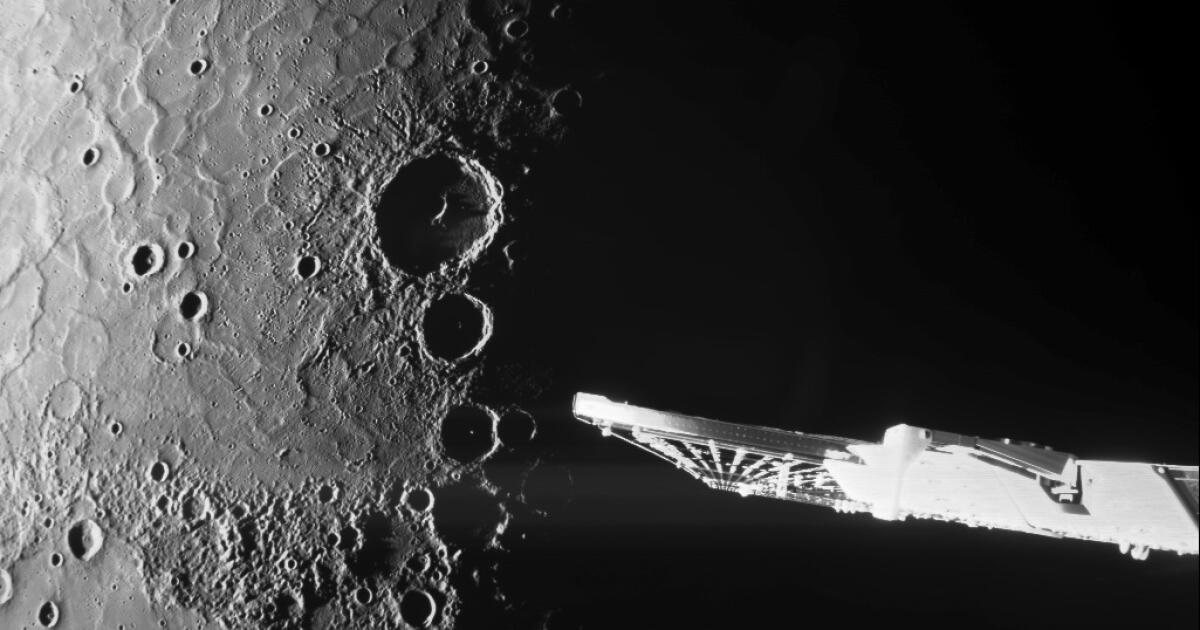
BepiColombo has traveled over 6 billion miles, executing nine planetary flybys to gather enough energy to enter Mercury’s weak orbit. The latest flyby in January 2025 provided stunning images of Mercury’s craters and volcanic plains.
Starting next spring, various scientific instruments will analyze Mercury’s magnetic field, dense interior, and surface geology, including hollows believed to be eroded by vaporizing minerals.
Mercury presents a world of contrasts, with temperatures soaring above 800 degrees on one side and icy poles shrouded in deep, shadowed craters.
Engineers had to design the spacecraft to endure extreme conditions close to the sun. “It’s essentially equivalent to operating with a very hot pizza oven running right on your back,” stated Ignacio Tanco, a mission operations chief with the European Space Agency.
Science observations are anticipated to start in spring, with the European Space Agency covering the majority of the mission’s $2 billion cost.
Dunn writes for the Associated Press.