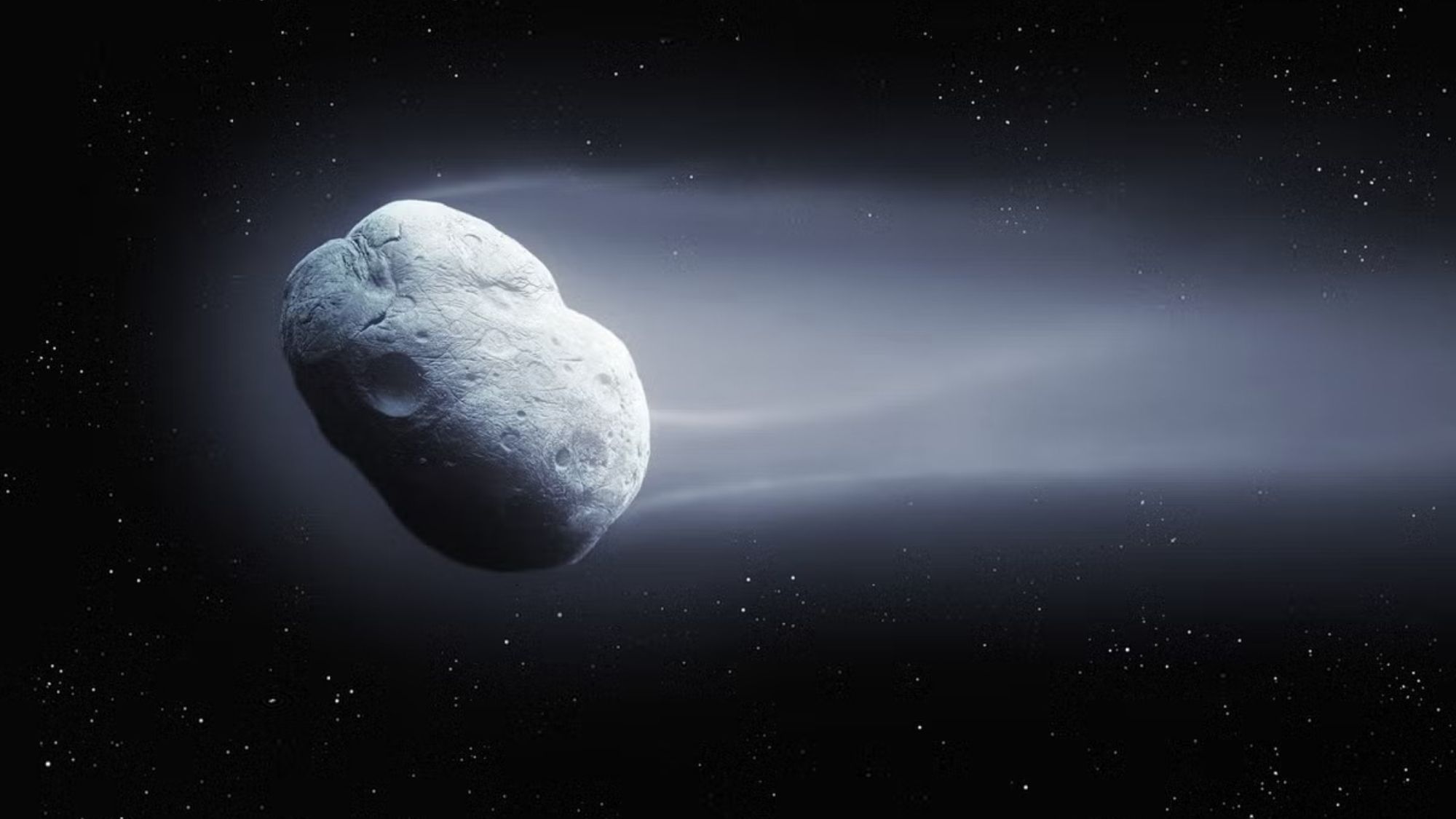
Astronomers have observed a small icy body beyond Jupiter, named 450P/LONEOS, transforming from an inactive centaur into a comet. Discovered in 2004, this centaur’s orbit lies between Jupiter and Neptune. It is believed to have originated in the Kuiper Belt, influenced by gravitational interactions with the solar system’s gas giants.
Currently having a 22-year orbital period, 450P is not yet classified as a Jupiter-family comet (which have shorter orbital periods influenced by Jupiter). However, astronomers led by Charles Schambeau from the University of Central Florida have detected the onset of cometary activity, specifically the formation of a coma— a cloud of gas and dust around its nucleus—observed using the Gemini North telescope in Hawaii.
This behavior is expected to intensify as the object approaches perihelion in August 2024. Increased solar heating may release volatile ices trapped below its surface, leading to comet-like activity. Notably, observations from the James Webb Space Telescope (JWST) identified carbon dioxide gas in the coma, indicating it drives the activity, with hints of crystalline water-ice suggesting thermal processing.
A past encounter with Saturn in 1992 significantly altered 450P’s orbit, causing it to approach the sun closely, which is crucial for its transformation. The study of 450P offers insights into small-body evolution in the solar system, potentially bridging our understanding of centaurs and comet formation. These findings have been accepted for future publication in the Planetary Science Journal.