Automotive Cam Phasers Market Overview
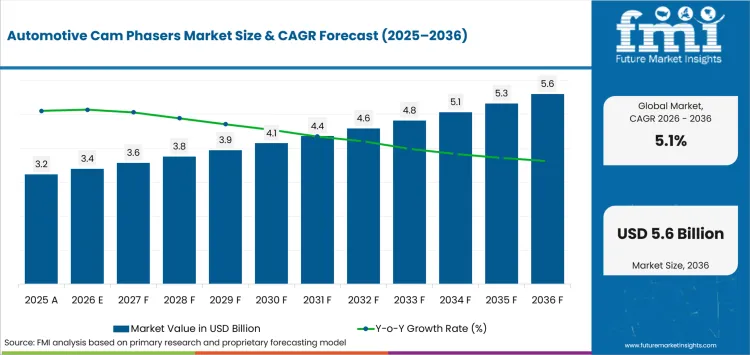
Market Size and Forecast
- 2026: USD 3.4 billion
- 2036: USD 5.6 billion
- CAGR (2026-2036): 5.1%
The market is expected to grow, primarily driven by the demand for automotive cam phasers in combustion and hybrid engine programs that support adjustable valve timing for improved fuel efficiency and performance.
Key Drivers and Trends
-
Demand Drivers:
- Increased adoption of hybrid and combustion engines.
- Need for efficiency in vehicle operation and emissions control.
-
Technological Innovations:
- Development of electromechanical camshaft phasing units.
- Integration of controls and software for higher-performance vehicles.
-
Regional Insights:
- Varying demand based on regional vehicle mixes and types.
- High growth rates in countries like Mexico (CAGR 6.6%) and South Korea (CAGR 6.3%).
Market Segment Insights
-
By Phaser Type:
- Hydraulic Cam Phasers: Expected to hold 38.0% market share in 2026 due to widespread compatibility with existing architecture.
- Other types include vane-type, electric, sprocket-type, and cam torque actuated designs.
-
By Engine Type:
- Inline Engines: Predicted to lead with a 31.0% share mainly due to the prevalence of four-cylinder layouts.
- Includes hybrid ICE, turbocharged, V engines, and performance engines.
-
By Vehicle Type:
- Passenger Cars: Expected to hold a dominant share (42.0%) due to their significant use of hybrid tech.
-
Sales Channels:
- Leading channel is OEM direct, predicted to represent 57.0% in 2026, due to program-specific engineering requirements.
Competitive Landscape
Key players include:
- BorgWarner Inc.
- Schaeffler AG
- AISIN CORPORATION
- Astemo, Ltd.
- Mikuni Corporation
- Melling Tool Company
Competition centers on access to OEM programs, phasing technology, and service capabilities.
Market Challenges
- Restraint:
- Rapid adoption of battery-electric vehicles (BEVs) is reducing the demand for new cam phasers as they typically don’t require variable valve timing.
Conclusion and Future Outlook
The automotive cam phasers market shows solid growth prospects thanks to ongoing innovations and the sustained presence of hybrid vehicles in the market. However, the shift towards electrification poses challenges that could reshape demand dynamics over the next decade.
Note: For a comprehensive understanding, including detailed statistics and visual data representation, further insights into specific country markets, and analysis of competitive landscape, a deep dive into the full report is recommended.