Automotive Driveline Aftermarket Industry Summary
Market Overview
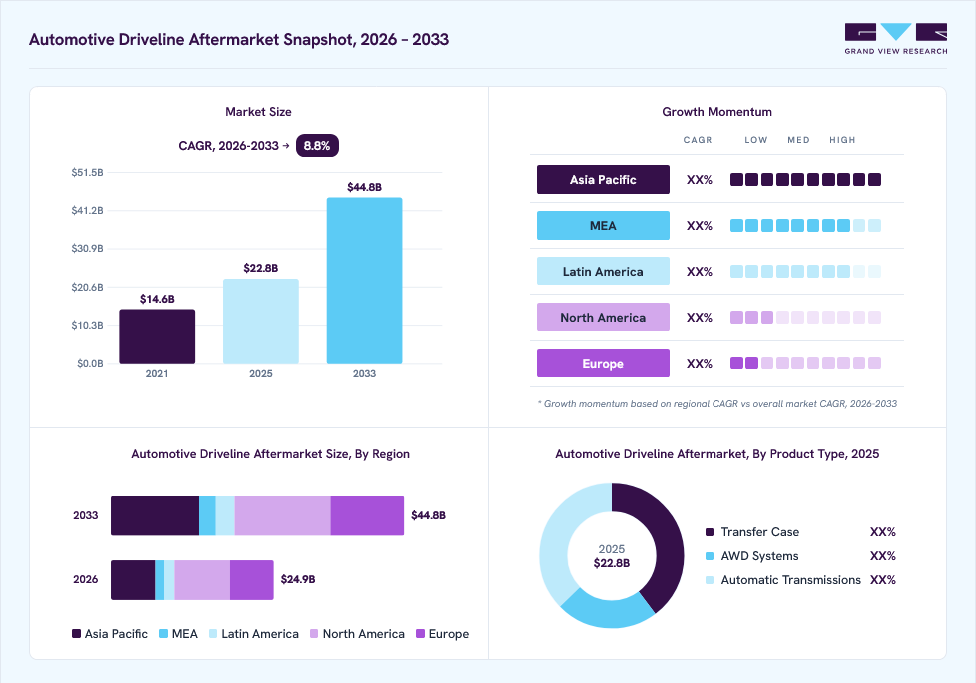
- 2026 Market Estimate: $24.9 billion
- 2033 Market Forecast: $44.8 billion
- CAGR (2026-2033): 8.8%
The global automotive driveline aftermarket is projected to grow from $24.9 billion in 2026 to $44.8 billion by 2033. North America accounted for 34.3% of the market share in 2025. Factors driving growth include digitalization, predictive maintenance, and an increasing number of aging vehicles on the road.
Key Market Trends & Insights
- Product Segmentation: The transfer case segment led with a 39.7% revenue share in 2025.
- Service Segmentation: Repair services held the largest share with 36.7%.
- Vehicle Preference: SUVs maintained a 34.0% market share in 2025.
- Distribution Channels: Independent aftermarket dominated with 42.1% of revenue in 2025.
Regional Highlights
- Largest Market: North America
- Fastest Growing Market: Asia Pacific
Market Size & Growth
- 2025 Size: $22.8 Billion
- 2026 Estimate: $24.9 Billion
- 2033 Projection: $44.8 Billion
Market Dynamics
-
Drivers:
- Expansion of independent repair workshops and multi-brand service centers.
- Increased vehicle age leading to more replacement parts being purchased.
-
Challenges:
- Complexity of modern driveline systems that require specialized diagnostic tools.
- Investment requirements tied to technological advancements can limit some workshops.
-
Opportunities:
- Advanced diagnostic technologies influencing growth.
- Integration of cloud-based systems for efficiency.
Competitive Landscape
Established Players
- Key Players: ZF Aftermarket, Dana Incorporated, BorgWarner Inc.
Emerging Players
- Key Players: Sonnax Industries, Transtar Industries, Jasper Engines & Transmissions.
Recent Developments
- ZF Aftermarket: New digital solutions for workshops introduced at Automechanika Frankfurt 2026.
- BorgWarner: $49 million investment in electric vehicle components in Mexico.
Conclusion
The automotive driveline aftermarket industry shows a robust growth trajectory driven by increasing vehicle numbers, prolonged ownership cycles, and technological advancements in driveline systems. The integration of digital solutions and a growing network of independent services will further catalyze this sector.