At first glance, one might have anticipated a rough September for financial markets after the tumultuous events of August. Media predictions suggested significant downturns were inevitable. However, contrary to these forecasts, September proved to be surprisingly favorable, with all major asset classes experiencing gains. This unexpected turn of events comes in light of the Federal Reserve’s recent decision to lower interest rates by an aggressive 50 basis points—a move intended to mitigate the anticipated impact of the subprime mortgage and housing market crisis on the economy and capital markets. While challenges may still lie ahead, the results for September indicate a positive trend across the board, as reflected in the chart below.
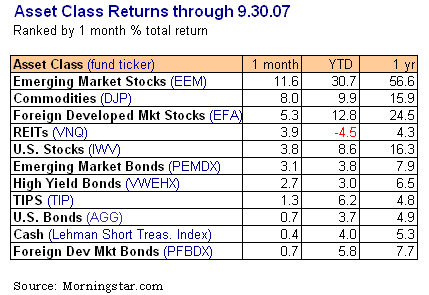
If you examined only the monthly returns without day-to-day fluctuations, you might conclude that the economic situation is quite stable, if not improving significantly.
Emerging market equities emerged as the standout performer last month, leading the pack with a striking gain of nearly 12%. Historically, such robust performance in dollar terms for emerging market stocks is rare. Commodities also enjoyed a stellar month, with the DJP index rising by 8% in September, buoyed by increasing prices for oil and gold. Meanwhile, developed market stocks, represented by EFA, secured the third position in terms of gains.
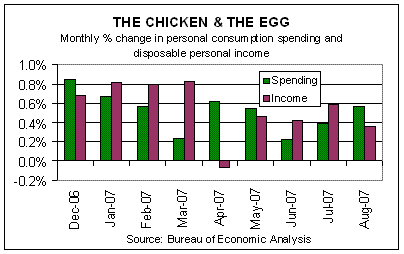
Let’s cut to the chase: American consumers are remarkably resilient. Even with the specter of recession looming, and the housing market facing significant downturns, Joe Sixpack remains undeterred in his pursuit of the beloved activity known as shopping. In fact, as demonstrated by the recent update on personal income and spending, it’s the unwavering American consumer who has kept the economy on an even keel throughout 2007. This strength is particularly notable given that personal income actually dipped last month. Typically, income and spending are closely linked; lower income generally leads to reduced spending, and vice versa. However, in the short term, this relationship often becomes convoluted, especially with the availability of easy credit and a plethora of innovations that encourage continued consumer spending.
The latest data on consumer spending reveals significant insights: personal consumption expenditures (PCE) increased by 0.56% from July to August. This represents the most substantial monthly rise since April, and it’s particularly noteworthy considering it occurred alongside a decrease in disposable income.
Moreover, signs of economic strength may be more pronounced than previously thought, as suggested by last week’s jobless claims report, which indicated that new unemployment filings had dropped to a four-month low. This offers an optimistic outlook for economic momentum. However, this encouraging news was somewhat tempered by a report indicating that new home sales plummeted in August to their lowest annualized rate in seven years, confirming the ongoing struggles in the housing market.
In a quest for economic indicators, today’s durable goods report for August has heightened concerns about a potential downturn. The data reveals a significant percentage drop—the largest since January—and marks the first decline since May. Excluding defense orders, new orders experienced an even steeper decline of 5.9% last month.
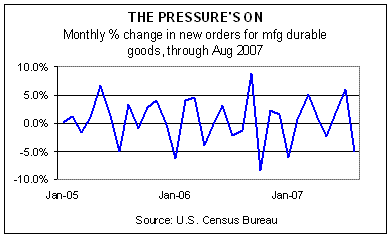
It’s challenging to cast this durable goods report in a favorable light, especially when coupled with yesterday’s announcement of a more than 4% decline in existing home sales in August—the lowest annualized rate seen in five years. Dismissing these warning signs as mere noise would be misguided; however, it’s also premature to declare the economy is on the brink of recession. Our second chart gives broader historical context to the current durable goods data, illustrating that while the recent drop is concerning, it does not conclusively indicate an impending recession. We remain within the volatility thresholds typical of recent years.
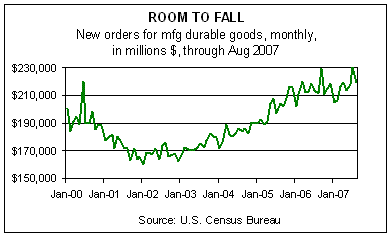
To be sure, pressures are mounting, and it would be wise to expect that the news may exacerbate before it improves. Nonetheless, the economy is currently holding steady, and despite various pressures, it appears to be resilient. A pivotal factor in determining the future trajectory will likely be consumer spending, which accounts for over 70% of GDP.
In recent years, commodities have emerged as a vital component of investment portfolios, largely because of their low correlation with traditional asset classes like stocks and bonds. Including commodities in a portfolio can enhance overall expected returns, adjusted for risk. However, it’s crucial to recognize that what appears beneficial in theory can become complex in practice. Numerous mutual funds and traded products provide investors with straightforward access to commodities, yet these often involve futures contracts rather than the actual physical assets. While futures can serve as reasonable substitutes for commodities, they introduce additional layers of risk, along with opportunities.
A newly launched Exchange-Traded Note (ETN) aims to navigate these risks while offering broad exposure to the commodity asset class. The S&P GSCI Enhanced Commodity Total Return Strategy Index (NYSE: GSC) is designed to track the Goldman Sachs Commodity Index. However, it distinguishes itself by proactively managing its futures contracts to enhance performance and mitigate risks. Initial investors, like Kochis Fitz, have shown confidence in this approach by committing $70 million to the fund. To delve deeper into the potential effectiveness of this strategy, we spoke with Jason Thomas, chief investment officer at Kochis Fitz. To learn more, read on….
It may just be coincidence, but it’s certainly noteworthy. Frederic Mishkin, a key member of the Federal Open Market Committee, recently released a research paper discussing how monetary policy has evolved into a more scientific endeavor over the past generation. According to Mishkin, nine key principles govern contemporary central bank thought, derived from both theoretical and empirical evidence. First among these principles is Milton Friedman’s assertion that “inflation is always and everywhere a monetary phenomenon.”
This insight leads us to examine the latest money supply figures from the Fed, specifically through September 10. In light of the Fed’s recent 50-basis-point cut in interest rates, it is not surprising to see a bullish trend in M2 money supply, the broadest classification published. Notably, in late August, the 52-week change in M2 surpassed 7% for the first time in nearly four years, as shown in the chart below. Although this surge has moderated slightly in recent weeks, the overall upward trend remains intact. Unless the Fed signals otherwise, a careful observer of monetary trends should anticipate that M2 growth will continue.
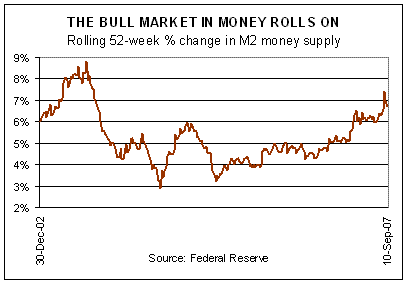
This trajectory shouldn’t come as a shock, as M2 has shown a steady rise over recent years. The Fed seems to be operating under the premise that the economy is decelerating, with the need to stimulate growth. Thus, increasing liquidity is their primary strategy.
This brings us to the question of how strategically-minded investors should respond. Some are choosing to hedge against potential risks by converting cash into gold, a historically recognized store of value and protective measure against the risks associated with fiat currency. Recently, gold prices surged nearly $14, reaching approximately $736 per ounce—the highest level since the early 1980s.
Simultaneously, the dollar has fallen to new lows, illustrating the inverse relationship between gold and the dollar. This dynamic further underlines the risk of escalating inflation. Foreign oil exporters are likely aware of the dollar’s decline, which may compel them to inflate oil prices in dollar terms to mitigate currency risks. While oil prices are set globally, producing countries, especially within OPEC, may contemplate production adjustments if the dollar continues to weaken.
Ironically, despite the inflationary signals from gold and currency markets, official inflation figures from the United States show deflationary trends. Recently, the Bureau of Labor Statistics reported a 0.1% decline in consumer prices for August. This stark discrepancy between soaring gold prices and falling consumer price indices highlights a significant disconnect in economic statistics. It’s increasingly apparent that either the CPI or gold is wrong about future inflation expectations—one side will likely have to adjust their stance significantly.
The August employment report revealed the first job loss in four years, serving as a significant indicator influencing the Federal Reserve’s decision to cut interest rates. With economic uncertainty looming, one must wonder why initial jobless claims this month have not confirmed recession fears.
This morning’s update on new unemployment filings through September 15 shows a noticeable decline in claims, falling to 311,000 last week—the lowest since late July and slightly better than the previous year’s 322,000.
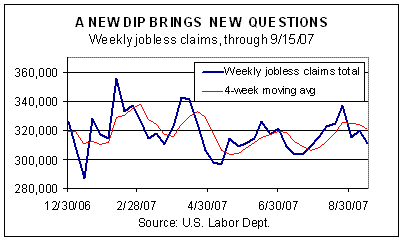
While it’s premature to assert that recession fears have evaporated, the latest jobless claims report raises questions about whether the Fed may have acted too hastily. Indeed, in a thriving economy in 2007, a jobless claims figure in the low 300,000 range is considered relatively normal.
However, it would be unwise to overinterpret this one statistic; next week’s report could reveal a different narrative. Given the volatility in jobless claims, the more reliable four-week moving average provides a clearer picture of ongoing trends. As indicated in the chart, this average is also trending downward.
Ultimately, the true state of the economy will only be revealed through time, as data is published and scrutinized. Those eager for immediate clarity must navigate the complexities of interpreting statistical data while maintaining an overarching perspective. Balancing timely insights against accuracy presents a formidable challenge for market participants and possibly for central banks as well.
The merits of the recent interest rate cut remain open for debate. However, as the decision has been made, investors must navigate its implications moving forward.
The immediate aftermath on Wall Street was decidedly optimistic, with stocks soaring after the Federal Reserve’s 50-basis-point reduction. The S&P 500 surged by 3% by the close on Tuesday.
Yet, multiple bull markets are evolving, which presents potential complications in the future. Notably, crude oil reached a new high, and gold prices have also risen above $720.
Conversely, the beleaguered dollar faced yet another decline as a result of the lowered interest rate. The U.S. Dollar Index fell by half a percentage point, hitting a record low.
A declining dollar typically signals inflationary pressures. As the United States is the largest importer of crude oil, foreign sellers may be inclined to adjust prices upward in response to the dollar’s diminishing value.
Although international oil prices are determined globally, OPEC may consider production limits if the dollar’s value continues to fall, taking into account their need for technological investments to meet growing demand.
Furthermore, the Federal Reserve’s leadership argues that rising oil prices may not generate inflation, suggesting that they should be ignored in their policy decisions. This perspective will likely face scrutiny in the coming months, as the efficacy of this assertion comes under real-world testing. Ultimately, investors must ponder whether these potential risks warrant hedging strategies.
As we stand on the brink of potentially transformative monetary policy, one must reflect on the lessons learned this year.
The future is inherently unpredictable, yet clues about imminent changes sometimes emerge. However, these insights often become clearer in retrospect.
An example is the market response on June 13, when the 10-year Treasury yield spiked at 5.3%. At that time, the yield looked favorable compared to the 4.46% yield observed recently. Although there were inklings of market tension back in June, the certainty of yields made the prospect of purchasing 10-year Treasuries less urgent.
Now, with three months of data behind us, it’s evident that a more aggressive investment approach would have yielded substantial returns, given that bonds have outperformed stocks significantly during this period. The iShares Lehman Aggregate Bond ETF experienced a total return increase of around 4% since June 13, contrasting sharply with a 1.5% loss from the S&P 500 Spider ETF.
Asset allocation remains a cornerstone of strategic investment decisions. While most investors recognize its importance, the method of executing an asset allocation strategy often raises questions. The conventional approach advocates for allowing market dynamics to dictate asset weighting, adhering closely to modern portfolio theory, which suggests owning global stocks and bonds in their market-weight proportions.
However, deviating from this passive approach introduces risks associated with active management. One intriguing strategy that has emerged is a momentum-based tactical asset allocation (TAA) method developed by Mebane Faber of Cambria Investment Management. His research, published in the Spring issue of The Journal of Wealth Management, invites debate on the merits of active portfolio management. We engaged in a discussion with Faber in the September issue of WM. You can read the conversation here….
With growing attention on employment statistics, the recent update on jobless claims provided a disappointing yet unsurprising revelation—the headlines didn’t offer anything novel.
The initial jobless claims rose marginally by 4,000 to 319,000 for the week ending September 8, as reported by the Labor Department. While this increase isn’t what optimistic observers had hoped for, it doesn’t signify a drastic shift either.
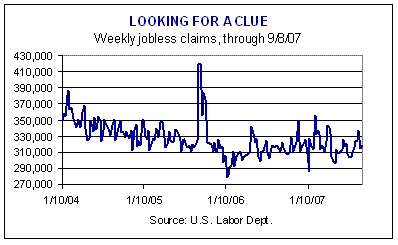
Additionally, the four-week moving average has seen a slight decline, further complicating the interpretation of these trends.
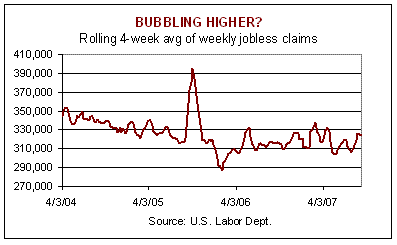
What can we glean from these latest figures? Not much. The current trend does not indicate a looming boom, nor does it validate the pessimism stemming from the August employment report. There’s a possibility that confirmation of a downturn could be on the horizon; however, for now, the job market’s immediate future does not reveal any alarming signs. It seems that the economy may take its time unfolding, leaving many hungry for more immediate insights.