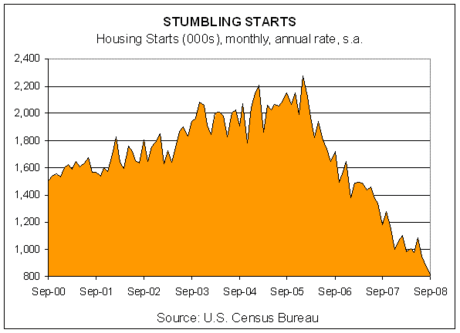
The current state of the housing market presents a troubling narrative that has become all too familiar. As the government continues to release updates, the news remains discouraging, signaling ongoing economic troubles that seem unyielding. The latest data reveals a 6.3% decline in new housing starts for September, according to the Census Bureau. While this drop is less severe than the previous month’s 8% fall, the persistent downtrend since early 2006 offers little solace.
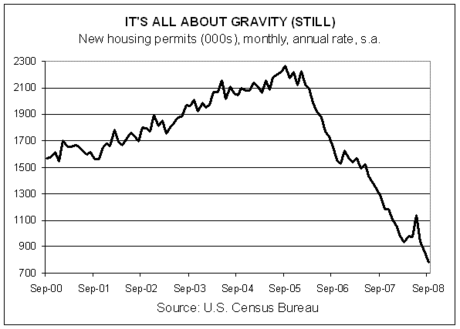
The outlook for new housing permits is similarly bleak, casting a shadow over future construction activity. Our second graph illustrates that this critical measure is under intense pressure, signaling a likely continuation of the decline in housing-related initiatives. Last month saw new permits plummet by 8.3%, only slightly improved from August’s substantial 8.5% decrease, emphasizing that negative trends remain firmly in control.
For now, the best we can hope for is nearing a bottom in the housing market. Any talk of a rebound feels premature, likely a year or two away at best. The immediate priority is to halt the ongoing deterioration in the market. Identifying effective policies to facilitate this remains uncertain, though a natural unwinding of excess appears necessary. While government intervention will undoubtedly attempt to alleviate some of the hardships, achieving effective relief remains a trial-and-error process.
In light of ongoing financial distress and economic contraction, inflation is beginning to ease. Consumer prices were stable last month, following a 0.1% decline in August, as reported by the Labor Department. Among the eight major components of the consumer price index, three—housing, apparel, and transportation—saw decreases. Food and beverage prices increased by 0.6%, while the core CPI, which excludes food and energy, rose by 0.1%.
Although these numbers don’t definitively confirm that inflation is dissipating, a continued decline seems probable, with CPI’s annual rate dropping to 4.9% in September from 5.4% in August. As the economy slows, further reductions in consumer inflation are likely in the coming months, particularly if we are already in a recession.
Commodity prices have also fallen significantly this October, with crude oil dipping below $75 per barrel during New York futures trading for the first time in over a year. Other key commodities are under similar selling pressure.
The unwinding of previous economic conditions is underway and is expected to continue for some time. This widespread correction is driven by fundamental issues and fear, a predictable reversal after a protracted period of market euphoria. Historical patterns reveal that cycles are inevitable, but the current amplitude of this shift is astonishing, largely due to our tendency to focus on recent trends and mistakenly adopt them as a long-term perspective.
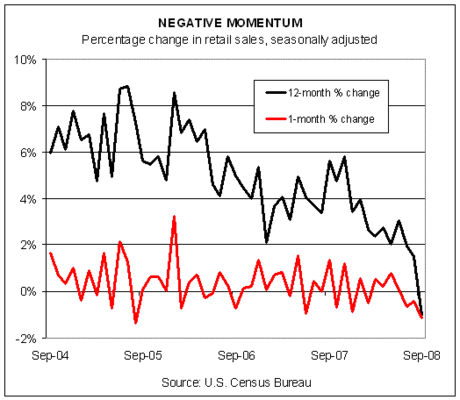
This morning’s retail sales report doesn’t bring any surprises to those who have been observing the economy closely, yet the data remains troubling. Retail and food service sales experienced a significant decline of 1.2% last month, the steepest drop in over three years, according to the U.S. Census Bureau. Year-over-year, retail sales are down 1%. Our accompanying chart clearly illustrates this downward trend, indicating that further declines are almost inevitable in the months ahead.
Given that consumer spending accounts for approximately 70% of the U.S. GDP, these retail figures starkly signal that a recession is already underway. One particularly pessimistic outlook from a money manager at a recent press conference in New York predicted GDP could fall by an annualized 5% in the latter half of this year. Although that might be an exaggeration, it does reflect the gravity of the current economic landscape, where negative surprises have become all too common.
Large single-day rallies of 900 points or more in the Dow Jones Industrial Average are noteworthy events, as they are fantastical yet sometimes realized. Recently, however, we have witnessed events straddling the line between the surreal and the disconcerting. With markets in turmoil, it feels crucial to recalibrate our perspectives amid the chaos to conceptualize the economic cycle’s current phase.
The government’s attempts to stabilize the financial sector may treat the symptoms of our economic troubles, but it doesn’t address the underlying issues that led us here. Their interventions focus on preventing further damages and shoring up systems to avoid total collapse. Although we cannot gauge the full effectiveness of these measures right now, their impact on the broader economy is uncertain. The repercussions of the financial crisis have begun to manifest in everyday life, and it seems this trend will persist for several months.
We are contending with lingering fallout from real estate bubbles. The issues didn’t emerge overnight, nor will they dissipate rapidly. As we evaluate the situation, our proprietary measure of economic activity—the CS Economic Index—illustrates a tendency toward continued downside momentum. This isn’t groundbreaking news; many observers have noted ongoing economic weaknesses. In previous discussions, we were perhaps too early in predicting noticeable shifts in the broader economy.
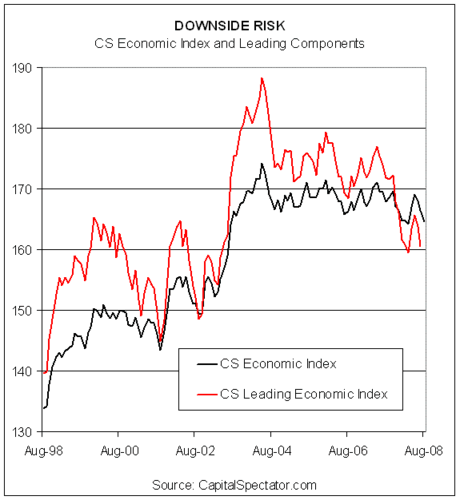
As suggested by the above chart, we should anticipate more economic weakness. Such conditions typically beget additional downturns until a threshold is met. Following this, recovery may not come immediately but could be followed by extended periods of stagnation. The distinction between these various phases of the economic cycle often blurs; forecasting is as much about art as it is about science.
Rarity in economics and finance amplifies the importance of such events for study. The current crisis exemplifies this principle. While analyzing market performance during stable periods is quite straightforward, gleaning insights during turbulent times is a different matter entirely. In considering the benefits—or lack thereof—of diversification, questions arise regarding how volatility and selling pressures have influenced correlations between major asset classes. To explore this, we analyzed the trailing 36-month correlations through September 30, 2008, as illustrated in the chart below.
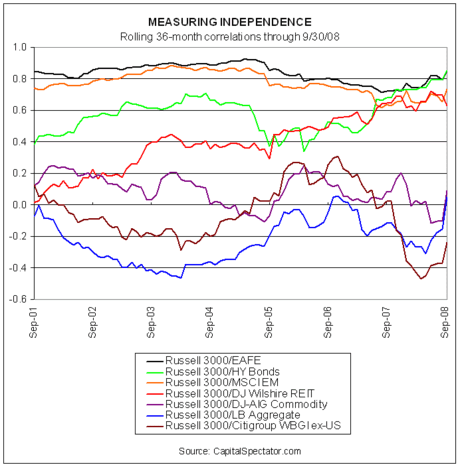
Our findings show that correlations have indeed intensified, highlighting how equities across the globe have moved similarly. In times of financial distress, all stocks appear to converge, reflecting a universal rush for liquidity: investors want immediate access to their capital. This trend contributes to the rising correlations observed between U.S. equities (Russell 3000) and foreign stocks (MSCI EAFE and MSCI EM).
While strategic investing may seem straightforward on paper, making investment choices in real-time—especially during a banking crisis impacting the global economy—presents a significant challenge. Each January, we offer an annual chart reflecting the performance of major asset classes, tracking the past year and several preceding ones. This year’s chart, which we published last January, can be found at the end of the linked post. This historical perspective creates an illusion that one can easily navigate risks and choose winning strategies, while managing a portfolio in real time is considerably more complex, requiring significant emotional fortitude alongside informed financial analysis.
There are numerous methods for managing global market portfolios, ranging from complete exclusion of certain classes to actively favoring specific ones. Whether utilizing passive broad market strategies or selective active management, decision-making at crucial points in the cycle remains essential. Rebalancing portfolios based on a pre-established strategy is crucial, particularly in volatile environments. Passive strategies often adjust automatically in response to market conditions; however, investors must still decide on cash positions within the context of the overall portfolio, determining how much risk to accept over time.
It is crucial that decisions are made diligently, as inaction driven by fear amidst a need for prudent analysis can lead to regret. Inaction during critical downturns might compound losses. While the path to recovery is unpredictable, it is vital to maintain faith in an eventual market rebound, even if we cannot ascertain when that will occur.
As we look towards the future, perhaps it will be the upcoming decade that shapes our financial landscape. Carl Weinberg, chief economist at High Frequency Economics, succinctly addresses the pressing challenge in a recent New York Times quote:
“The core problem is that the smart people are realizing that the banking system is broken. Nobody knows who is holding the tainted assets, how much they have, and how it affects their balance sheets. So nobody is willing to believe that anybody else isn’t insolvent until it’s proven otherwise.”
As long as uncertainty clouds the financial system and the true status of institutions remains concealed, the challenges will persist. A straightforward suggestion for progress is increased transparency; all financial institutions should disclose their asset holdings, enabling public scrutiny. While this might complicate matters for some, it would diminish the mystery that currently exacerbates uncertainty. Although this represents only an initial step, it is vital for improving confidence and does not require astronomical financial investment.
Often, the most appealing investment opportunities arise during periods of investor skepticism. This phenomenon is evident in the current market environment. Analyzing our chart displays the month-end trailing equity dividend yields across major developed economies. The rising trend in yields, particularly in Europe at 4.93% last month, is noteworthy as others, including the U.S. and Asia Pacific, also show significant increases compared to recent years. Despite these attractive yields, investor enthusiasm is surprisingly subdued, especially when compared to the 10-year Treasury Note yield, which stood at 3.85% at the end of September 2008.
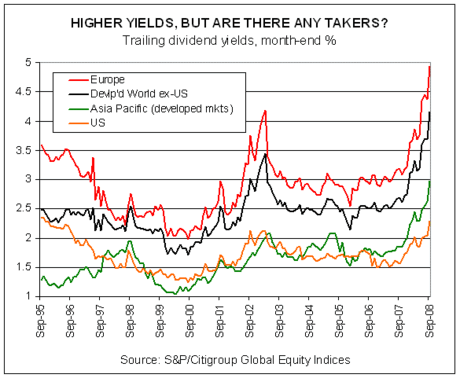
Avoiding stocks with relatively high yields could either be a wise decision or an opportunity missed. Yield is just one aspect of total returns; capital gains and potential valuation changes play significant roles, all of which remain speculative at best. Despite current yields being uninviting, many investors seemed unfazed by the low yields exhibited from 2003 to 2007. Was it that the anticipated capital gains made lower yields acceptable? Understanding these dynamics often requires a psychological perspective alongside financial analysis. Ultimately, the cycle of fear and greed remains an enduring aspect of market behavior.
In conclusion, dividend yields and other fundamental indicators will experience continual shifts, which implies varying prospects for returns over time. While this information may seem irrelevant for quick traders, long-term investors with a time horizon of five years or longer might find the outlook more promising than what headlines suggest.
This morning, the Federal Reserve and various global central banks announced interest rate cuts, a necessary response to evident market turmoil. Under typical circumstances, such cuts would be critiqued for contributing to a flood of liquidity. However, these aren’t ordinary times, and the timeline for returning to normalcy is unclear.
One sign of the abnormalcy is the diminishing threat of inflation—at least for the near future. As the credit crisis escalates, expectations of rising prices have taken a backseat to disinflation or even deflation concerns. This allows the Fed, with a 50 basis point cut bringing the target rate to 1.5%, more room to maneuver. While this reduction offers some monetary flexibility, it also signals trouble in the broader economy. Although measures to curb inflation can take varied approaches, the current dynamics highlight the urgency of the situation.
The critical question now is how effective these rate cuts will be in stimulating lending in the stagnant credit markets. The primary aim should be to reassure financial institutions to resume lending. While these cuts and recent Fed measures will help, rebuilding confidence in the repayment of loans will require more than just lower rates; patience and time will be essential elements in addressing the challenges ahead.
The ongoing crisis requires us to confront the stark realities that have brought us here. Understanding the roots of our current predicament might offer valuable insights for future policymaking. Acknowledging our shortcomings is vital, particularly the misguided belief that the economy could be artificially engineered to eliminate recessions altogether. For some time, it appeared that central banks had discovered ways to smooth the business cycle, promising that recessions would become rare and less painful. The so-called Great Moderation led many to assume we had entered a new economic paradigm. Although historical data suggested a decrease in the frequency and severity of downturns, this notion was challenged by the tech bubble’s burst in the early 2000s, which many chose to overlook due to resilient consumer spending, aided by the Federal Reserve’s interventions.

