Recent discussions on political cinema have explored the genre beyond its overtly political narratives. In this piece, Satyajit Das delves into films that, while not explicitly centered on political themes, carry significant political weight through their subtler undertones. As readers contributed their thoughts and recommendations in previous discussions, we encourage more insights in the comments below.
By Satyajit Das, a former banker and a prolific author known for his works on finance and derivatives, including titles such as: Traders, Guns & Money: Knowns and Unknowns in the Dazzling World of Derivatives (2006, 2010), Extreme Money: The Masters of the Universe and the Cult of Risk (2011), and A Banquet of Consequences (2016, 2021). His forthcoming book, The Everything Bubble: A Guide to the New Age of Financial Speculation and Phantom Wealth, is expected in 2027. In addition, he has authored works on ecotourism, including In Search of the Pangolin (2006, with Jade Novakovic) and Wild Quests: Journeys into Ecotourism and the Future for Animals (2024). This presentation is co-published with The South First.
Exploring Subtle Political Themes
This article focuses on films that, while not overtly political, convey powerful political messages through their narrative and character dynamics. Presented in broad alphabetical order, these films examine the intertwined nature of public and private politics.

Being There (1979)
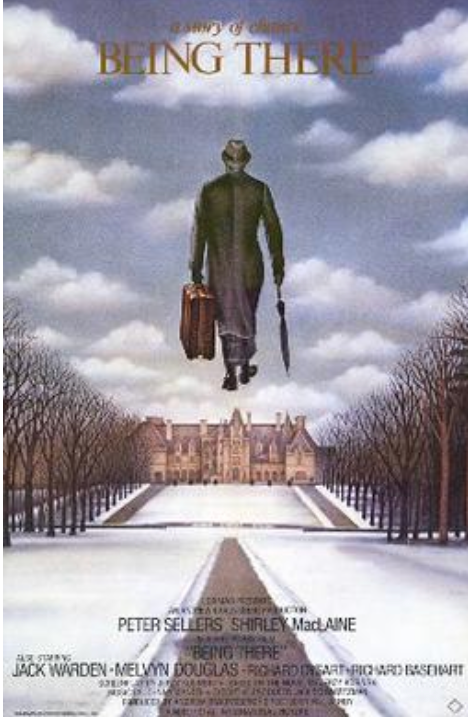
Directed by Hal Ashby and based on Jerzy Kosinski’s novel, Being There tells the story of Chance, a man with intellectual disabilities played by Peter Sellers. Having spent his life in the confines of a wealthy recluse’s estate, Chance’s world unravels after his patron’s death. Through a series of improbable coincidences, he finds himself in the company of Benjamin Rand, a wealthy but ailing millionaire, and his wife, Eve.
As the plot unfolds, misunderstandings about Chance’s name and his gardening knowledge elevate him to the status of a confidant and advisor to the President. His vague yet seemingly profound observations, like “Spring, summer, autumn, winter… then spring again,” illustrate how easily the public can be swayed by superficial appearances and platitudes. Being There critiques the political landscape, highlighting the media’s function in perpetuating empty statements lacking substance, demonstrating the superficiality of voters and the public’s superficial engagement with politics.
Key scenes reveal Chance’s peculiar relationship with television and culminate in a bizarre episode involving muggers and a remote control. The film concludes with Chance’s surreal walk across a lake, symbolizing his improbable rise to prominence.

Bulworth (1998)
Bulworth stars Warren Beatty as a jaded senator who struggles to reconcile his liberal ideals with the current political landscape. Faced with substantial financial troubles, he contemplates ordering a hit on himself to cash in on his life insurance. The film captures his newfound freedom to speak candidly, leading to provocative remarks in various social settings that critique race and class disparities.
While the narrative is somewhat whimsical, the underlying anger and social commentary resonate with contemporary political frustrations, echoing sentiments found in films like Network and The China Syndrome.

The Conformist (1970)
Set in 1930s Europe, The Conformist, directed by Bernardo Bertolucci, follows Marcello Clerici, a man assigned to assassinate his former professor, an anti-Fascist dissident. Through his marriage and interactions, the film explores themes of personal and societal complicity with fascism. The visual storytelling, crafted by cinematographer Vittorio Storaro, stands out with its lush aesthetics and striking compositions.
The assassination scene, hauntingly set in a snowy landscape, encapsulates the film’s exploration of cowardice and complicity, as Clerici’s inaction highlights the moral decay of individuals in oppressive political climates.

Dr. Strangelove (1964) and A Clockwork Orange (1971)
Stanley Kubrick’s films Dr. Strangelove and A Clockwork Orange tackle political themes from vastly different angles. The former humorously examines Cold War anxieties, portraying a rogue general’s erroneous command to unleash a nuclear strike. Its satirical edge critiques military and governmental absurdities surrounding nuclear weapons.
A Clockwork Orange, set in a chilling dystopia, centers on the theme of violence and societal failure. The protagonist, Alex, undergoes aversive conditioning to eliminate his violent impulses, raising uncomfortable questions about free will and state-sanctioned violence. This film pushes viewers to reflect on the societal contradictions around aggression and redemption.

Mephisto (1981)
Istvan Szabo’s film Mephisto analyzes the complexities of political collaboration during the rise of the Nazis. The protagonist, Hendrik Hofgen, is an ambitious actor who maneuvers through the tumultuous political landscape of Nazi Germany, justifying his self-serving actions as merely a part of his career. The film explores moral ambiguity and the consequences of prioritizing personal ambition over ethics.
Its success lies in portraying a society transformed by totalitarianism, blending a rich narrative with a visual style that deepens the emotional impact of Hofgen’s moral descent.

Wag the Dog (1997)
Barry Levinson’s Wag the Dog presents a more conventional take on political themes, centering on a fabricated war designed to distract from a presidential scandal. The film cleverly exposes the blurred lines between politics and media manipulation, underscoring the notion that political theater often takes precedence over substantial governance.

Z (1969)
Costas-Gravas’s Z directly addresses political corruption, depicting the aftermath of a political assassination in Greece. This film scrutinizes the lengths to which government institutions will go to obscure truth and maintain control, illustrating the often grim reality of justice when state power is involved. Its concluding remarks reinforce a bleak vision of political accountability and the pervasive nature of corruption.
Conclusion
These films collectively challenge our understanding of political systems and the societal complicity within them. Being There strikes a poignant note by highlighting how leaders can adapt their personas to appeal to the electorate, while citizens often overlook the substance of political dialogue. The themes portrayed in these narratives compel audiences to confront their roles in sustaining the systems they participate in, encouraging vigilance and deeper engagement in the political process.
© 2026 Satyajit Das All Rights Reserved


