Today, we delve into the latest developments surrounding U.S. sanctions on Iran and their broader implications. As tensions escalate, the effectiveness of economic strategies in subduing nations is called into question.
The primary focus today is the ineffectual U.S. strategy aimed at crippling Iran’s economy—a tactic the U.S. has tried before with little success. Despite economic pressures, Iran has emerged as one of the fastest-growing nations in the region, particularly when assessed on a purchasing power parity (PPP) per capita basis.
In an attempt to convey seriousness, recent remarks from Treasury official Scott Bessent suggested that new sanctions would significantly impact the global economy. Notably, Iran has previously warned it could disrupt global energy markets if its civilian infrastructure were targeted. This acknowledgment of Iran’s potential retaliatory capabilities, coupled with documented depletion of U.S. military resources, has seemingly prevented the U.S. from escalating tensions further.
Bessent’s exaggerated claims reflect a sense of weakness, especially when compared to the well-coordinated sanctions imposed by the U.S., U.K., and E.U. in February 2022. The branding of this effort as “Operation Economic Outcast” seems less than intimidating in light of the lack of a comprehensive strategy.
The full speech:
Although I didn’t listen to the speech due to my reservations about Bessent, I reviewed the full transcript.
Some analysts have observed that Bessent’s assertion of achieving regime change implies a return to earlier policies of regime alteration. This echoes the rationale surrounding the Iraq War—once its primary justification was exposed as false, various reasons were circulated to maintain public support. Current arguments seem to be cycling through, indicating a lack of fresh strategies.
The key points from Bessent’s speech include:
We are launching Operation Economic Outcast to limit every option available to the Iranian government.
The Treasury has thoroughly mapped the channels through which Iran has evaded sanctions.Starting today, actions by the Treasury and other agencies will further restrict revenue sources that fund the IRGC and Iranian government. We aim for a zero-tolerance policy regarding any opportunities for the regime to regain its capability to spread terror.
The last refuge for this regime lies in the misguided support from nations attempting to mitigate the Iranian threat. Engagement in ambiguous actions is no longer acceptable; countries cannot feign ignorance regarding their facilitation of Iranian activities.
These nations purchase and transport Iranian petroleum, manage financial flows through various financial hubs, and overlook numerous illicit practices.
I remain skeptical about whether the Treasury can fully track Iranian trade-related finances. They lack visibility into dealings with Russia and probably cannot oversee cryptocurrency transactions effectively. Notably, only around 120 countries adhere to the OECD Common Reporting Standard, which allows for the exchange of financial information between tax authorities. Small-scale trade could still maneuver through informal systems like hawala.
Thus, Bessent’s claim of comprehensive oversight appears tenuous. John Mearsheimer has pointed out that Iran’s pivotal trading partner, China, is unlikely to comply with U.S. sanctions. Will Bessent risk a standoff with China that could provoke further restrictions on critical U.S. imports?
Interestingly, Bessent’s level of preparedness, as indicated by his assurances of imminent sanctions, seems lacking. He stated:
I expect a significant announcement regarding a financial institution to be sanctioned by the end of this week.
This raised eyebrows. If urgency is paramount, why delay?
Bessent’s response to a reporter’s inquiry about immediate sanctions was perplexing:
Reporter: Why not impose sanctions immediately?
Bessent: “Why would I want to destabilize the global financial system?”
This contradiction begs the question: Are these sanctions a real threat or mere rhetoric?
In line with Bessent’s claims, he unveiled a new set of sanctions targeting five critical sectors that Iran exploits abroad: digital assets, technology, gold, aviation, and shipping. These measures impose additional risks on anyone engaging with Iran’s economy, with Treasury’s Foreign Asset Control Office sanctioning over 60 entities and individuals implicated in supporting the Iranian government’s harmful endeavors.
This is a sustained campaign to eliminate every last option available to Iran.
A focus on only 60 sanctions targets, especially in light of the global scale needed, is quite minimal. However, Bessent’s rhetoric does have some receptive ears. This is highlighted by feedback from Middle East Eye:
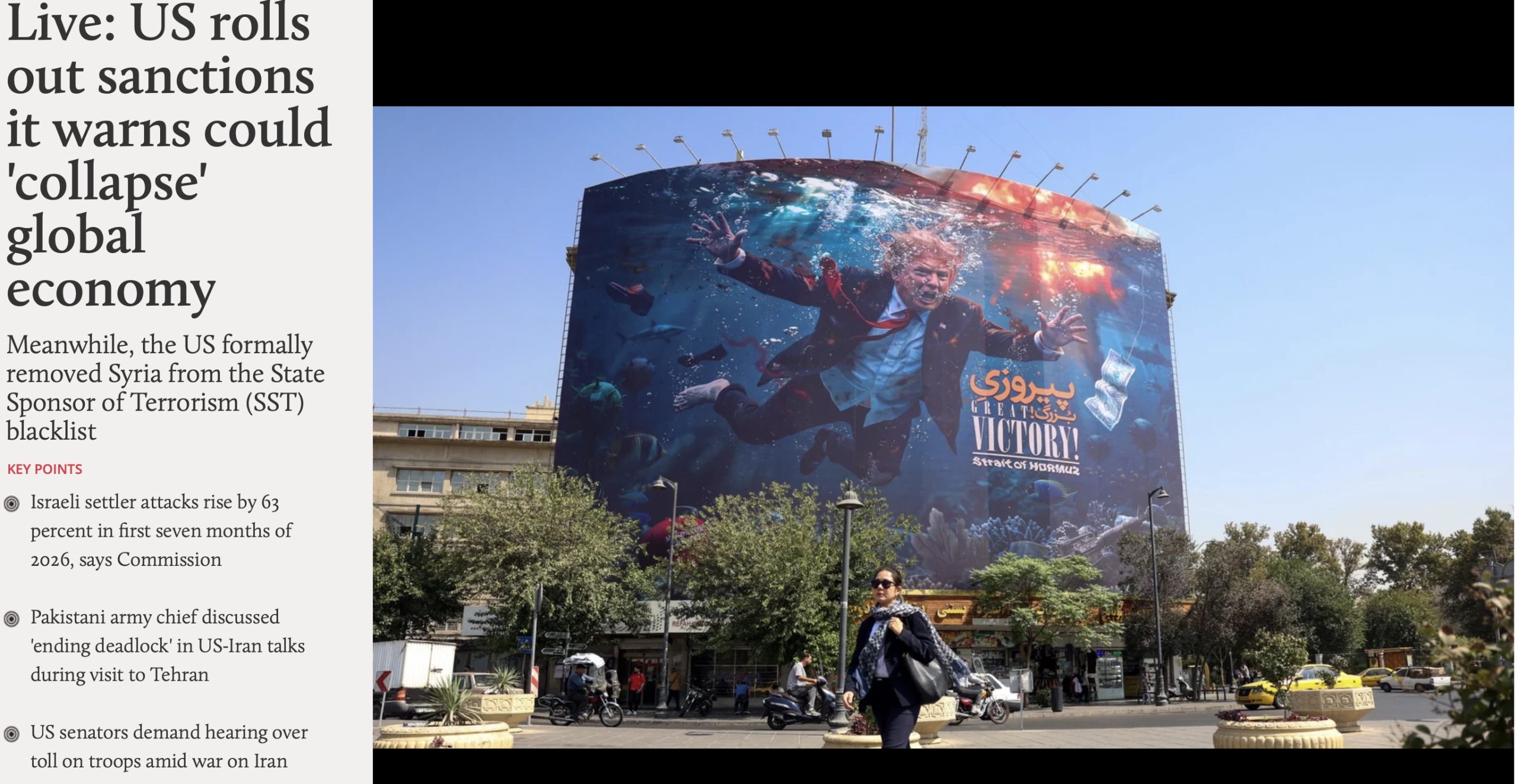
So, what does this actually mean? Any attempt to severely undermine the global economy through the U.S. dollar system, particularly where U.S. involvement is significant, only serves to detrimentally affect the U.S. itself. It reminds one of a comical moment in Blazing Saddles, where a character threatens to take drastic self-harm actions to deter an angry mob:
Yet, such dramatic tactics are only effective in fiction.
The powerful Foreign Minister of China, Wang Yi, has already dismissed Bessent’s threats. The Chinese Foreign Ministry reiterated its stance:
‘ECONOMIC WARS and maximum pressure are not the solution’ — China’s FM spox Lin Jian responds to Bessent
China defended its cooperation with Iran, cautioning that U.S. sanctions could escalate tensions and disrupt the global economy https://t.co/G7ekc0JKSB pic.twitter.com/CgHphQGGaL
— RT (@RT_com) August 25, 2026
Furthermore, a lead story in the Financial Times highlighted:
Any significant escalation in U.S. sanctions against China, which imports 90% of Iran’s oil, could jeopardize diplomatic relations just weeks before a crucial summit between Presidents Trump and Xi.
This meeting is pivotal to the global economy, where the leaders are expected to discuss extending a truce in their trade conflict.
“China will take all necessary measures to protect its interests,” asserted a Chinese Foreign Ministry spokesperson in response to the threat of sanctions.
“China has consistently opposed unilateral sanctions that lack grounding in international law,” they added.
While Chinese state-owned refiners generally comply with sanctions, private refiners have been reported to still import Iranian crude.
China is establishing an increasingly firm anti-sanctions regime to counter any foreign restrictions on its operations.
Should the U.S. aggressively expand secondary sanctions targeting Chinese firms, retaliation from Beijing could ensue, similar to previous threats that impacted U.S. manufacturing.
“We need to determine whether this is genuine intimidation or a frivolous proposal for secondary sanctions on China,” remarked Wang Dong, a senior scholar at Peking University.
In a discussion led by Robert Pape on the illusory concept of “Economic D-Day,” he notes that economic sanctions have historically proven ineffective in altering the course of conflict. His insightful analysis reveals that no significant war has ever concluded through economic measures alone:
A noteworthy excerpt from Pape’s lengthy commentary:
Scott Bessent, and I carefully choose my words, is confronted with the weight of historical precedent.
It’s crucial to recognize that since World War I, no major conflict has concluded solely through economic pressures or blockades.
This was more effective during earlier periods of global politics, such as the British control during the 17th to 19th centuries.
A pivotal point occurred during World War I with the British blockade against Germany. Even more crucial were the sanctions against Japan in World War II and various cases against Iraq and Iran through the years. In every instance, these economic pressures failed to yield the desired political outcomes without substantial military intervention.
Thus, Bessent’s assertion that he has discovered an alternative to the necessity of military force is not substantiated.
Moreover, U.S. sanctions on Iran have not yielded the anticipated outcomes. Data presented by Steve Hanke continues to affirm this viewpoint, highlighting previous discussions on its implications for international trade and relations:
As noted in the article from OilPrice concerning the repercussions of Trump’s demands, major nations including China, Iraq, Turkey, India, and the UAE are facing diverse levels of exposure to secondary U.S. sanctions:
- Trump’s “Economic D-Day” places pressure on Iran’s primary trading partners, with China being particularly significant, as it purchases over 80% of Iran’s oil.
- Sanctions imposed on major Chinese banks risk escalating economic tensions and diplomatic relations.
- Iraq and Turkey are facing critical energy challenges, while India’s remaining trade with Iran is susceptible, and the UAE has largely severed ties.
It’s important to clarify that while the UAE publicly claimed an end to commercial relations with Iran, practical adherence to this has been minimal. Will Bessent escalate this situation further? Turkey remains cautious, sensing its own vulnerabilities, and possesses robust legal control over its NATO bases, critical for U.S. actions in the region. How will the U.S. strategy adapt to this pushback?
Even India, though compliant with U.S. expectations, is facing drug shortages, leaving considerable humanitarian concerns. Does Bessent genuinely wish to take responsibility for disrupting vital imports of generics from India?
In another rapidly evolving narrative, Stan Druckenmiller, Bessent’s former boss at Soros Fund Management, publicly criticized him. Bloomberg echoed his sentiments regarding Bessent’s maneuvers in the bond market:
- Druckenmiller suggested Bessent is misguided in attempting to reduce yields through bond purchases.
- He argued that market forces should prevail, asserting that “Governments that defend prices against fundamentals always lose.”
- Critics have raised concerns that Bessent’s approach merely provides short-term relief without tackling underlying fiscal issues.
In Druckenmiller’s op-ed, he discussed Treasury’s recent announcement of doubling bond buybacks:
The Treasury declared on August 19 an intention to increase long-dated bond buybacks, a move viewed as price management rather than true liquidity support. Healthy markets don’t necessitate intervention unless clear dysfunction arises, yet current conditions appear stable.
Druckenmiller’s insights correlate with Rob Urie’s assertion that the bond market is stable, emphasizing that Bessent may be reacting to Trump’s sensitivity to rising interest rates rather than addressing central issues, particularly in the face of escalating tensions regarding Iran.
CNBC reports that Treasury may further escalate its interventions. However, until similar narratives emerge from major financial outlets, this remains speculative:
BREAKING: The U.S. Treasury is evaluating the use of its $950 billion General Account to support increased purchases of long-term government bonds, according to CNBC.
The bond market intervention era was officially initiated on August 19.
— The Kobeissi Letter (@KobeissiLetter) August 24, 2026
On an operational level concerning shipping activities, there is limited visibility into how many vessels are operating in the Oman area. Iran could easily disrupt these movements if it chose to. Some analysts suggest Iran might be allowing limited trade to avoid exacerbating tensions with Oman while also considering economic repercussions for China and surrounding nations.
Following Bessent’s remarks, a US-escorted vessel was reportedly struck, aligning with Iran’s prior threats regarding the Strait of Hormuz:
⭕️ UKMTO confirmed that an Oil Tanker escorted by the US in the Strait of Hormuz was struck and disabled around 20h25 UTC last night. https://t.co/KBOhyTOjvX pic.twitter.com/rYi01IiRwS
— MenchOsint (@MenchOsint) August 25, 2026
As per Middle East Eye’s updates, traffic through the Strait of Hormuz has dropped significantly:
Tanker traffic in the Strait of Hormuz is at its lowest since May
Only two commodity tankers were recorded transiting the Strait on Monday, a notable decline from the 10-day average of 14 vessels.
Preliminary figures indicate oil flows in the region have also dropped significantly.
These developments extend to the U.S. Strategic Petroleum Reserve (SPR), which continues to decline:
BREAKING: U.S. crude oil inventories in the Strategic Petroleum Reserve have officially fallen below 290 million barrels for the first time since 1982, reaching a historic low.
— The Kobeissi Letter (@KobeissiLetter) August 24, 2026
There are growing concerns about the resilience of U.S. salt caverns, suggesting that the administration may be planning for drastic reductions in reserves:
Caution: some U.S. SPR salt caverns are reportedly nearing depletion pic.twitter.com/AFshc8BOAV
— JustDario (@DarioCpx) August 25, 2026
Additionally, the situation in Yemen remains volatile, as evidenced by recent attacks from Houthi rebels. An incident involving a Saudi supertanker highlighted the ongoing threats in the region:
Yemen’s Houthi group recently targeted a Saudi supertanker traversing the Red Sea, demonstrating that conflicts are far from resolved.
In conclusion, the U.S. strategy regarding Iran remains contentious and fraught with challenges. As global reactions unfold, the effectiveness of sanctions and their broader implications continue to be subjects of debate and concern.
We will continue to monitor the situation and provide updates as it evolves. Stay tuned for tomorrow’s developments!


