For the past three years, the Von der Leyen Commission has been quietly negotiating a controversial agreement to transfer sensitive data of its citizens to a state accused of committing numerous genocides.
Although public support for Israel has diminished significantly in the “collective West,” the Israeli government still maintains the backing of many Western political leaders, albeit with some reluctance.
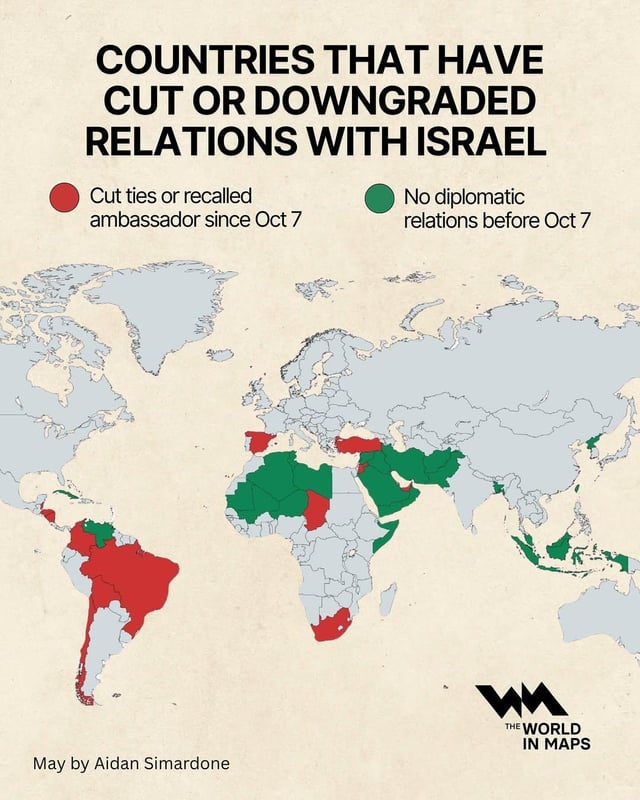
Since the ongoing genocide in Gaza escalated almost three years ago, only a handful of nations have chosen to sever or downgrade their diplomatic ties with Israel. Some countries, such as Colombia, Honduras, Chile, and Bolivia, reverted to supporting Israel after changes in their governments.

Recent polling by YouGov indicates that public sentiment towards Israel in Western Europe has reached an all-time low, with fewer than one in five respondents in the six surveyed countries holding a favorable opinion of the nation.
Earlier this year, over a million EU citizens signed a petition calling for the suspension of the EU-Israel Association Agreement. In April, the governments of Spain, Slovenia, and Ireland suggested suspending this agreement, prompting the EU Council to at least feign consideration before Germany and Italy rejected the idea decisively.
Consequently, billions of dollars in trade, including military equipment and technology, continue to flow monthly between Israel and the EU, Israel’s largest trading partner. The absence of substantial repercussions for Israel’s alleged war crimes has emboldened the country to intensify its military actions.
In Southern Lebanon, for instance, an estimated 20% of farmland and forests have been devastated, displacing around 270,000 residents, as reported by the Financial Times. Shaiel Ben-Ephraim notes, stating, “this is a stated policy and an intentional plan to render the area uninhabitable, preventing the population from ever returning.”
Israel is pursuing similar strategies in the West Bank. Recently, the Netanyahu administration, reportedly under the influence of Finance Minister Bezalel Smotrich, has initiated tenders for the construction of approximately 1,200 settlement homes in East Jerusalem—a move marked by its provocation.
Smotrich is rapidly expanding Israeli settlements in the West Bank, during his last months in office as Minister of Finance, co-Minister of Defence and Governor of the West Bank Civil Administration (yes, he is holding all of these titles) https://t.co/0NQWpUEMVE
— Andrey X (@the_andrey_x) August 20, 2026
THIS IS FUCKING HORRIFIC.
You won’t believe what Israeli bulldozers are doing to the West Bank.
They keep destroying entire roads and infrastructure on purpose.
Israel wants to make life impossible so Palestinians have no choice but to leave. pic.twitter.com/hoUDoJ4wVA
— Parody Jeff (@Parodyjeffx) August 14, 2026
It’s not just violence: Israel is crushing the Palestinian economy too https://t.co/e7r821m7Oh
— Haaretz.com (@haaretzcom) August 20, 2026
As the violent attacks by Israeli settlers in the West Bank increase, Western governments find themselves ill-equipped to assign blame, as there are no groups like Hamas or Hezbollah present for scapegoating. In response, they have issued a joint statement expressing feigned outrage over the escalating violence while taking no substantive action to curb it.
Typical impotence from the EU, UK and Canada:
Hi Israel: we know we buy all your weapons and give you what you want and we always will.
We have to say we don’t really like the aggression in the West Bank and would like you to stop but won’t do anything when you continue.♥️🇮🇱 https://t.co/abOeYKL58m
— Glenn Greenwald (@ggreenwald) August 20, 2026
In March, a group of United Nations experts warned that the ongoing genocide in Gaza is spilling over into the West Bank, as violence and Israeli military operations ramp up across the occupied Palestinian territories.
“Under the cover of an existential war against the Palestinians, Israel is accelerating measures that alter Jerusalem’s demographic composition, religious character, and legal status, destroying the remnants of the pluralistic fabric that Jerusalem has represented for centuries, for Muslims, Christians, and Jews,” the experts stated.
Yet the EU struggles to achieve a consensus on imposing trade sanctions against illegal settlements in the occupied West Bank. This region has received billions of euros in EU investments over the years but is now facing relentless assaults by state-supported terror groups.
The Ultimate Betrayal
However, Brussels is not entirely inactive. According to exclusive reports from EU Observer and State Watch, the Von der Leyen Commission has been in secret discussions to forge an agreement that would allow for the large-scale transfer of sensitive personal data from EU systems to Israeli authorities.
This data may include biometric information, genetic data, location tracking, political opinions, health records, and trade union affiliations of EU citizens. The proposed agreement would involve Europol, the EU’s policing agency, allowing the data to be accessible to Israel’s National Police and internal security service, Shin Bet.
This arrangement signifies a considerable escalation from a 2018 agreement that explicitly prohibited personal data sharing and specifically excluded the occupied Palestinian territories. This new version includes both regions.
Notably, these negotiations have persisted throughout the genocide in Gaza, despite warnings from the EU Council’s legal advisors in late 2022—long before the genocide commenced—that allowing data to be utilized in the occupied territories would risk legitimizing Israel’s occupation and violate international law.
The EU has operated a mission in the West Bank to assist the Palestinian Authority with policing since 2005. Should the data-sharing agreement be finalized, information gathered by EU police operations in the West Bank and the Gaza Strip could be integrated into Israel’s military surveillance systems.
Deaglan O’Mulrooney highlights in an article for Washington University’s The Spectacle Mag that the EU’s legal service had declared the agreement unlawful in 2022, yet the Commission proceeded anyway:
The Council Legal Service concluded that the Commission had breached its negotiating mandate, violated EU treaty requirements, and failed to consult the relevant working group. The lawyers explicitly objected to provisions that would permit data shared with Israel to be used in the occupied territories, warning that it would be the first time an international agreement between the EU and Israel would allow its application to the territories occupied since 1967, thereby violating the Palestinian people’s right to self-determination and breaching international law. The Commission acknowledged these objections and continued negotiating anyhow.
Although the agreement was officially frozen following these legal objections in late 2022, Statewatch’s investigation revealed that negotiations did not cease. Commission officials held at least seven meetings with Israeli diplomats from January 2023 to January 2026, including one with Israel’s then-foreign minister Eli Cohen in April 2023. When Statewatch inquired about the current status of the negotiations, the Commission declined to comment and did not reveal whether it had revised its draft to address the legal concerns. The Israeli embassy, foreign ministry, and police remained unresponsive. Europol described itself as a ‘passive observer’ yet hosted at least five Israeli delegations between August 2024 and March 2026, culminating with a visit from the Israeli ambassador to Europol’s headquarters in The Hague in March of this year.
“The data exchanged via this agreement could be instrumental in supporting decisions to attack and kill Palestinians,” legal expert Eitan Diamond stated to Statewatch. “The EU risks unjustly depriving individuals of their liberties and exposing them to systematic mistreatment under harsh detention conditions.”
Conditions such as these…
The use of trained rape dogs in Israeli prisons is so well-documented that it is no longer in doubt. All the hasbarists can say is “It’s absurd to think Israel would do something so cruel!” which no one following the situation believes. https://t.co/hJjHd7K3go
— Caitlin Johnstone (@caitoz) April 18, 2026
Itamar Ben-Gvir revealed the site where Israel plans to execute Palestinians convicted of terrorism.
It will include a death row section, with gallows at its center and viewing areas that allow victims’ families to witness executions—an announcement Ben-Gvir characterized as… pic.twitter.com/pZ3PDENroV
— The Telegraph (@Telegraph) August 19, 2026
Did you think Epstein’s island was bad?
Israel constructed the world’s only military prison for children, where non-Jewish children reportedly endure abuse.
Conviction rates in these courts are claimed to reach 99.7%. pic.twitter.com/3K7PXSLgNy
— GBC (@GBC_Press) August 18, 2026
A number of experts interviewed for the State Watch and EU Observer investigation cautioned that the proposed agreement could amplify human rights violations against both Palestinians and Israelis alike.
Negotiations have continued even after the ICJ’s July 2024 advisory opinion stating that Israel must promptly end its illegal presence in the occupied Palestinian territories. As O’Mulrooney highlights, all states and international organizations were urged to refrain from actions that could perpetuate this unlawful presence:
The proposed agreement would do exactly the opposite, enhancing the capabilities of Israeli security forces across the occupied territories using data supplied by European institutions. The Commission has been fully aware of this yet persisted in negotiations…
Douwe Korff, a Yale University legal scholar, expressed profound concern regarding the Commission’s apparent intent to share sensitive data about individuals across the EU, including details of their communications with aid workers, officials, and journalists in Israel and the occupied territories, with a state that has conducted targeted killings of children, aid workers, and journalists at an unprecedented scale and is credibly accused of genocide.
In July 2026, 27 Members of the European Parliament (MEPs) submitted written inquiries regarding the negotiations. Mounir Satouri, a French Green MEP, emphasized that “we are facing a double scandal,” due to the “serious violations of international humanitarian law in Gaza” and the “extreme secrecy” surrounding the negotiations. He urged an immediate suspension of these talks, asserting that “the commission has disgraced itself by conducting them.”
What Happened to GDPR?
This is one of many pressing questions raised in light of Statewatch’s findings. The European Commission claimed that any potential agreement would include safeguards to protect fundamental rights, including data protection measures and restrictions on the use of data related to the death penalty.
That assurance, however, holds little merit. Any data protection measures would be rendered meaningless when in the hands of the Israeli police force and Shin Bet. As Novara Media emphasizes, it’s not just Palestinian citizens that could become targets of this deal; journalists, as well as pro-Palestine and anti-war activists in Europe, could also face risks.
This scenario unfolds while EU institutions are constructing extensive databases on EU citizens, integrating national security authorities with Europol, and expanding technical capabilities for biometric identification and automated data analysis. As reported some months ago, the EU’s digital surveillance infrastructure is nearing completion.
Moreover, Israel is not the only country with which Brussels is negotiating a comprehensive data-sharing agreement; the EU is also in talks with the United States regarding the exchange of information for security screenings and identity verification related to border procedures and visa applications.
Negotiations for this agreement began in 2022, when the Biden Administration proposed sharing biometric data of US citizens—with many cases being collected without consent—across all 40 countries included in the US government’s Visa Waiver Program (VWP), which comprises 23 EU member states. The understanding was that those countries would also reciprocate.
It is presumed that digital public infrastructures like digital identity frameworks and central bank digital currencies will become interoperable across international borders. Although the negotiations between the US and the EU have been somewhat more transparent, Statewatch indicated in May that the EU Commission’s current proposal “overtly violates EU law.”
The proposal significantly exceeds the limited negotiation mandate granted by the Council of the EU and contravenes essential data protection safeguards established by the European Data Protection Authorities. Data exchanged under this proposed agreement could be utilized for a vast range of purposes, including the prevention or arrest of individuals traveling to the US who have expressed opposition to US policies in Europe, or for automated discriminatory profiling of travelers, including EU citizens.
The EU has until December 31 to comply with Washington’s demands to open its biometric databases to US border officials. Failure to do so may jeopardize their visa-free travel status to the US. Given that the Trump administration has increasingly weaponized visa policies for geopolitical leverage—punishing dissenters while rewarding allies—this could be a blessing in disguise.
Meanwhile, the EU’s covert plan to transfer citizen data to a state accused of multiple genocides remains largely under wraps, as most European media outlets have chosen to ignore Statewatch’s alarming revelations.
The Von der Leyen Commission seems to prefer this state of oblivion. As O’Mulrooney observes, “the Commission disregarded its lawyers. It disregarded the ICJ. It disregarded its parliament. It kept meeting, kept negotiating, and hoped no one would notice.”
“Statewatch noticed. Now you have, too.”


