Hello, this is Yves. Understanding how to address the personal impacts of El Niño can be challenging, especially for those not directly involved, like farmers who face its consequences head-on. While experts predict that this phenomenon will peak during late summer and fall, its effects will linger for an additional nine months to a year. As such, the ramifications on planting and crop yields are likely to extend into the 2027 spring and summer seasons. Below, Tom Neuburger elaborates on the lasting climate effects of a super El Niño.
By Tom Neuburger. Originally published at God’s Spies

This article serves as a follow-up to our recent climate report titled “A Record El Niño Is Coming.” In that report, we highlighted the unprecedented rise in sea surface temperatures this summer and observed the escalating heat across various regions worldwide.
We are not alone in expressing concern; numerous publications have commented on the unusual nature of the upcoming El Niño and its potential impacts. For instance:
• Newsweek: El Niño Breaking 176-Year Record: The Impact on Florida, Texas, California
A potentially historic El Niño is intensifying in the Pacific, likely leading to significant changes in weather patterns across the United States, including variations in rainfall, storm risks, and tropical activity affecting Florida, Texas, and California.
Florida meteorologist Matt Devitt noted in a recent post that forecasts indicate this El Niño could surpass any seen since 1850, potentially setting a new benchmark after 176 years.
Though El Niño originates in the tropical Pacific, its effects can significantly alter weather systems across the U.S.
The following post by Devitt illustrates this:
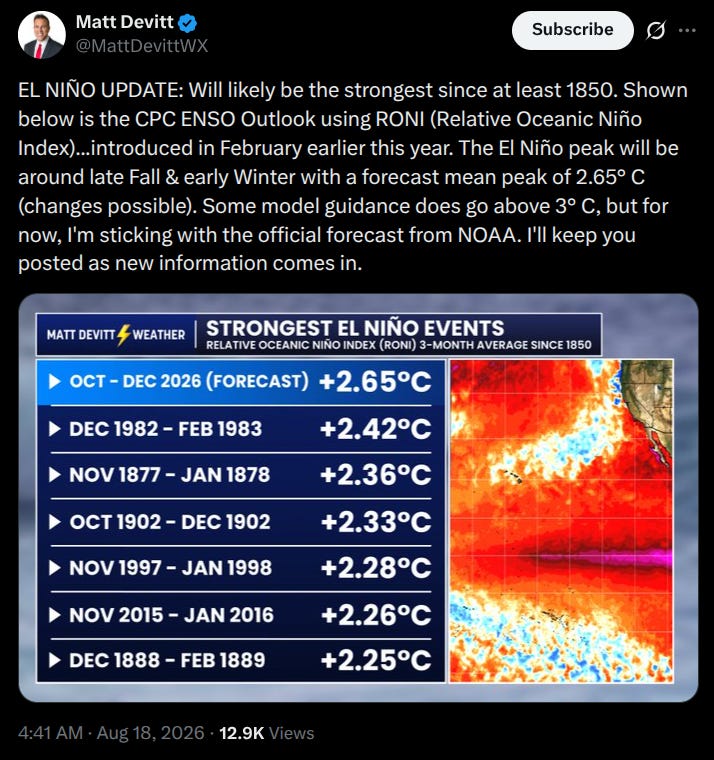
How to interpret the chart: The numbers shown correspond to the intensity of each El Niño, determined by the increase in temperature it triggered. The forecasted +2.65°C (4.77°F) is a significant figure for a weather system to absorb. The El Niño event of 2015-2016 is estimated to have caused up to $90 billion in immediate global damages; the long-term consequences of such disruptions have amounted to trillions.
Moreover, the aforementioned forecast may be quite conservative. An article from Wired states that “median temperatures for the Niño 3.4 region [defined in a section of the Pacific] could escalate to 3.6 degrees Celsius above normal—even when accounting for long-term global warming effects” (emphasis added).
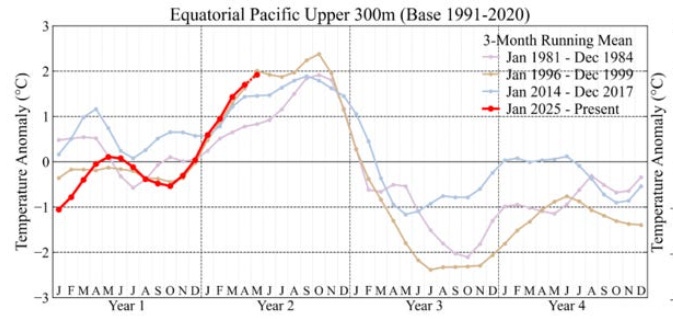
For visual representation, refer to a chart by James Hansen, which displays current temperatures (in red) alongside earlier “super” El Niños. (Note: Hansen employs a different measurement from the standard El Niño gauge—he considers the temperature of the upper 300 meters of the ocean—resulting in slightly differing figures.)
If the most dire predictions hold true, the red line in the chart may soar above the graph’s upper limit.
The following chart from NOAA demonstrates temperature deviations associated with El Niño and La Niña dating back to 1950 (click to enlarge).
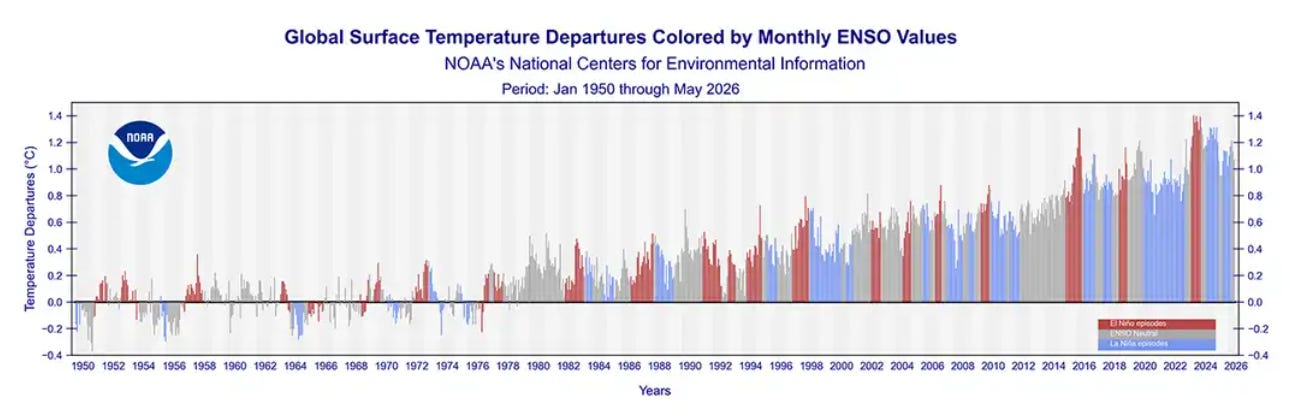
This provides a broader perspective on the situation, doesn’t it?
What to Anticipate
Looking ahead to this year and next:
- Typically, El Niños result in fewer hurricanes in the Atlantic, but may lead to more and stronger typhoons in the Pacific (refer to this).
- As the Pacific jet stream shifts south and east, the southern United States can expect wetter and colder conditions, while the northern states may experience warmer and drier weather.
- Tornadoes in the southern U.S. could be more intense, alongside other storms that may become more frequent and severe.
- The economic effects can be substantial and unpredictable. As mentioned in Wired, “the 1997–98 El Niño led to a cumulative loss of about $5.7 trillion over the subsequent five years.”
The Impending, Escalating Crisis
However, the most significant impact may be on our longer-term climate systems. We know that global warming is already accelerating. As Hansen explains, the speed of temperature change has shifted as follows (see the second chart here):
- 1970-2010 — 0.18°C per decade
- 2010-present (without an El Niño this year) — 0.30°C per decade
- 2010-present (with a “super” El Niño this year) — 0.41°C per decade
Hansen’s estimates have now been validated. Tweets from Ben See and Mike Hudema confirm this (annotations provided):
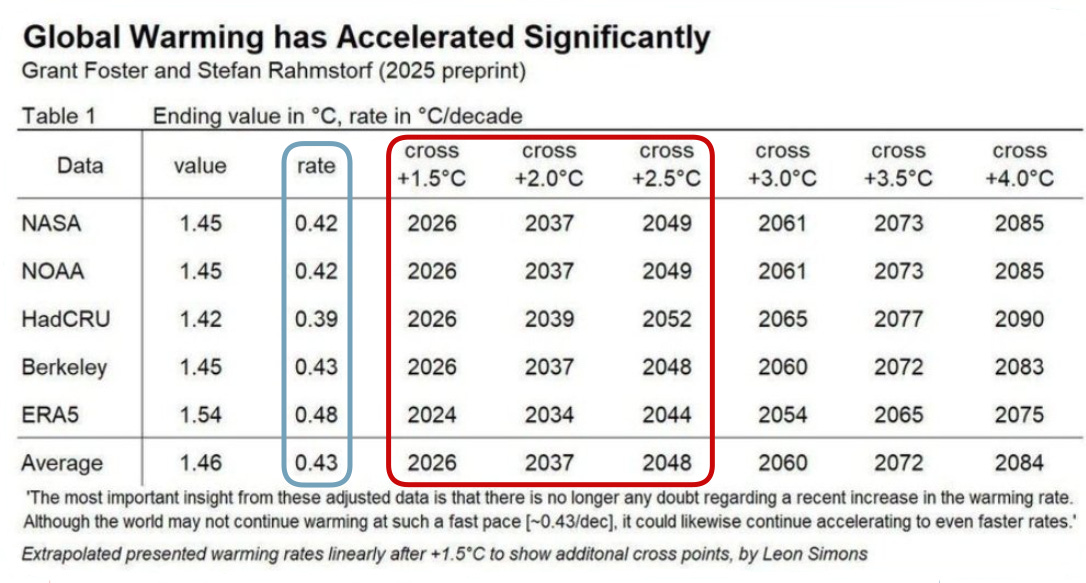
The average warming rate, calculated from these five measurements, stands at 0.43 degrees Celsius per decade, with one outlier at 0.48 (outliers often provide more accurate data in today’s “keep-everyone-calm” messaging narratives).
This suggests that a +1.5°C increase will likely be reached this year if it hasn’t occurred already; a +2.0°C rise could happen within the next ten years; and a +2.5°C increase is anticipated in the 2040s.
Virtually everyone alive today will experience these changes.
What Can Be Done
Addressing these issues could be a topic for another discussion. I’ve written previously on this and will continue to explore it. But to summarize my thoughts:
- Avoid trying to “fix” global warming. The capitalist world, characterized by endless growth and exploitation, is unsustainable and cannot be preserved. It’s essential to shift focus to more constructive endeavors.
- Begin creating a future based on the remnants of what will remain. In sports terms, anticipate where the receiver will be rather than where they are currently. This foresight will be essential after the consequences of this storm unfold.
- Embrace courage rather than fear. Humanity is inherently resilient. Celebrate that resilience as a positive attribute.
- Grieve for the loss of the current way of life, but also find joy in the emergence of a new paradigm. This idea encompasses many layers, some overt and others less visible. Start with this insight: Our happiness isn’t contingent on material possessions like TVs and cars.
More insights will follow. Thank you for reading.


