● Humans Need Not Apply: A Guide to Wealth and Work in the Age of Artificial Intelligence
By Jerry Kaplan
Summary via publisher (Yale University Press)
After decades of research and substantial investment, advancements in artificial intelligence are finally coming to fruition. As we approach an era of significant transformation, Jerry Kaplan explores cutting-edge developments in robotics, machine learning, and perception, with technologies that might equal or surpass human aptitude. The emergence of driverless vehicles, robotic assistants, and intelligent agents could lead us into a new era of wealth and leisure. However, Kaplan cautions that without thoughtful intervention, this transition could be challenging and painful, especially in the face of persistent labor market volatility and rising income inequality. He advocates for innovative, market-driven reforms in our economic framework and social policies to mitigate potential upheaval. This accessible and timely exploration of the advantages and risks associated with artificial intelligence is essential reading for business professionals and policymakers across the political spectrum.
Continue reading

The Labor Department has reported that U.S. companies added 210,000 jobs in July, aligning with the consensus forecast from Econoday.com. Although this figure was a slight decline from June’s increase of 227,000, it reflects a consistent upward trend in employment, maintaining over a 2% year-on-year growth. While the annual growth rate is tapering off, the labor market’s expansion remains robust, suggesting a potential for continued growth. Consequently, the argument for a near-term interest rate hike by the Federal Reserve appears to gain strength with this report.
Continue reading
Jon Hilsenrath from The Wall Street Journal, known for his close ties to the Federal Reserve, has stated today that “A Bad Jobs Report Still Might Not Shake Fed’s View.” This suggests that the upcoming payroll data from the Labor Department, due to be released at 08:30 am Eastern, is unlikely to disrupt the central bank’s strategy to commence raising interest rates, possibly as soon as next month. However, the immediate outlook for adjusting monetary policy remains uncertain due to mixed signals from Treasury yields.
Continue reading
● Jobless claims in the U.S. have risen but remain close to four-decade lows
● Challenger reports that U.S. layoffs reached a four-year high in July
● Bloomberg’s Consumer Comfort Index declined for the fifth consecutive week
● The payroll report from Washington is anticipated to show strong growth
● WSJ article states: “A Bad Jobs Report Still Might Not Shake Fed’s View”
● Germany’s industrial output unexpectedly fell in June
According to estimates, private nonfarm payrolls in the U.S. are expected to see an increase of 205,000 (seasonally adjusted) in the Labor Department’s upcoming report for July. This forecast represents a modest decline compared to June’s figure of 223,000.
Continue reading
Yesterday’s ADP report indicated a disappointing outcome for U.S. private payrolls in July, with only 185,000 new jobs added—the smallest increase in three months. This implies that the forthcoming official jobs report from Washington may also reflect diminished growth. Though this weaker increase may indicate a cooling labor market, recent ISM Non-Manufacturing survey results for July suggest that the services sector, which is the main driver of U.S. employment, is still expanding jobs robustly. Therefore, the decline in ADP’s payrolls is largely attributed to the manufacturing sector, particularly due to the energy industry, which is struggling with diminished commodity prices. Overall, the employment outlook remains positive, supported by strong service sector hiring.
Continue reading
● ADP reports that U.S. private job growth slowed in July
● ISM indicates that U.S. services sector growth accelerated in July
● U.S. Services PMI strengthened in July
● The U.S. trade gap rose 7% in June due to higher imports
● PMI shows that global economic growth increased in July
● Eurozone retail PMI surged to a four-year high in July
● German factory orders increased significantly in June
● UK industrial production was unexpectedly weak in June
According to the recent ADP report, U.S. companies saw payrolls rise by a seasonally adjusted 185,000 in July, which is lower than the consensus estimate of 210,000 by Econoday.com. This marks the smallest monthly gain in three months. Moreover, the year-over-year growth rate has diminished, dropping to 2.26% for the year leading up to last month—the slowest rate of annual growth in over a year.
Continue reading
The U.S. stock market has experienced significant volatility recently; however, this rise in price fluctuations has not diminished the healthcare sector’s prominence. Conversely, energy companies are struggling, leading the trend for downside momentum.
Continue reading
● U.S. factory orders saw an upturn in June—marking the first increase in three months
● Small-business borrowing in the U.S. hit a record high in June
● Redbook reports that U.S. retail sales increased in July
● CoreLogic’s U.S. Home Price Index surged 6.5% for the year ending in June
● Eurozone retail sales were significantly lower in June
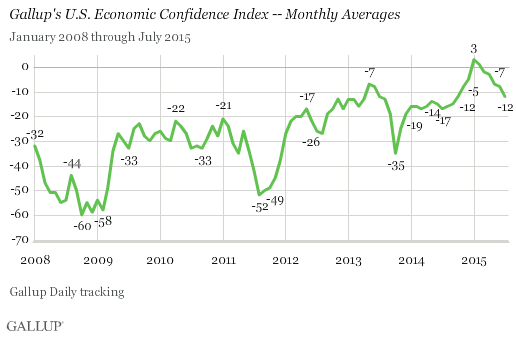
● Gallup’s U.S. Economic Confidence Index plunged to a nine-month low in July