
Introduction: The debate surrounding international trade and its impact on American jobs is ongoing. Understanding the actual effects requires examining empirical data and economic theories. Contrary to popular belief, international trade does not significantly harm job security in the U.S. economy.
How much is international trade costing Americans jobs? In truth, not a significant amount.
Protectionist arguments often claim that engaging in international trade, especially with lower-wage countries, jeopardizes American employment. This notion evokes a metaphor related to Ross Perot’s famous commentary about a “giant sucking sound,” suggesting that jobs will flee to these nations.
However, from a theoretical standpoint, this concern seems misplaced. Wages are primarily influenced by the marginal productivity of workers. Since workers are not identical across borders, companies do not merely chase lower labor costs. The reality is that workers in other countries earn less than their American counterparts not solely because they are willing to accept a lower standard of living, but also due to lower marginal productivity. This concept is akin to why professional sports teams, like the New England Patriots, choose young, skilled athletes over older individuals with no experience.
Mainstream trade theory suggests significant job offshoring—and subsequent wage declines—occurs only under specific conditions: when productivity and technology levels are identical, yet one country specializes in labor-intensive goods while the other focuses on capital-intensive products. In such scenarios, we would likely hear a “giant sucking sound” as jobs move to Canada rather than to low-wage markets like Mexico or China. Overall, while international trade can have an impact, it is expected to result in minimal effects on overall employment levels, as workers shift between different jobs.
Standard theory casts doubt on protectionist claims. Yet, protectionists offer a counter-theory that warrants empirical testing to determine which narrative aligns more closely with the data.
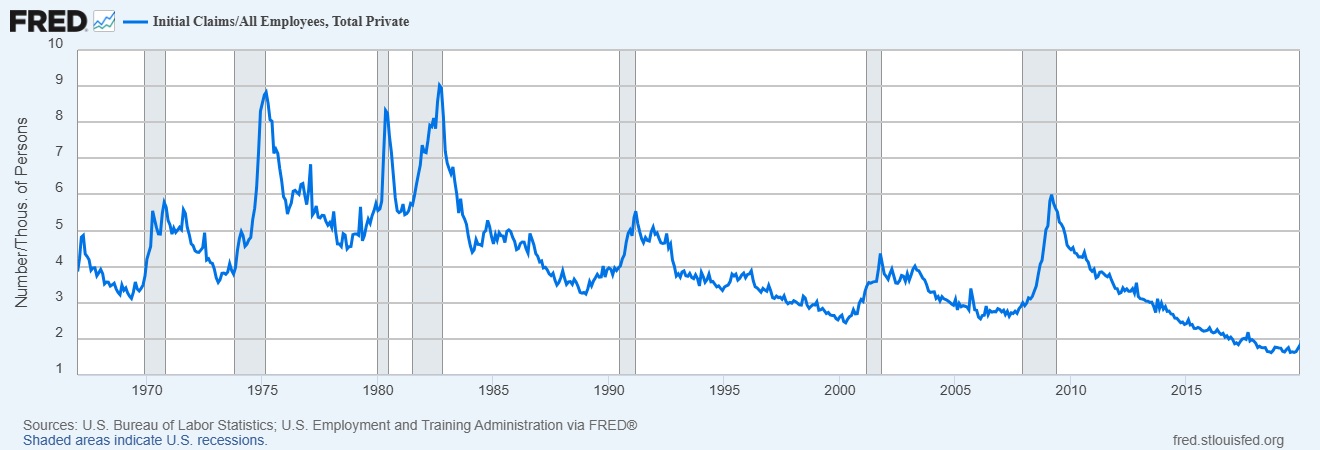
To begin, let’s examine job security. One measure of job security developed by University of Chicago economist Steven J. Davis analyzes the percentage of initial jobless claims relative to the total employed population. Jobless claims represent individuals who lost jobs involuntarily due to business downturns, not incompetence. A high percentage indicates greater insecurity, while a lower percentage indicates more security. The graph below illustrates this data from 1967–2019 (the graph excludes the COVID-19 period due to data anomalies).
Two key observations emerge:
First, since the 1980s (excluding recessions), the average jobless claims percentage has declined, suggesting that American workers are growing more secure in their roles. Even during the 2008 recession, the rate was still lower than it was during the recessions of the 1970s and 80s.
Secondly, significant international trade agreements—such as NAFTA (1994) and China’s accession to the WTO (2000)—did not disrupt overall job security levels. The long-term downward trend remains intact, save for recessions. If these trade deals had devastated the job market, we should have seen corresponding data. However, no such evidence exists; increases in jobless claims correspond primarily with recession periods rather than trade policies.
“But wait!” some protectionists may argue. “It wouldn’t show in the aggregate. Manufacturing jobs may vanish, but those workers find more secure positions in minimum-wage roles. That’s our main concern!” This is a fair point, yet similar patterns emerge in manufacturing as well.
The next graph displays data pertaining to job security in American manufacturing. It illustrates layoffs and discharges within the sector as a percentage of total manufacturing employment. The timeline is shorter because the Bureau of Labor Statistics began collecting this data only in 2000.
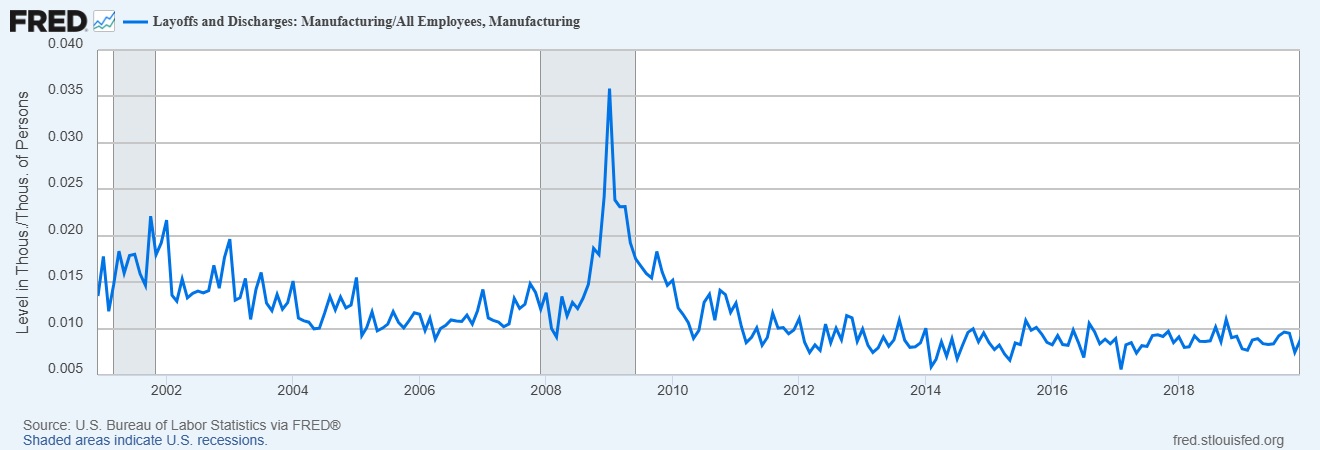
Again, setting recessions aside, manufacturing workers have become increasingly job-secure over the nearly two decades captured in this data. Surprisingly, this trend contradicts the protectionists’ stance: job security in manufacturing improved after the so-called “China Shock,” and showed little change following the implementation of NAFTA.
This argument may still not satisfy protectionist concerns. They might counter, “You’re generalizing. It’s the regional impacts that we should focus on. Look at the struggles in the Rust Belt! That’s evidence of international trade’s consequences!”
Regional effects are indeed a valid concern. However, studies indicate that the struggles in the Rust Belt do not necessarily reinforce the protectionist narrative. As documented by Douglas Irwin in his insightful 2017 book, Clashing Over Commerce, trade policy has long been shaped by regional dynamics. Yet, a 2023 paper by Simeon Alder, David Lagakos, and Lee Ohanian in the Journal of Political Economy reveals that labor market factors account for roughly half of employment declines in that region. In fact, foreign competition serves as a secondary influence, mainly evident after the bulk of the employment decline had already occurred. Essentially, they argue that labor market issues—not international trade—are the primary culprits behind the Rust Belt’s decline.
Addressing every expression of concern regarding international trade is an extensive endeavor. Adam Smith’s Wealth of Nations provides a foundational critique of the protectionist rhetoric that persists today. Additionally, Douglas Irwin’s Free Trade Under Fire offers further insights. The consensus is that international trade has not been the significant job-destroying force that many protectionists contend. Macro-economic factors appear to be the more significant influencers of the overall job landscape.
One notable argument from protectionists is that trade has led to the “deindustrialization” of the United States. This assertion merits careful examination. “Deindustrialization” has two interpretations: absolute deindustrialization and relative deindustrialization.
Absolute deindustrialization refers to an overall decline in manufacturing output. This is often the interpretation used by politicians and activists opposed to free trade. By this definition, trade has not led to deindustrialization; while U.S. manufacturing output has declined since its peak in 2007, it remains higher than it was before China joined the WTO or NAFTA. Although manufacturing appears stagnant, it is not in decline.
Relative deindustrialization occurs when a nation’s share of manufacturing output falls relative to other countries. Trade economist Richard Baldwin uses this frame (see, for example, this blog post). From this viewpoint, relative deindustrialization is happening due to trade, primarily because the U.S. economy is shifting toward a more service-oriented model. While we still produce significant manufacturing output—valuated at an annual rate of $7.5 trillion nominal dollars—we now focus on a larger proportion of knowledge-based industries such as tech, healthcare, finance, and education.
America’s strength lies in its comparative advantage in knowledge-driven sectors rather than traditional manufacturing. This trend suggests that our economy capitalizes on higher levels of education and specialized skills. Notably, even our manufacturing output increasingly involves complex goods that demand skilled labor. Thus, reshoring manufacturing may prove cost-prohibitive, largely due to existing skill mismatches in the workforce.
Conclusion: In sum, while international trade does have some impact on American jobs, the evidence suggests it is not as detrimental as protectionists claim. Instead, factors such as macroeconomics and labor market dynamics play a more decisive role in shaping employment patterns. As the U.S. economy evolves, it continues to capitalize on its strengths in knowledge-based industries, illustrating the adaptive nature of labor markets in response to global trade. Understanding these complexities is essential for informed discussions on trade policy going forward.

