In a recent discussion, Radhika Desai and Michael Hudson delve into the upcoming midterm elections, drawing insights on the political landscape. They suggest that the situation may not be as advantageous for the Democratic party as many believe. While aversion to Trump is prevalent, it doesn’t necessarily spark enthusiasm for the Democrats, who have often been criticized for inaction.
Originally published at Geopolitical Economy Hour
Radhika Desai:
Hello, and welcome back to another episode of Geopolitical Economy Hour, where we engage in socialist and anti-imperialist discussions that illuminate today’s rapidly evolving political economy. I’m Radhika Desai, and it’s great to have you here. Before we dive into today’s topic, I encourage you to like and share this video, subscribe to our YouTube channel, and if possible, support us through Patreon or Substack. Your contributions enable us to deliver high-quality, free content. Now, let’s proceed with our regular biweekly chat with Professor Michael Hudson.
Welcome, Michael.
Michael Hudson:
Good to be here.
Radhika Desai:
In our previous conversation, we analyzed how Trump has exacerbated economic disparities in the U.S., enriching the wealthy while impoverishing the majority. This trend may set the stage for a significant electoral setback for the Republican Party in the upcoming midterms. Trump is well aware of this, making every effort to avert a possible loss of congressional power. Such a defeat could lead to extensive investigations into his myriad personal corruption issues, with impeachment also a looming threat if the Democrats secure control.
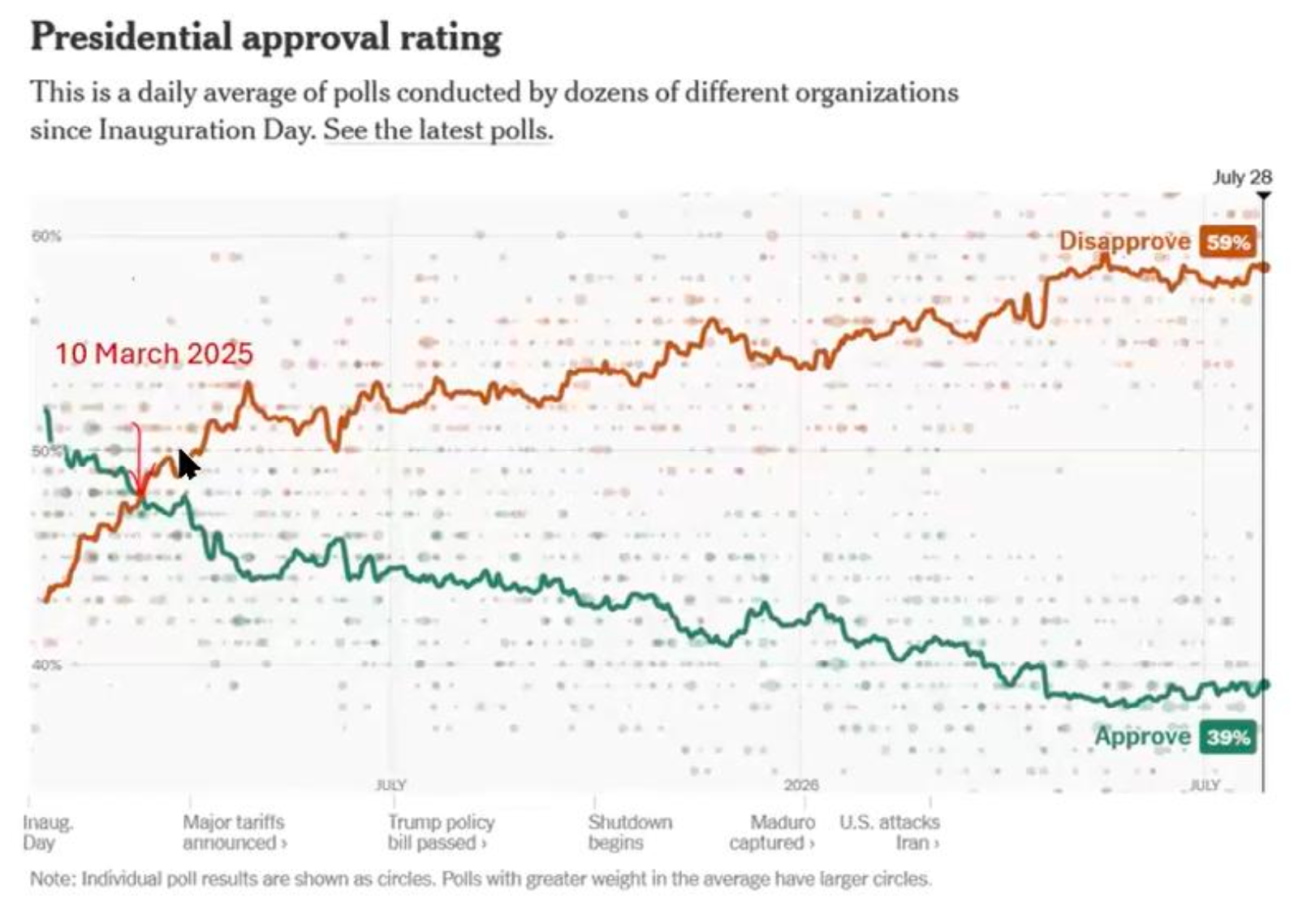
To illustrate this, let’s look at a chart from the New York Times depicting Trump’s approval ratings. As we can see, his disapproval ratings have steadily increased, while approval ratings have dropped since March 10, 2025. With these figures updated to July 28, it becomes evident that Trump faces serious challenges.
His promises to voters of a prosperous future have mostly served his affluent allies instead, resulting in economic turmoil—rising inflation, declining real wages, and growing debt. The consequences of these policies have made Trump acutely aware of his precarious position.

Michael, what are your observations regarding Trump’s various efforts to prevent what seems inevitable?
Michael Hudson:
Radhika, interestingly, the public’s disapproval of the Democrats is nearly as pronounced as that of Trump. As much as I dislike Trump, the Democrats have equally underperformed, damaging the U.S. economy and political landscape. This is why both you and I served as advisors to Jill Stein’s Green Party campaign. Trump’s initial victory was partly due to Jill’s campaign in key states, where voters opposed the pro-war stance of the Democrats. Many individuals who might have supported the Democratic party opted out altogether or voted for Jill Stein.
Radhika Desai:
Let me show you the chart you mentioned. It traces approval ratings back to 2017, primarily focusing on changes since the start of 2025. The trend indicates a decline in favorable ratings and a rise in unfavorable ones, mirroring Trump’s trajectory.

Michael Hudson:
What is the current approval level?
Radhika Desai:
As of June 8th, the disapproval stands at 56.6%, compared to 40.5% approval.
Michael Hudson:
This paints a bleak picture for the upcoming elections. I believe we may witness one of the lowest voter turnouts in history. Personally, I will not vote for the Democrats, even if I don’t support Trump. Historically, voting patterns have shown that significant factions in labor and political movements have chosen not to participate due to disillusionment with the policies of both major parties.
Interestingly, many Americans now express a preference for the term “socialism” over “capitalism,” even as prominent figures in the Democratic National Committee decry this sentiment and declare that socialism is detrimental. They assert that their funding, largely stemming from Wall Street, equips them to overcome grassroots candidates funded by small contributions.
This raises a crucial question: will voters trust socialist candidates who claim to be unbought? If campaign financing significantly ties candidates to affluent donors, then their ability to advocate genuinely for the needs of everyday people becomes compromised.
Consequently, I foresee a lack of an emphatic Democratic victory during the elections. Even if the Democrats retain control of the House, several of their members may align with Republicans on key votes, impeding the enactment of policies that truly benefit voters. This realization among the electorate may lead to historically low turnout, with Trump’s base losing faith in his ability to deliver meaningful change.
Radhika Desai:
Michael, your observations regarding the erosion of democracy in America deserve emphasis. The mechanisms for relaying public sentiment into governance have steadily deteriorated, particularly since the Democratic Party shifted towards prioritizing corporate interests under Bill Clinton. Both parties have manipulated working-class voters to neglect their actual needs. The upcoming elections are likely to reveal intense internal conflicts, especially as democratic socialists gain traction against establishment Democrats clinging to corporate funding.
This situation is exacerbated by the funding landscape, with the Republican Party significantly outpacing the Democrats financially, impacting their electoral viability. The Republicans have notably attracted vast financial resources from wealthy donors, while the Democrats struggle under a burdensome debt. Trump’s impending maneuvers could wield major consequences.

Michael Hudson:
Indeed, Trump has a history of leveraging crises for political gain, from tariffs justified by national emergencies to potential future claims of fraud surrounding the elections. His strategy may involve creating false narratives about voting irregularities, especially pertaining to mail-in ballots. Moving forward, I anticipate scenarios where he intensifies efforts to suppress voter participation through stricter ID requirements and intimidation at polling places, potentially disenfranchising many voters, particularly in urban areas.
Radhika Desai:
The implications are troubling; if electoral outcomes don’t favor Trump, he has the infrastructure and rhetoric to contest results aggressively. He’s also keen on undermining access to mail-in ballots, a significant voting method in many states, along with orchestrating gerrymandering that could diminish turnout among demographics less likely to support him.
Michael Hudson:
Our earlier discussions have indicated how the present political atmosphere may denote a collapsed political system similar to the economic failures you’ve highlighted. Unlike a more adaptable parliamentary system, the entrenched two-party setup in the U.S. restricts meaningful alternatives, leaving many voters disillusioned.
Michael Hudson:
Consider the current Democratic response to political unrest and dissent, especially in relation to censorship of critical voices. Trump’s campaign against perceived leftist threats serves to rally his base while marginalizing opposing viewpoints. Only time will reveal how these dynamics play out in the lead-up to November.
Michael Hudson:
This upcoming midterm is not merely a contest for power; it symbolizes a clash of interests between everyday voters and an entrenched elite. Systemic discontent arising from broken promises and corporate influence paves the way for genuine disillusionment among both parties’ bases. The electoral battle is a stage for the forces shaping the future of Democratic ideologies and the U.S. political landscape.
Michael Hudson:
In the wake of these revelations, we may be witnessing the onset of significant shifts within both the Democratic and Republican parties, especially with grassroots movements gaining traction. It’s imperative that emerging leaders grasp the reins to fight for a political identity beyond corporate affiliations.
Michael Hudson:
At this juncture, I implore you to consider the current state of American democracy and reflect on how political figures respond to their supporters. Voter experiences trump general campaign rhetoric every time.
Radhika Desai:
Exactly! Thank you for your insights, Michael. To our listeners, I hope you found our discussion enlightening. If you did, please like, share, subscribe, and lend your support if you can. Michael and I will reconvene in two weeks for another discourse, and I’ll be back with more updates before then. Until next time, goodbye.


