Ernest Shackleton famously called the frigid waters, shifting pack ice, and powerful currents of the Antarctic’s Weddell Sea the “worst portion of the worst sea in the world.” His assessment proved accurate in 1915 when the Endurance sank in these merciless conditions. Remarkably, these same harsh factors helped preserve the vessel for over a century.
Since its discovery in 2022, the Endurance has become more accessible, but this increasing reach is intertwined with the pressing issue of climate change.
The very climate changes that are making Shackleton’s ship easier to reach are also fueling competition for shipping routes, underwater minerals, and fossil fuels. Many are starting to view global warming not solely as an impending danger, but as a potential opportunity.
The Heritage Foundation, a notable conservative think tank behind Project 2025, even claimed that the National Oceanic and Atmospheric Administration’s (NOAA) efforts were “harmful to US prosperity.”
Thus, we find ourselves navigating a complex landscape, with Shackleton’s Endurance serving as a guiding metaphor. As geopolitical tensions escalate over resource hotspots, shipping routes, and transit corridors, it seems evident that Mother Nature is the only true victor in this ongoing struggle.
A Vicious Spiral
Let us first turn our attention away from Shackleton’s resting place to the intensifying competition in the Arctic, where warming temperatures are threatening to accelerate the melting of the ice.
The traditional sea route from eastern China to England—normally taking 40 days through the Suez Canal or over 50 days around the Cape of Good Hope—can be halved through a navigable Arctic route.
As reported by The Economist, “the Arctic will become more connected to the global economy,” framing it as a beneficial development. However, the implications for our climate are far from positive.
Snow reflects about 85% of sunlight, while open water reflects only 7%. Consequently, as the Arctic ice melts, it accelerates the decline of the remaining ice. A recent study indicates that since 1979, the Arctic has warmed four times faster than any other region on the planet. It is projected that all ice-going vessels will find it difficult to navigate in spring by 2065, and by 2100, the route will be navigable year-round. Exciting, right?
The optimistic narratives surrounding Arctic shipping routes often overlook the devastating repercussions for our climate.
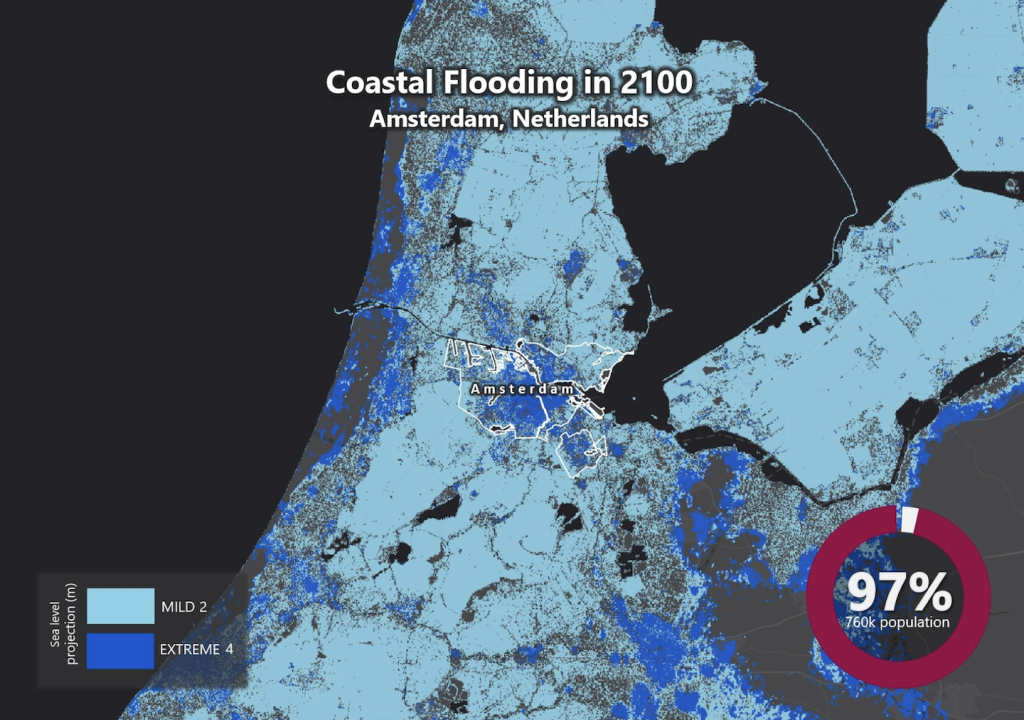
Here’s a glimpse into what certain cities might resemble should these routes become frequently used:


If we truly wish to integrate the Arctic into the global economy, we must also consider a future devoid of ice.


Many of us likely gaze at these maps with dismay, while proponents of rapid shipping through the Arctic, including supporters of Project 2025, are all too eager to see dollar signs.
But remember, the repercussions go beyond rising sea levels; they encompass the breakdown of vital ocean currents, extreme weather, global food shortages, and a seemingly inevitable cycle of disaster.
The Arctic’s integration into the global economy is further accelerating its disintegration. According to France24:
It’s a vicious cycle. As sea ice diminishes and opens new routes for maritime traffic, the environmental damage from vessels burning fossil fuels exacerbates global warming, leading to even more ice melt.
A salient example is black carbon, a soot-like substance produced by incomplete combustion in gas and diesel engines. Not only does it contaminate the air, but it also absorbs heat, thereby contributing to climate change.
When black carbon settles on Arctic ice, it reduces its ability to reflect sunlight.
“The dark particles on the white ice cause it to absorb more sunlight, resulting in further melting,” remarked Sammie Buzzard, a polar scientist at Northumbria University.
***
Similar geoeconomic struggles are occurring over transit routes that may soon be under threat from climate change.
The Caspian Sea has become a focal point for the Middle Corridor, heralded by the geopolitical aspirations of the Trump Route for International Peace and Prosperity. As contests ensue over Central Asian minerals and energy flows from the Caspian Sea, tensions are escalating, increasing the potential for conflict.
Regrettably, the Caspian Sea is on a worrisome trajectory. From SciTech Daily:
Water levels in the Caspian Sea, the world’s largest landlocked body of water, are steadily declining as rising temperatures lead to evaporation outpacing inflow. Even if global warming is limited to 2°C, scientists estimate the sea could drop by 5 to 10 meters. With higher temperature rises, the decline could reach up to 21 meters by the century’s end.
In northern Caspian, research indicates that some ports and settlements may soon find themselves stranded kilometers away from new shorelines. The exposed dry seabed would likely release harmful dust, contaminating air and posing severe health risks, reminiscent of the aftermath of the Aral Sea’s drying.
The implications for regional industry are equally troubling, as critical ports in bordering countries face significant operational challenges. Baku (Azerbaijan), Anzali (Iran), and Aktau (Kazakhstan) may see their distances to shore increase by over a kilometer, while Turkmenbashi (Turkmenistan) and Lagan (Russia) could experience expansions of 16 km and 115 km, respectively…
Some Caspian cities already rely on desalination for freshwater, and declining water levels are impacting operations in Aktau, Kazakhstan.
The loss of water from the Caspian may also shift the regional climate, leading to diminished rainfall and drier conditions across Central Asia, indirectly affecting agriculture.
In the eastern regions, where geopolitical maneuvers echo the old “Great Game,” water scarcity is increasingly evident. A recent analysis indicates concerning trends. From IOP Science:
The year 2025, declared by the United Nations as the ‘International Year of Glaciers’ Preservation,’ ironically marked the worst mass-balance year for glaciers in Central Asia. Observations show significant ice loss across the region, although not all individual glaciers experienced extreme declines. Modeling indicates that 64% of glaciers larger than 1 km2 faced their most severe annual losses during this period. In just one year, glaciers in Central Asia shed around 30 ± 6 km3 of ice, equating to approximately 2% of their total mass—an alarming trend.
This loss was most pronounced in the western Tien Shan and western Pamir regions (−2% to −4%), while eastern counterparts experienced milder declines (−1% to −1.5%). Climate data attributes these extreme losses to persistently elevated spring and summer temperatures, an unusually early melt season, and reduced late spring and summer snowfall. Together, these conditions have compounded feedback loops, resulting in earlier snow loss and exposing low-albedo ice surfaces.
Such extreme losses underscore a troubling milestone for Central Asian glaciers and may set alarming precedents for the future.
To provide further context, approximately 81% of Central Asia’s population depends on water sourced from the Tien Shan and Pamir ranges. As supplies dwindle, the likelihood of internal conflict and destabilization rises, threatening food systems, energy markets, and regional trade.
The Panama Canal
This crucial passage stands at the forefront of the ongoing tug-of-war between the US and China for dominance over global shipping infrastructure. Under pressure from Washington, Panama recently regained control of the Pacific port of Balboa and the Atlantic port of Cristobal after a court annulled a deal that had allowed a subsidiary of Hong Kong’s CK Hutchison Holdings to operate both ports since 1997. In response, Beijing detained Panama-flagged vessels, and Cosco, a major Chinese shipping enterprise, halted operations at the canal’s busiest ports.
This conflict has intensified following a consortium led by Blackrock’s attempt—with support from Washington—to acquire multiple ports from CK Hutchison. Beijing opposed the deal, concerned that it could allow Washington to manipulate shipping operations or even militarize the ports.

Whoever controls the Panama ports might not have much to celebrate.
The Panama Canal Authority is already reducing maximum ship drafts in anticipation of the impending El Niño weather pattern.
Under “normal” conditions, the canal supports 34 to 38 daily transits; however, it had to reduce this number by approximately 30% in 2023-24 due to the previous El Niño, which resulted in the driest recorded rainfall in October 2023.
The forthcoming El Niño is anticipated to be even more severe.
***
From my perspective, the blame for this reckless path toward self-destruction falls largely on Washington and the transnational elites it serves. Other nations have shown a willingness to cooperate and compromise; however, if China emerges as a new hegemon, one wonders whether it will prioritize effective climate action or continue the relentless pursuit of growth.
Many apply the Thucydides Trap to the US-China dynamic, attempting to explain the US elite’s determination to engage in these costly contests. Yet, perhaps this term is being misapplied to the wrong battle.
In 1980, when Herman Wouk popularized the Thucydides Trap, he was reflecting on the Cold War, asking:
“How do we break out of this Thucydidean trap, which now threatens to strangle, if not to destroy, our world?”
This notion resonates deeply, equally applicable to the unfolding climate crisis alongside the threat of nuclear warfare. We find ourselves cursed to confront both predicaments under a system that views both as acceptable risks—or even desired outcomes—in the unyielding quest to extract every last resource from our planet and its inhabitants.


