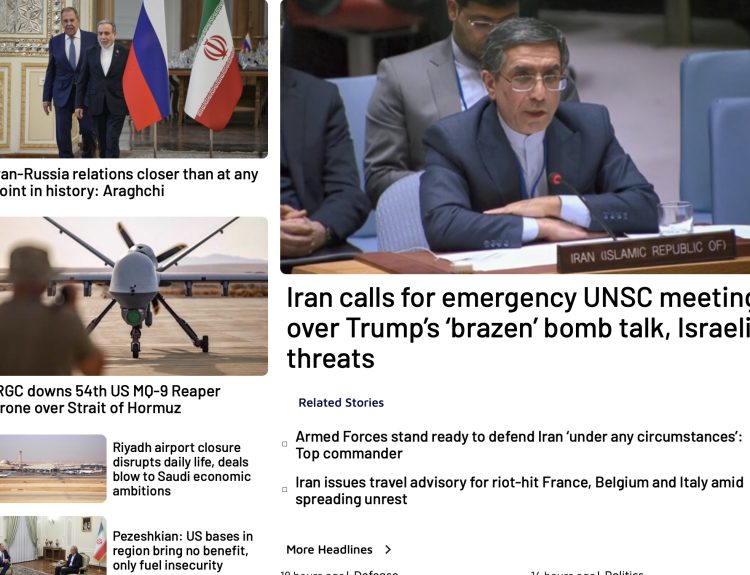
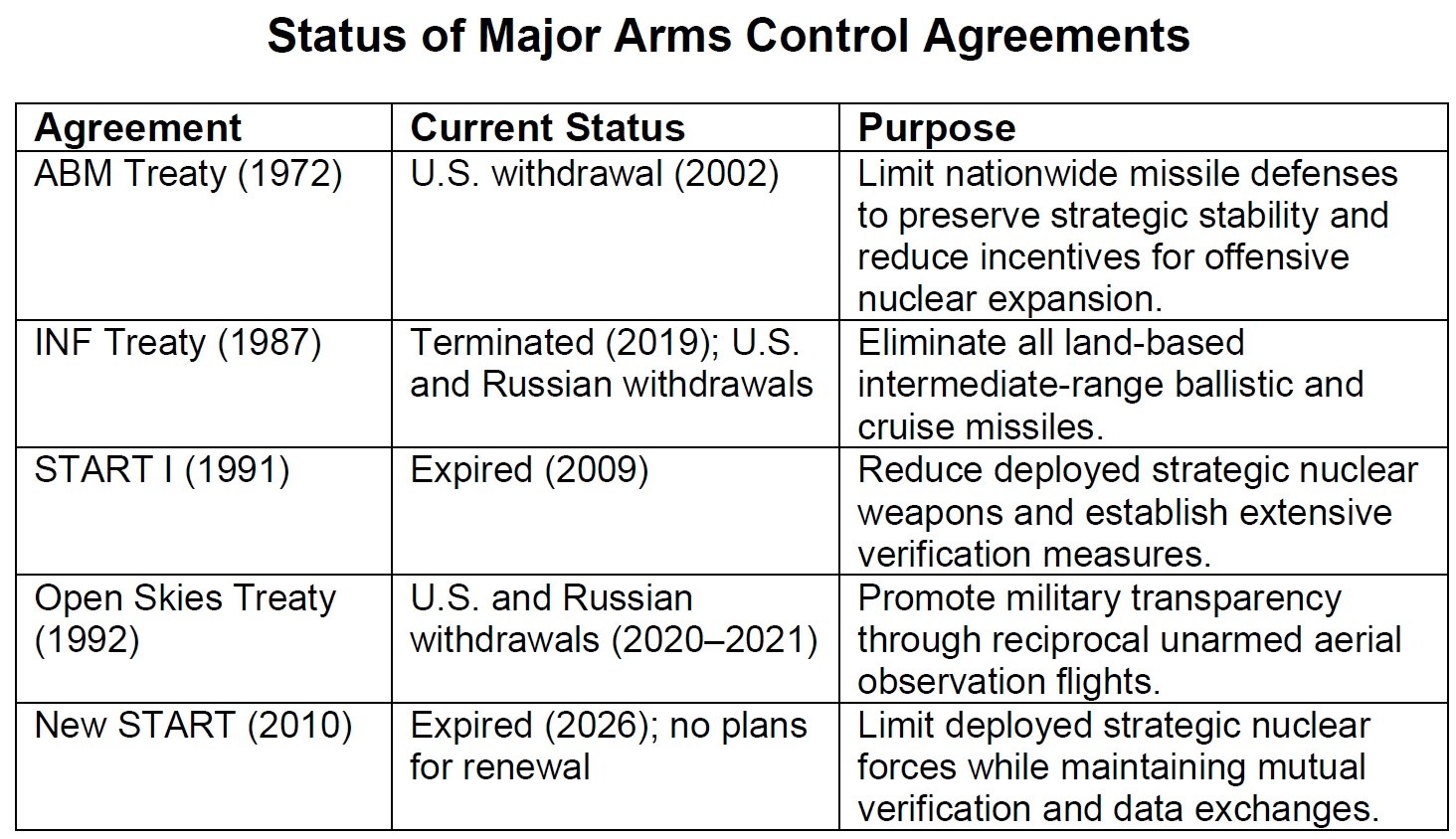
For over fifty years, arms control has served as a vital safeguard against the threat of catastrophic warfare. However, this framework is currently showing clear signs of deterioration. Significant treaties have either lapsed or been discarded, and disputes over verification processes are becoming increasingly heated. Meanwhile, evolving military technologies continuously surpass the pace of existing agreements, extending strategic rivalries into new realms such as cyber warfare, autonomous weaponry, and outer space.
While it is often said that international politics has lost its cooperative spirit, this reasoning presents an incomplete picture. Historically, arms control has faced institutional decline under a variety of political conditions. The root issue lies not merely in shifting governments or deteriorating diplomatic relations, but in the underlying dynamics of the global security landscape itself.
Military power tends to reinforce itself through a self-perpetuating cycle. Competition breeds fear, which propels armament, leading to strategic ambiguity that encourages secrecy. This secrecy, in turn, erodes the trust essential for successful arms control. While treaties may disrupt this cycle temporarily, they rarely address the fundamental forces working against them. As technological change accelerates, resisting these pressures becomes increasingly challenging.
Conventional arms control has depended heavily on what can be termed imputed trust—trust arising from diplomatic engagements, political commitments, inspections, and perceptions of national intentions. Though these mechanisms have yielded significant achievements, they remain susceptible to crises, technological shocks, and strategic exploitation of uncertainty and fear.
This analysis proposes a shift towards a more effective paradigm. The current convergence of persistent satellite surveillance, distributed sensing, artificial intelligence, global communication networks, and advanced evidence integration enables a shift from imputed trust to verifiable trust. This new form of trust is based on independently observable and continuously updated evidence, reducing reliance on mere diplomatic assumptions.
The future of arms control may hinge less on negotiating more robust treaties and more on constructing robust trust infrastructures. Peace Power posits that trust can be deliberately engineered, creating systems intended not just to regulate armaments but to continuously produce, verify, and safeguard the credible knowledge necessary for enduring arms control.
Discussions surrounding military competition often zero in on distinct events: a nation’s exit from a treaty, the introduction of a new weapon, or a diplomatic standoff. While critical, these instances represent symptoms rather than root causes. The more profound truth is that military power operates as an interlinked system of feedback loops, continuously amplifying itself.
Military competition naturally incites uncertainty regarding a rival’s capabilities and objectives. In response, nations prepare for worst-case scenarios, which often materialize as new weapon programs and larger military budgets, alongside increased operational secrecy. Each of these actions is interpreted by rival states as escalating threats, inciting reciprocal efforts, culminating in a positive feedback loop where fear amplifies military readiness.
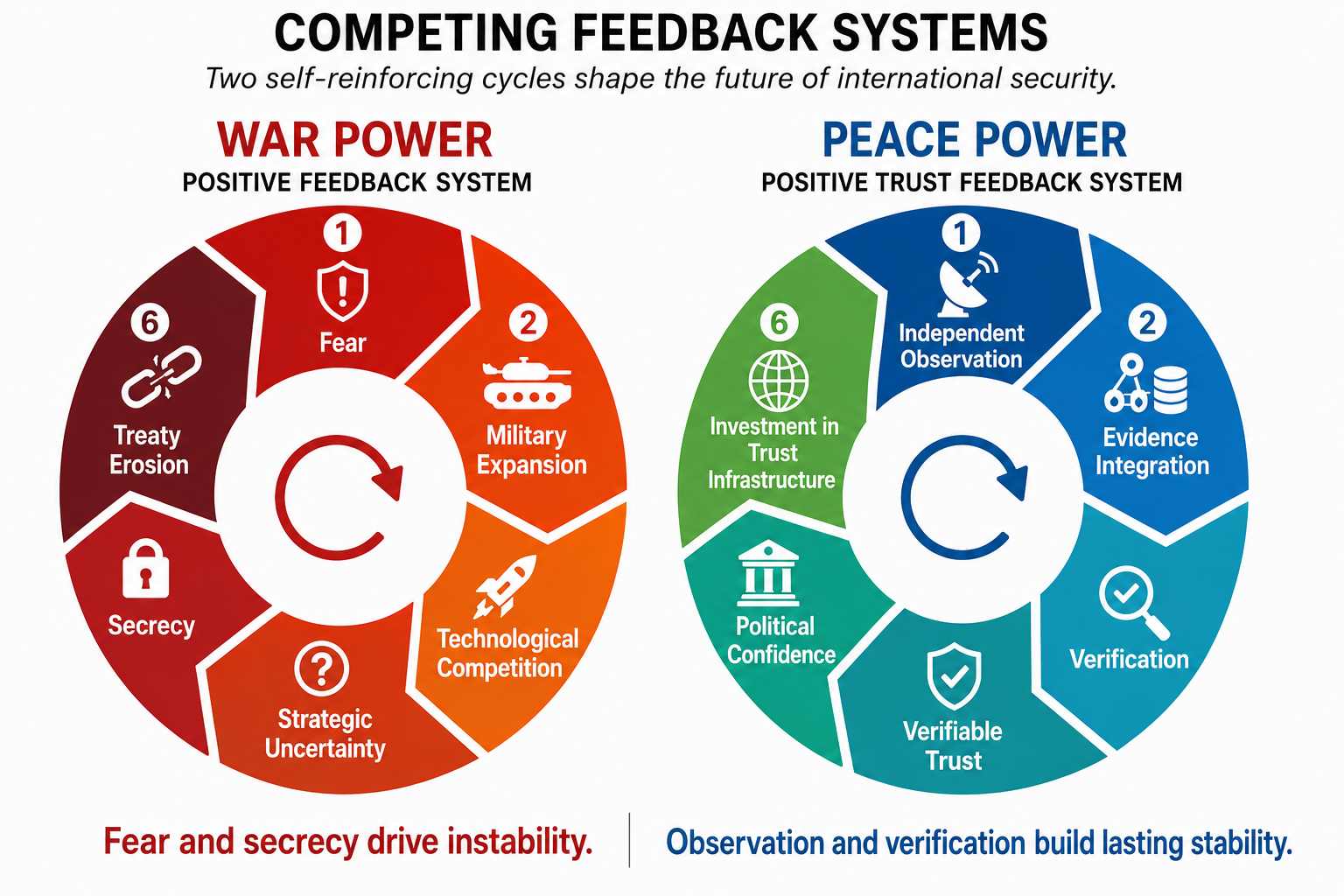
This dynamic extends beyond mere arms procurement. Strategic secrecy complicates independent verification. When verification diminishes, uncertainty rises, promoting political support for intelligence gathering, military modernization, and enhanced deterrence. Rapid technological advancements introduce novel weapon classes before existing treaties can adapt, further undermining established arms control norms. Meanwhile, defense industries and national security institutions cultivate incentives favoring ongoing military competition over institutional restraint.
These reinforcing dynamics do not necessitate coordinated central efforts. No state aims for instability as an end goal; rather, instability arises from the cumulative effects of rational individual choices spurred by uncertainty. Nations pursuing greater security often adopt measures that inadvertently undermine the security of others, leading to a cycle of defensiveness that progressively destabilizes the system as a whole.
Although traditional arms control has achieved notable success by momentarily interrupting these cycles, such interruptions do not equal meaningful transformation. Because the fundamental feedback mechanisms remain, treaties must perpetually fend off pressures that are persistent, adaptive, and driven by technological innovation. Over time, these forces exploit verification gaps, generate new ambiguities, and chip away at the trust essential for negotiated agreements.
Viewing military power as a dynamic system alters the nature of the challenge. The primary objective shifts away from simply brokering better treaties to creating institutions capable of generating sufficient verifiable trust to offset the ongoing forces that propel military competition. Without these institutional counterweights, arms control will likely remain in an asymmetrical struggle against a system that inherently reproduces the conditions that treaties aim to restrain.
The Offense–Defense Arms Race Spiral
The history of modern arms control illustrates that military power rarely remains unchanged; it constantly adapts to regain strategic advantages when new constraints or defensive capabilities emerge. This leads to a persistent spiraling cycle of offense and defense, wherein every security-enhancing initiative incites the next phase of military innovation.
During the Cold War, strategic stability largely hinged on mutual vulnerability. The Anti-Ballistic Missile (ABM) Treaty recognized that unconstrained missile defenses could imperil deterrence by convincing one side it could effectively neutralize the other’s retaliatory capabilities. Consequently, limiting national missile defenses became a strategy for curtailing offensive arms competition.
This precarious balance proved to be short-lived. Technological advancements in missile defense reignited interests in intercepting incoming ballistic missiles, while offensive systems evolved to circumvent those defenses with multiple independently targetable warheads, penetration aids, and increasingly sophisticated delivery mechanisms. Recent developments, such as maneuverable hypersonic weapons, further challenge existing missile defense systems.
Each technological leap merely shifts the competitive landscape rather than resolving it. As hypersonic weapons challenge ground-based missile defenses, focus has shifted to mid-course interception strategies, necessitating persistent orbital sensing and proposed space-based defense systems. Such advancements create additional incentives for developing counter-space capabilities to neutralize orbital assets, effectively expanding the arms race into yet another arena.
This pattern is remarkably consistent. Innovations designed for defense evoke incentives for offensive adaptations, which provoke new defensive measures, prompting further offensive innovations. Arms control agreements often slow certain stages of this cycle, yet they rarely alter its foundational dynamics.
This historical trajectory reveals a broader principle: military power not only generates new weapons but also perpetually extends the competition into every domain offering strategic advantages. Land, sea, air, cyberspace, and, more recently, outer space have all become battlegrounds for the offense-defense cycle. The strategic frontier continually advances as each technological solution creates new opportunities for competitive adaptation.
For Peace Power, this understanding carries significant implications. If military competition naturally spills into every domain relevant to technology, then institutions aiming to maintain peace must adapt equally swiftly. Future arms control cannot solely depend on restricting specific weapons systems. It must also safeguard the information systems that increasingly underpin verification, transparency, and global trust. Failing to do so will allow the same dynamics that have historically undermined previous treaties to migrate into emerging technological domains, perpetuating the cycle of competition.
Conflict in Orbital Space
Throughout the Space Age, satellites primarily served as military support systems, enhancing communications, navigation, reconnaissance, and early warning without assuming a primary role in military operations. However, this dynamic is shifting. Orbital systems are now becoming integral to both military functions and international verification frameworks.
This evolution presents two fundamentally distinct strategic pathways. The first follows the established logic of military competition. As space-based systems grow more valuable, they become attractive military targets. Continuous orbital sensing motivates the development of counter-space weaponry. Concepts surrounding missile defense spur interest in intercepting potential threats from orbit. Satellite constellations invite electronic sabotage, cyber intrusion, blinding, jamming, and kinetic strikes, escalating arms races into orbit.
The second pathway diverges sharply from this trajectory. Instead of regarding orbital systems purely as military assets, Peace Power positions them as global trust infrastructure. Satellites capable of independently monitoring missile deployments, launches, troop movements, environmental conditions, and treaty compliance generate information that no single nation can monopolize. When organized effectively, these systems can continuously produce independently verifiable evidence that diminishes uncertainty and bolsters diplomatic decision-making.
This distinction marks a significant shift in the understanding of outer space. The strategic worth of orbital systems is no longer confined to enhancing military might. Their greater historical importance may lie in enabling institutions capable of generating trusted global knowledge. In this sense, orbital observation becomes as crucial to international governance as to national defense.
Current international law reflects a different era. The Outer Space Treaty established vital principles, such as prohibiting weapons of mass destruction from orbit and promoting the peaceful use of celestial bodies. Yet, it fails to explicitly shield satellites or other orbital systems from attacks, nor does it categorize certain space-based assets as components of shared international verification systems. As the strategic relevance of orbital information continues to soar, this oversight will become increasingly consequential.
Peace Power thus advocates for a broader objective than merely preventing the militarization of space. It aims to establish and protect orbital systems primarily designed to generate trusted knowledge. Verification satellites, launch-monitoring networks, environmental sensing platforms, and other transparency-enhancing assets should be regarded not solely as national belongings, but as integral parts of an emerging international trust framework. Safeguarding these systems serves both the interests of individual nations and the stability of the international order.
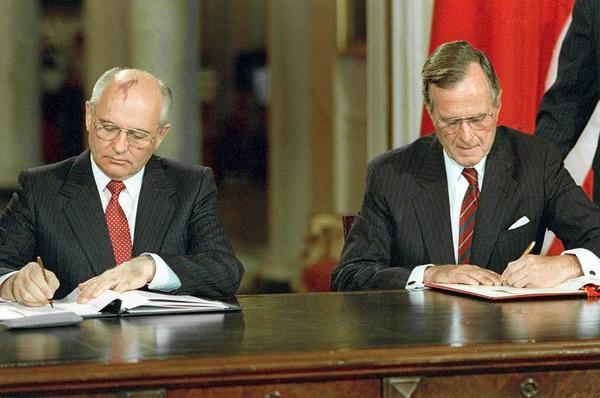
President George H. W. Bush and Soviet President Mikhail Gorbachev sign the START I Treaty in Moscow on July 31, 1991. Its successor, New START, has also expired without a subsequent agreement.
The Missing Element: Verifiable Trust
The strategic question facing the twenty-first century transcends the simple issue of whether nations will compete in space; that competition is already in motion. The more pressing concern is whether humanity will establish institutions that protect space as the world’s primary platform for independent observation and verifiable trust. The outcome of this question may determine whether outer space becomes yet another battlefield or serves as the informational foundation for a more enduring system of international peace.
The frequent failures of arms control indicate that the issue at hand is not merely a lack of trust, but rather the type of trust that underpins international institutions. Traditional diplomacy heavily relies on imputed trust, where nations assess one another’s intentions through commitments, relationships, intelligence evaluations, inspections, and political leadership judgments. While these forms of trust have historically led to significant agreements, they remain vulnerable to strategic deception, government changes, technological surprises, and crises of uncertainty.
Peace Power starts from a different perspective. Instead of urging nations to become more trusting, it evaluates how that trust can be anchored in independently verifiable evidence. This nuance transforms the core of the problem. Trust shifts from depending mainly on confidence in a government’s intentions to being based on the quality, transparency, and independence of available information.
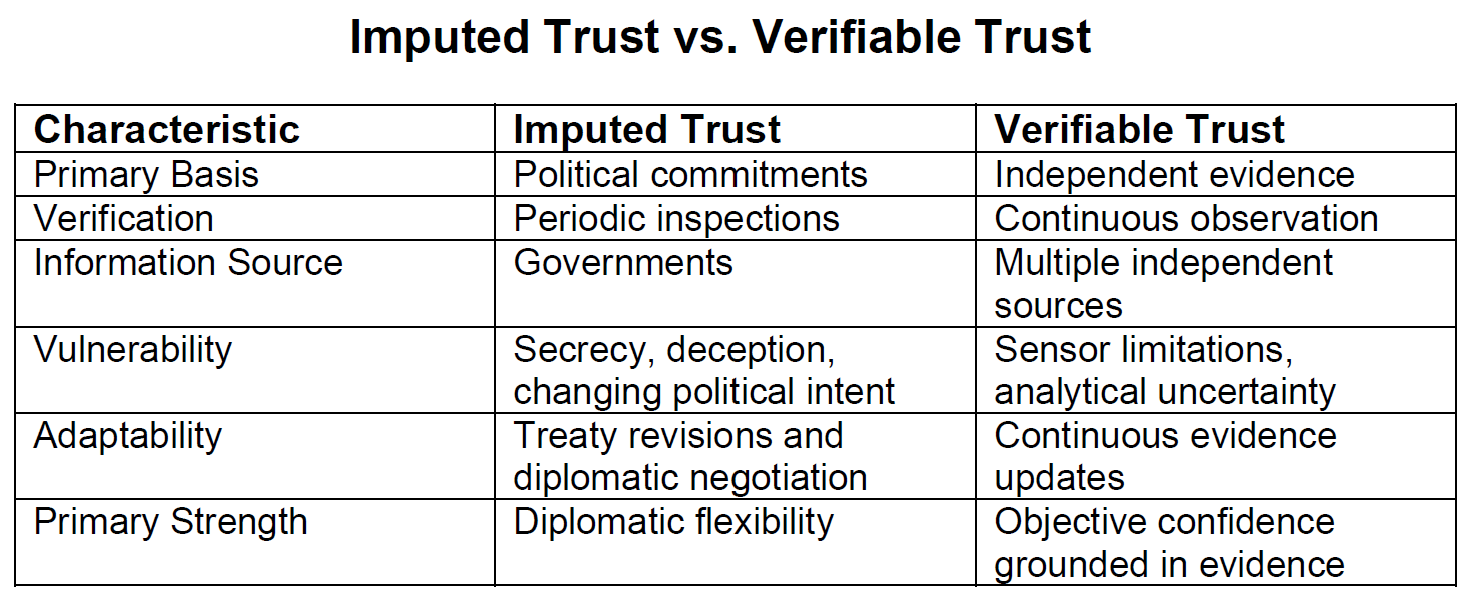
Imputed trust and verifiable trust do not stand in opposition; they are complementary elements present in every meaningful diplomatic decision. Advanced verification systems will never eliminate uncertainty or fully replace political judgment. Diplomacy will consistently involve negotiation, compromise, and assessments of intent. Consequently, the goal is not to eradicate imputed trust, but to lessen dependence on it whenever technological advancements enable verifiable trust.
This shift represents a fundamental historical transition. For centuries, international institutions had little choice but to rely on imputed trust due to technological limitations. Today, advancements in global observation, distributed sensing, real-time communications, and artificial intelligence have altered this landscape. A significantly larger portion of the information needed for international decision-making can now be independently observed, cross-validated, and continuously updated.
Civilization has progressively substituted authority-based judgments with ones grounded in objective measures. Modern engineering, medicine, and science increasingly rely on instrumentation and reproducible observation rather than intuition or reputation. Peace Power seeks to apply this same evolution within international diplomacy.
The goal of trust engineering is both straightforward and ambitious: to systematically tilt the balance from imputed trust towards verifiable trust. As independently verifiable evidence becomes more plentiful, transparent, and consistently available, diplomatic decisions will rely less on mere assumptions regarding national intentions. Trust itself will become more robust, resting on an ever-expanding foundation of observable reality instead of solely on political assurances.
This approach does not presume that nations will become more cooperative, altruistic, or less competitive. It merely acknowledges that technological progress has laid the groundwork for a different information architecture. By increasing the proportion of trust that can be independently verified, future institutions may become significantly more resistant to the cycles of fear, secrecy, and technological competition that have historically undermined prior arms control efforts. Peace Power aspires to qualitatively transform trust by replacing imputed trust with verifiable trust whenever technological opportunities permit.
Why Peace Power Is Becoming Practical
The shortcomings of previous arms control efforts should not solely be viewed as diplomatic failures; they also reflect the technological limitations of their time. Many twentieth-century treaties were negotiated during an era when independent verification was either costly or sporadic, often accessible only to a few major powers. The scarcity of reliable information necessitated a heavy reliance on imputed trust.
Fortunately, this historical limitation is beginning to fade. In recent decades, advancements in sensing, communication, computation, and artificial intelligence have fundamentally shifted the economics of verification. Persistent commercial satellite networks can now monitor military activities with increasing resolution. Distributed sensor systems can oversee launches, environmental shifts, and other treaty-relevant developments over vast regions. Global communication capabilities allow for near real-time sharing of observations, while artificial intelligence can analyze large volumes of diverse evidence, identify anomalies, and continuously update insights as new information emerges.
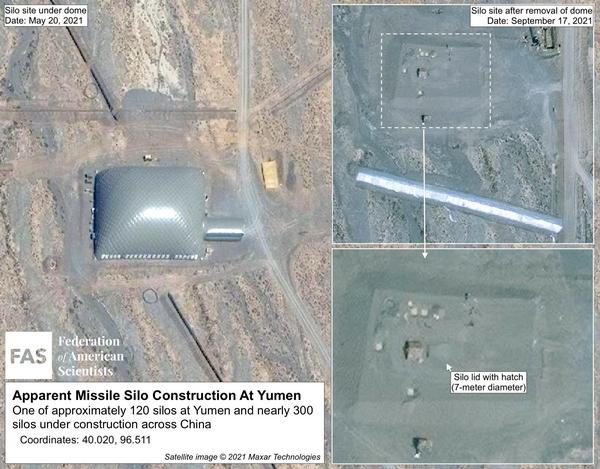
Commercial satellite imagery revealed the rapid construction of China’s Yumen missile silo field before any official confirmation.
Independent satellite and sensor-based observations should not be viewed as complete substitutes for established verification methods. Instead, they should be incorporated into a comprehensive verification framework that integrates space-based and terrestrial sensing systems, ground inspections, environmental monitoring, open-source intelligence, commercial data, and other independent evidence streams. Peace Power aims to enhance arms control not by overwriting established verification processes, but by weaving them into a continuously functioning trust framework capable of generating verifiable international trust.
Such a shift represents a significant enhancement in institutional abilities. Past arms control frameworks were designed for an age marked by information scarcity. Trust engineering for arms control is becoming viable due to the current era’s information abundance. The ongoing challenge lies in harnessing these new informational resources to create trusted knowledge that can inform critical international decisions.
Raw information, however, does not create trust. Satellites don’t resolve diplomatic disputes, and artificial intelligence cannot replace political judgment. Trust emerges only when evidence is collected independently, analyzed transparently, subject to adversarial evaluation, and integrated into institutions with procedures deemed credible. Consequently, the challenge lies not just in developing better sensors or more efficient algorithms, but in designing institutions that convert plentiful information into verifiable trust.
This distinction is vital. Peace Power does not represent a technological endeavor in disguise as diplomacy; it is an institutional endeavor made feasible by technology. The modern technical landscape provides the building blocks, but the ultimate aim is to construct trustworthy international architectures resilient enough to withstand the ongoing pressures that have traditionally undermined arms control.
The Economics of Peace Power
At this juncture, critics may raise pragmatic concerns. Even if Peace Power is an appealing concept, who will finance the burgeoning global trust architecture it necessitates? This query is reasonable but founded on a flawed premise. The innovation proposed does not entail an immense new international initiative or the construction of entirely new technical frameworks; much of the necessary infrastructure already exists or is being established for independent commercial, scientific, and national security objectives.
Commercial Earth-observation satellites now monitor the planet with resolutions that were previously accessible only to intelligence agencies. Weather satellites continuously track the global environment. Communication networks relay vast amounts of information in real time. Artificial intelligence increasingly merges diverse data, identifies anomalies, and assesses confidence levels. Nations currently employ sophisticated systems for detecting launches, navigation, and reconnaissance. Thus, a significant portion of the technological infrastructure for Peace Power is developing regardless of whether it coalesces into a formal trust framework.
The institutions driven by military power illustrate the substantial financial resources already allocated for managing uncertainty. Each major military power dedicates considerable resources to intelligence collection, satellite surveillance, signals interception, strategic analysis, and early warning systems. These expenditures are widely accepted because the risks of uncertainty are recognized as strategic liabilities. Peace Power begins with the same understanding but arrives at a different conclusion. Rather than chiefly producing intelligence for national advantage, it seeks to convert segments of this growing information ecosystem into mechanisms generating internationally verifiable trust.
The relevant comparison must focus not on the costs associated with implementing Peace Power versus the cost of inaction. It should be a comparison between the expenses required for trust infrastructure and the significantly higher costs of persistent military competition. Modern fighter jets, missile defense initiatives, submarines, and strategic weapons systems each necessitate investments in the billions of dollars. Regional conflicts typically result in costs reaching hundreds of billions while inflicting substantial human suffering. Within this context, investments in international verification frameworks emerge as a remarkably prudent expense for risk reduction.
Historical precedents for such investments abound. Societies have consistently determined that certain informational systems are too valuable to remain fragmented along national lines. International weather networks, global navigation schemes, aviation safety protocols, scientific observatories, and public health monitoring all generate information that benefits the global community. Their value lies not merely in data collection but in crafting trusted knowledge that promotes coordinated action. Peace Power extends this principle into international security matters.
The real question, therefore, is not whether humanity can afford to cultivate institutions that foster verifiable trust but whether humanity can sustain an international framework that consistently allocates vastly greater resources to address the fallout of distrust while inviting the risk of immeasurable catastrophe.
Rebuilding international arms control requires more than just stronger treaties; it necessitates more resilient institutions—those deliberately designed to generate, protect, and renew verifiable trust despite the relentless forces that seek to undermine it. The twentieth century revealed the necessity of limiting armaments. The twenty-first may demand that humanity undertake a more fundamental task: engineering the trust required to strengthen those constraints and ensure their longevity. This process of trust engineering might well emerge as the defining institutional innovation through which the twenty-first century learns not only to deter war but also to govern peace effectively.