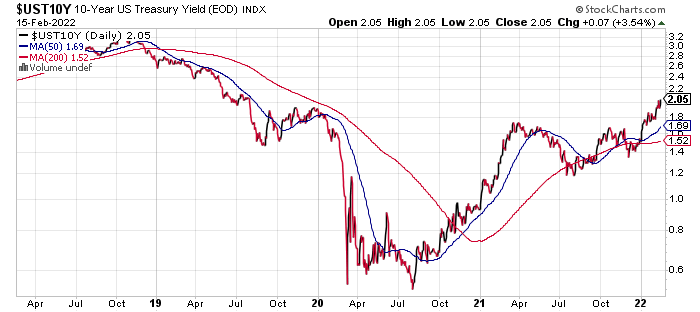
In recent weeks, the US 10-year Treasury yield has made a definitive upward movement after months of hovering below a critical threshold. This breakout suggests a change in momentum that had previously seemed elusive throughout the past year.
* The US government claims that Russia’s assertions of troop withdrawal from the Ukrainian border are “false.”
* Allegations of cease-fire violations emerge from both Ukraine and pro-Russian separatists.
* The Federal Reserve’s minutes suggest that the central bank is poised to proceed with rate hikes.
* US homebuilder sentiment decreased once again in February but continues to remain at a high level.
* A substantial rise in US import prices is adding to inflationary pressures seen in January.
* US industrial production surged in January, surpassing initial expectations.
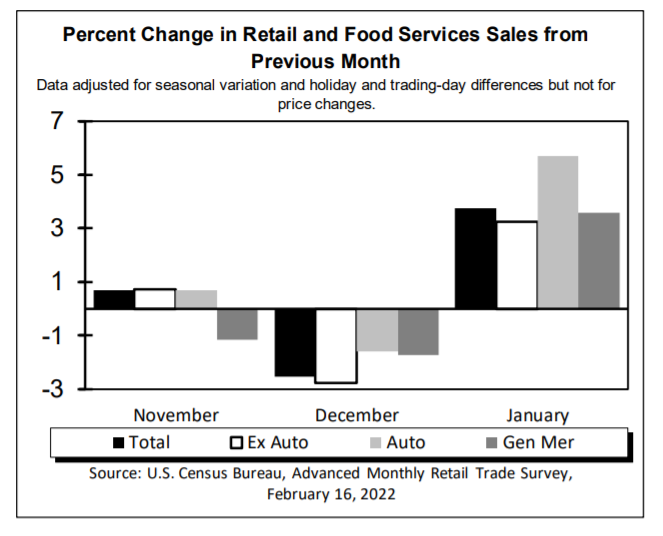
* US retail sales jumped in January, bouncing back vigorously from a lackluster December:
As interest rates have been on an upward trajectory in recent months, traditional segments of the US bond market have faced challenges this year. Except for one category, all major segments of fixed income are reporting losses in 2022, as reflected by a range of ETFs closing on January 15.
* Russia claims to be withdrawing some troops from the Ukrainian border, yet…
* NATO responds by asserting that Russia is still enhancing its military presence near Ukraine.
* Investors are anticipating the swiftest pace of rate hikes since 2010 across developed markets.
* China’s inflation decreased in January, paving the way for potential policy easing.
* UK inflation remained at a peak not seen in 30 years in January.
* The Russia-Ukraine crisis could potentially heighten US inflation further.
* Oil prices are expected to rise due to increasing demand and supply limitations.
* Soaring lumber prices increase the expense of constructing a new home by nearly $19,000.
* The US 10-year Treasury yield has risen to 2.05%, marking the highest point in 2.5 years:
Preliminary estimates suggest that economic activity is set to experience a significant slowdown in growth during the first quarter of this year, as reflected in gross domestic product (GDP) forecasts.
* The Kremlin emphasizes a softer stance regarding the Ukraine crisis.
* The German Chancellor is in Moscow today to engage in talks with Putin in hopes of averting war.
* Japan’s economy showed a rebound in Q4.
* Fed’s Bullard asserts that the central bank needs to expedite rate hikes.
* Is investing in emerging markets still a viable option? Perhaps not.
* The China central bank is expected to lower rates in the upcoming months.
* Intel is anticipated to acquire Tower Semiconductor for $5.4 billion.
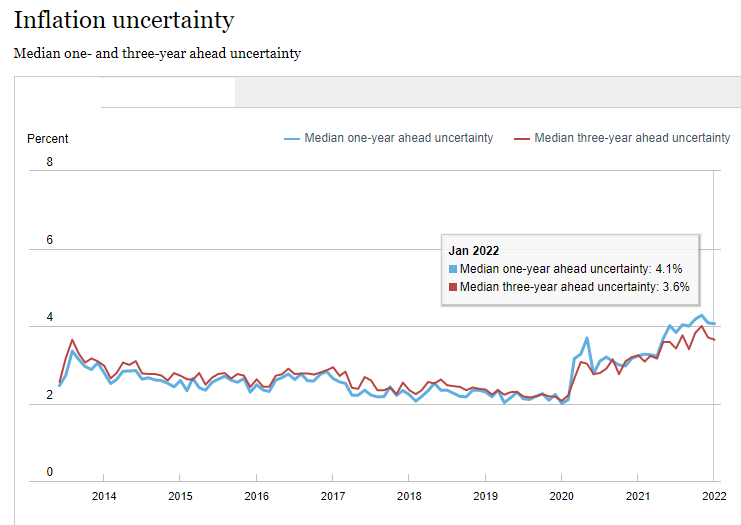
* The US inflation outlook dips for the first time since October, according to a survey by the NY Fed.
A wide-ranging index of commodities saw sustained growth last week, marking the best performance among major asset classes, according to a selection of ETFs trading through Friday’s close (February 11).
* The German Chancellor tours Ukraine as tensions rise over a potential Russian invasion.
* Ukraine seeks a meeting with Russia to prevent conflict.
* A significant US-Canada border crossing reopens after negotiations with truckers conclude.
* The looming threat of Russian invasion is pushing oil prices towards $100 per barrel.
* A confluence of rising demand and constrained supply conditions is boosting prices across commodities.
* Will the Federal Reserve’s intensified focus on countering inflation lead to an economic recession in the US?
* Has the trend of investing in Big Tech reached its peak?
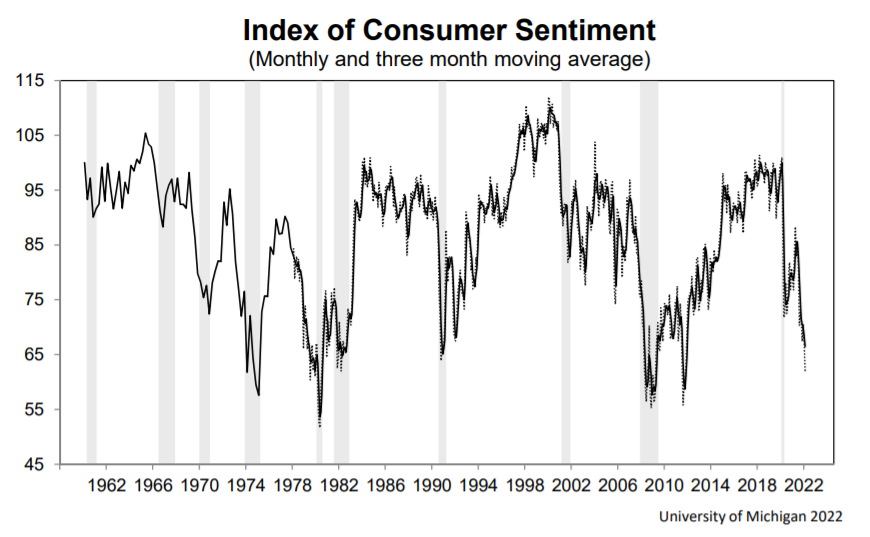
* US consumer sentiment dipped to a decade-low in February:

 ● Money, Magic, and How to Dismantle a Financial Bomb: Quantum Economics for the Real World
David Orrell
Summary via publisher (Icon Books)
David Orrell explores how money exhibits a range of seemingly magical traits. It can be conjured from thin air and disappear without a trace. It can traverse vast distances instantly, multiply indefinitely, and explode unexpectedly. Orrell posits that the emerging field of quantum economics is essential for demystifying the true nature of money. In this vibrant exploration of the history, philosophy, and mathematics of money, he illustrates how adopting quantum probability models can clarify conventional economic misunderstandings and expose the startling truths underlying our financial systems.
Financial Cycles – Early Warning Indicators of Banking Crises?
Sally Chen (Bank for International Settlements) and Katsiaryna Svirydzenka (IMF)
April 2021
This study investigates whether fluctuations in financial indicators can serve as early warning signals for banking crises. Analyzing data from 59 advanced and emerging economies, we find that signs of financial overheating can often be detected in real time. In advanced markets, equity prices and the output gap serve as the most effective leading indicators, while in emerging markets, equity and real estate prices, along with the credit gap, are more relevant. Moreover, aggregating these indicators can flag financial crises several years in advance. Our findings challenge the conventional wisdom regarding the frequency of financial cycles, which are shown to operate on a medium-term interval.

