What insights can a single Senate race provide into the intricate workings of American politics? In Maine, the patterns of financial contributions reveal how campaign financing influences party rivalry, political narratives, and the decisions voters face long before they cast their votes.
Only one signer of the Declaration of Independence originated from what is now Maine, and at the time, the area was still a part of Massachusetts. However, amidst celebrations of Thomas Jefferson’s iconic document, the Senate race in the Pine Tree State offers a clear perspective on the current landscape of American politics.
Two key figures illustrate this narrative.
The first figure is adapted from a previous study conducted by three of us several years ago. This analysis examines the actual size distribution of political donations to important political figures during the 2016 election cycle. The data aggregates contributions from the same donors, which may appear minor when viewed individually. This analysis starkly contrasts with often vague media tallies of total contributions by wealthy individuals or superficial comparisons of campaign expenditures, which are influenced by factors beyond just the famously opaque channels of “dark money.”
This data serves as a revealing X-ray of the substantial role that large financial contributions play in elections—a perspective rarely highlighted in social science discussions or mainstream media, which tend to focus primarily on polling data.
Figure 1: Influence of Major Donors: Contribution Sizes of American Political Leaders in the 2016 Cycle
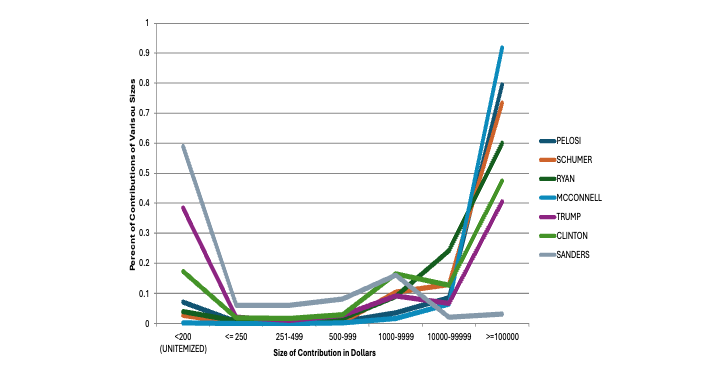
Each candidate is represented by a distinct color, with the left vertical axis indicating the percentage of donations sourced from various contributor sizes shown along the bottom axis.
The findings for 2016 are clear. One candidate, Senator Bernie Sanders, sourced nearly all his funding from the two lowest categories—donations under $200 and under $250.
In stark contrast, other leaders from both major parties received substantial portions of their campaign funds from high-end donors. Senators Chuck Schumer and Mitch McConnell, along with Nancy Pelosi and Paul Ryan from the House, were heavily reliant on major donors—typically those contributing over $100,000. This trend also applied to presidential candidates Hillary Clinton and Donald Trump, with Trump notably attracting a significant volume of funds from smaller donors, creating a unique “barbell” pattern.
Using data from the Federal Election Commission, we constructed similar visualizations for the much-publicized Maine Senate race. Incumbent Senator Susan Collins is the Republican nominee, with Graham Platner as her Democratic contender. Our totals include contributions from Super PACs and outside organizations funneling money to either candidate or against one, which we interpret as funds working to support the opponent in question.[1]
The figures for Platner reflect contributions from his primary campaign this year, while Collins has been steadily fundraising for the general election for an extended period, given that she faced no primary challenger. Because Senators only run for election every six years and can utilize previously accumulated funds, we believe past contributions provide crucial insights.
Our figures thus incorporate donations from her previous campaign in 2020. Compiling this complete dataset requires considerable effort: Seven different committees are raising and allocating funds on her behalf, along with another seven Super PACs purportedly operating independently of her campaign. Some entities only campaign against Platner; we account for these as well.
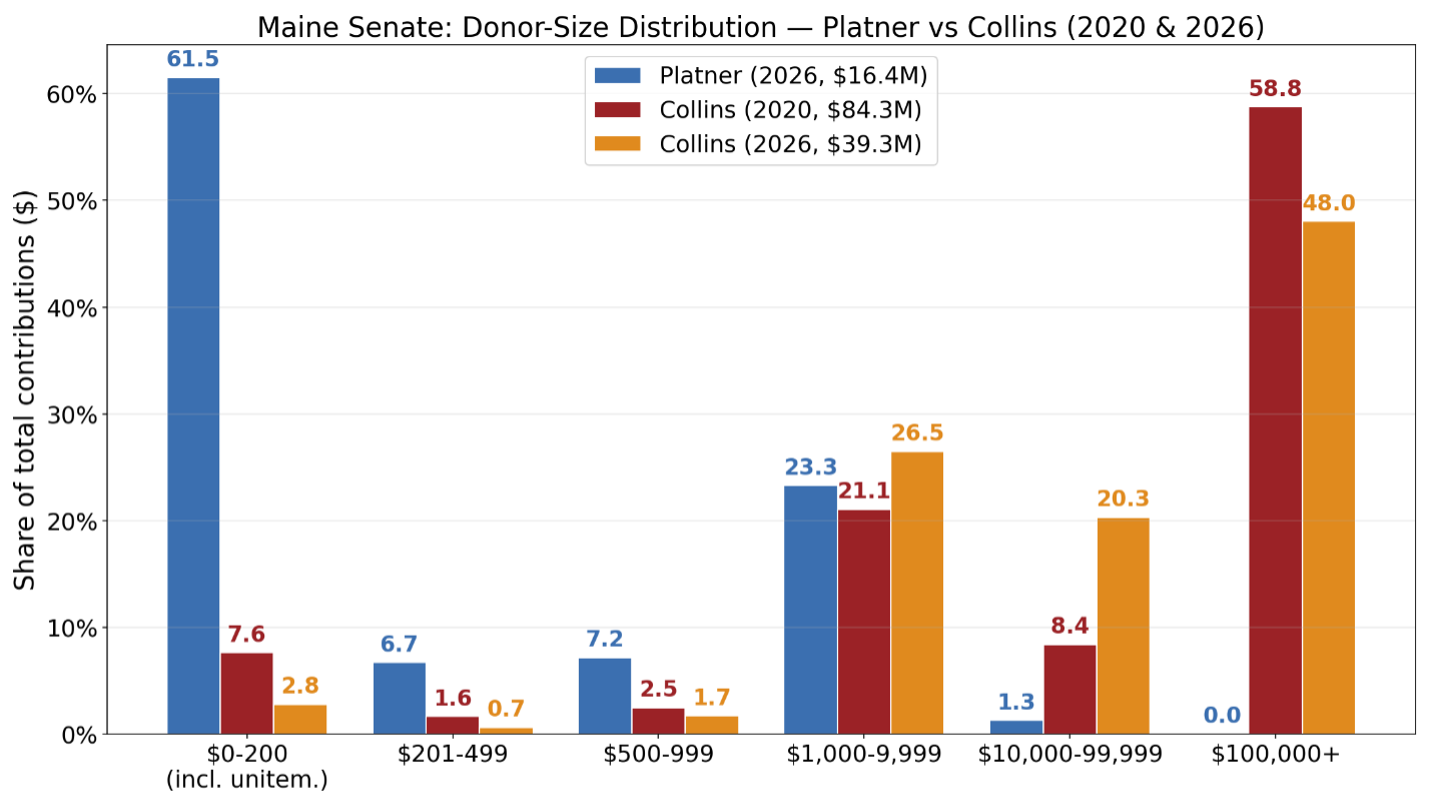
Figure 2: Major Financial Influence in Maine Senate Elections
Platner notably ousted his primary opponent, the sitting governor of Maine, long before the primary election, despite various controversies surrounding his past.[2] Supported by Senator Bernie Sanders and other progressives, Platner faces criticism from many establishment Democrats. Mainstream media frequently question his character. In contrast, Collins’ somewhat contradictory legislative history garners less critical scrutiny, with most discussions concentrating on her bipartisan cooperation rather than the implications of the unified stance that many Republican Senators maintain.
Our analysis illustrates that Collins aligns closely with a standard Republican funding pattern (or, to be fair, shares similarities with the established Democratic leaders depicted in Figure 1) regarding the profile of her donors. We examined both her 2020 campaign and the current cycle for 2026. The resulting shapes are virtually indistinguishable, as demonstrated in Figure 2.
The Republican Senator from Maine is significantly reliant on wealthier donors. In contrast, Platner, reminiscent of Sanders, attracts minimal funding from major contributors. Recently, the number of billionaires backing the candidates has become a topic of discussion, with Platner receiving only modest support from a few. Nearly a hundred donors (including spouses) have made various contributions to Collins. The overarching distribution is depicted in Figure 2, which is quite evident.
Our evaluation also uncovers another critical insight. Excluding contributions below the $200 disclosure threshold, the proportion of funds received from Maine-based donors is starkly different between the two candidates. Senate elections have been nationalized for quite some time. Approximately 20% of Platner’s total funding comes from within Maine, while Collins’ figure is significantly lower, at just under 3%. (This is not a mistake.) Her principal financial backers include prominent figures in private equity and hedge funds, such as Steve Schwarzman from BlackRock, Ken Griffin of Citadel, and other notable Republican contributors, including Larry Ellison of Oracle.
The outcome of the Maine Senate race could ultimately impact the balance of power in the Senate, suggesting that a considerable influx of funds is likely. This influx could modify the distribution patterns or potentially reinforce them. For now, it’s evident that the Maine election serves as a remarkable lens to view the stakes in American politics, encompassing not only the partisan divide in the Senate but also the diverse futures that may lie ahead for the Democratic Party.
______


