In recent economic news:
- Biden may reduce some of Trump’s tariffs on China.
- The Federal Reserve is expected to announce its largest interest rate increase since 1994.
- The European Central Bank has convened an emergency meeting following a sell-off in bonds.
- US mortgage rates have sharply increased, with the national average reaching 6.28% for a 30-year fixed mortgage.
- In the cryptocurrency market, companies are laying off employees and halting withdrawals as digital currency values decline.
- China’s industrial production has shown a modest recovery in May.
- US wholesale price inflation hit 10.8% in May, marking a near-record annual pace.
- Sentiment among US small businesses has dropped to a new record low in May.
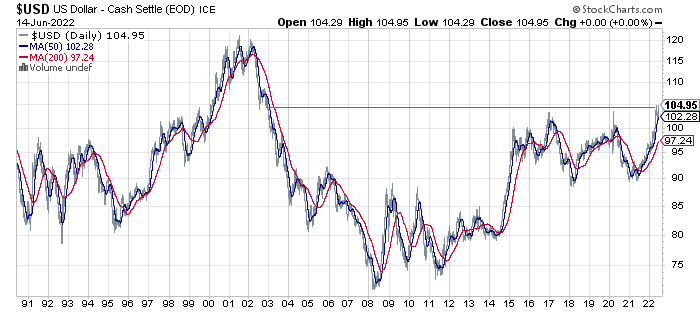
- The US Dollar Index remains close to a 20-year high.
A bear market is typically characterized by a 20% drop in stock prices. By this definition, the S&P 500 index has fallen past this threshold as of June 13, marking its first significant decline since the pandemic-induced crash in March 2020, with a pullback nearing 22%.
Key updates around global events:
- The conflict in Ukraine could last for a decade unless Russia is pushed back.
- China has issued its most severe warning regarding US support for Taiwan.
- Markets are currently contemplating the likelihood of a 75-basis-point interest rate hike from the Fed on Wednesday, according to reports.
- The 2-year/10-year Treasury curve has inverted, signalling a potential recession.
- Foreign stocks have found stability after a Wall Street sell-off on Monday.
- Bitcoin’s value has plummeted sharply after a crypto lender halted withdrawals.
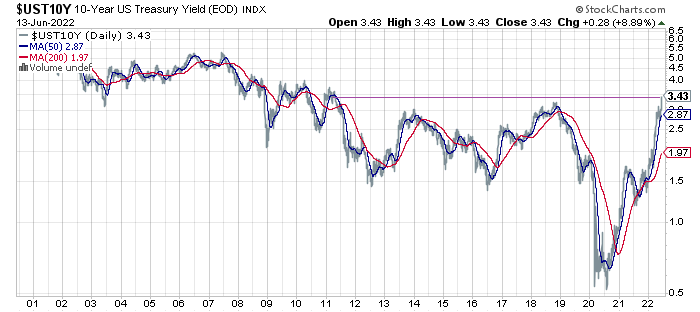
- The yield on the US 10-year Treasury has surged to 3.43%, reaching an 11-year high:
During the trading week up to June 10, commodities experienced another positive gain, while other major asset classes saw declines, according to a variety of ETF proxies.
In recent developments:
- Fed Chair Powell might have to choose between managing inflation and preventing a recession according to sources.
- Another Federal Reserve interest rate hike is anticipated this week, with more expected in the future.
- A serious Covid outbreak in Beijing raises concerns about China’s reopening plans.
- The UK’s economy contracted for a second consecutive month in April.
- The strengthening of the US dollar to a 20-year high is causing significant losses for US companies.
- Experts anticipate that the worst of the global food crisis may still be ahead.
- Bitcoin has dropped below $24,000, a level not seen since December 2020.
- US consumer sentiment has sunk to record lows in early June.
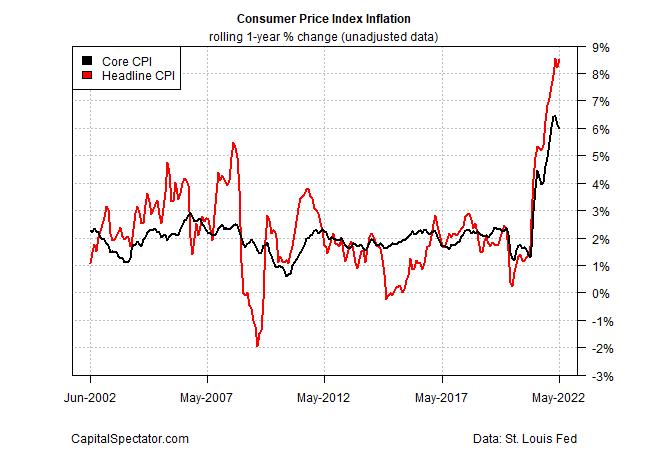
- The annual inflation rate for US consumers rose to 8.6% in May, marking a 40-year peak:

Mark P. Kritzman, et al.
Summary via publisher (Wiley)
In “Prediction Revisited: The Importance of Observation,” a team of distinguished experts in data-driven investing provides an innovative reassessment of the art of prediction for those who rely on data to forecast the future. The authors explain why traditional prediction methods grounded in classical statistics fail to capture the intricacies of social dynamics. They propose a new approach centered on the intuitive concept of relevance, explaining, both conceptually and mathematically, how this relevance is integral to making predictions based on observed experiences. Furthermore, they introduce a fresh and nuanced measure for assessing a prediction’s reliability.

Inflation as the Source of the Bond, Equity, and Value Premia
Martin Tarlie (GMO)
May 2022
This no-arbitrage pricing model posits that inflation is the sole priced risk factor explaining the bond, equity, and value premiums observed in the US over the last sixty years. While inflation is the exclusive priced component, the dynamics of the real rate and profitability are crucial, as they are sensitive to inflation shocks. For bonds, the yield curve’s shape affects excess returns based on maturity. In the equity market, the equity and value premiums are mostly driven by cash flows’ exposure to profitability, whereas growth stocks’ surplus returns are related to their cash flow sensitivity to real rates. With regard to inflation risk, equities serve as a store of value, and value stocks provide a robust hedge as their dividends tend to increase more than one-to-one with inflation.
In recent announcements:
- US Treasury Secretary Yellen indicated that a recession is likely to be avoided according to her statements.
- The average price of gasoline in the US is approaching $5 per gallon.
- Increasing fuel prices are impacting multiple industries and altering consumer behavior.
- China’s consumer inflation remained stable in May as factory-gate prices decreased.
- The European Central Bank plans to raise interest rates next month, the first increase in eleven years.
- The Federal Trade Commission chair issued a warning to the tech industry regarding regulations.
- Major US banks are set to benefit from a rise in credit card usage.
- Jobless claims in the US have risen to a five-month high for the week ending June 4:
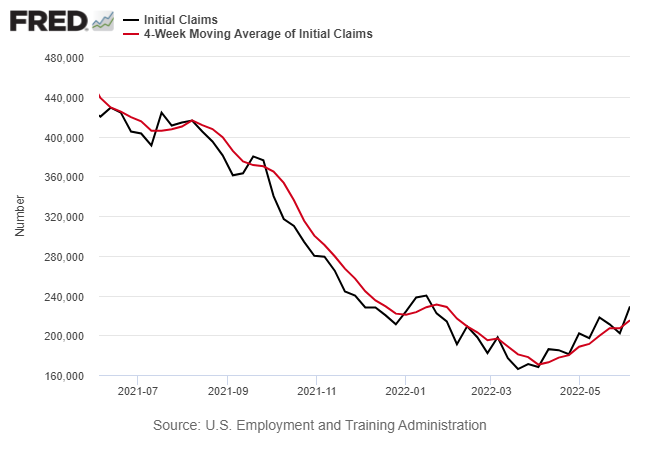
As discussions surrounding recession have intensified, preliminary estimates for US economic activity for the second quarter remain optimistic, indicating a potential recovery from the contraction experienced in the first quarter, according to several nowcasts.
Current efforts by the US and its allies are focused on finding ways to mitigate rising global oil prices.
Inflation poses an increasing challenge for the White House.
China’s demand for essential commodities has remained low throughout May.
The ECB is expected to announce its intent to raise interest rates next month.
China seems determined to maintain a strict zero-Covid policy for the foreseeable future.
A shortage of batteries is hindering the US transition to renewable energy sources like wind and solar.
Furthermore, a severe heatwave is predicted to hit the US Southwest, described as dangerous and deadly.
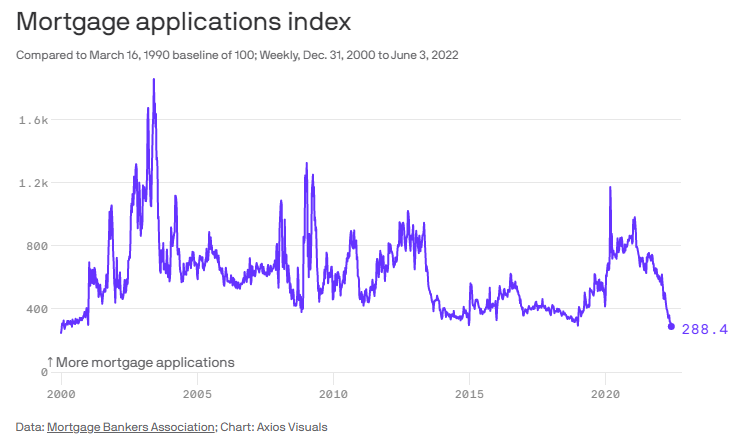
Additionally, mortgage application activity in the US has plummeted to a 22-year low for the week ending June 3: