Question:
Examine the markets for fresh vegetables and instant noodles. Fresh vegetables are considered a normal good, while instant noodles are classified as an inferior good. If Congress enacts a ban on a commonly used fertilizer and pest-control chemical in vegetable farming, it could lead to decreased vegetable yields because of spoilage and pest damage.
(a) Utilize a supply and demand diagram to illustrate how this policy impacts the equilibrium price and quantity of fresh vegetables.
(b) Discuss how the rise in vegetable prices influences the real purchasing power of households.
(c) Considering that vegetables are a normal good and instant noodles are an inferior good, explain how the policy affects the demand for each type of product.
(d) Use a supply and demand diagram to depict the ensuing changes in the equilibrium price and quantity of instant noodles.
(e) What unintended consequences does this regulation have on people’s diets?
Solution:
The influence of the ban is largely determined by two key elements: the distinction between normal and inferior goods, and the increase in production costs for vegetables. These factors collectively shape the effects on prices, quantities, and household dietary choices.
(a) The Market for Fresh Vegetables
The ban initially does not diminish consumer demand for vegetables. Instead, it raises the production costs. With the absence of the banned inputs, farmers are unable to produce as many usable vegetables from their available resources; this results in lower yields and more pest damage. Consequently, at every price point, farmers are prepared to sell fewer vegetables than before.
In typical supply and demand analysis, this scenario results in a leftward shift of the supply curve for vegetables. The demand remains unchanged for the moment. The market then adjusts, leading to a higher equilibrium price and a decreased equilibrium quantity. Consumers face elevated vegetable costs while purchasing less.
(b) Purchasing Power
The increasing price of vegetables diminishes real household income. While nominal income remains stable, a household’s previous budget allocation now allows for the purchase of fewer goods due to the higher cost of one of those goods. A household wishing to maintain its previous vegetable intake must spend more, resulting in reduced amounts available for other necessities; conversely, a household keeping vegetable spending fixed must accept a lesser quantity. In either case, budget constraints tighten.
The extent of this impact depends on the significance of vegetables within the household’s overall budget. For the majority of households, the proportion is modest, meaning the real-income loss from this price increase is noticeable but limited. This effect is significant not for its magnitude but for how it connects regulations affecting the vegetable market to other food markets.
(c) Demand for Each Good
It is essential to analyze two distinct impacts, as they affect the two goods differently.
The substitution effect arises from the altered relative prices. With vegetables becoming more expensive compared to instant noodles, consumers will shift their preferences toward noodles, maintaining constant real income.
The income effect, resulting from the decrease in real purchasing power, varies based on whether a good is considered normal or inferior. Since vegetables are normal goods, a reduction in real income leads to lower vegetable consumption. Conversely, as instant noodles are inferior goods, a drop in real income encourages an increase in noodle consumption.
For vegetables, both the substitution and income effects converge: the higher relative price decreases vegetable consumption. The increase in vegetable prices motivates consumers to reduce their purchase quantities, and the decline in real income further shifts the vegetable demand leftward since they are a normal good.
Regarding noodles, both effects are aligned. The substitution effect fosters an increase in noodle demand as vegetables are relatively pricier, while the income effect, prompted by reduced real income, also boosts noodle demand because noodles are inferior goods. This scenario is particularly interesting as the inferior status of noodles enhances the income effect rather than offsetting the substitution effect.
(d) The Market for Instant Noodles
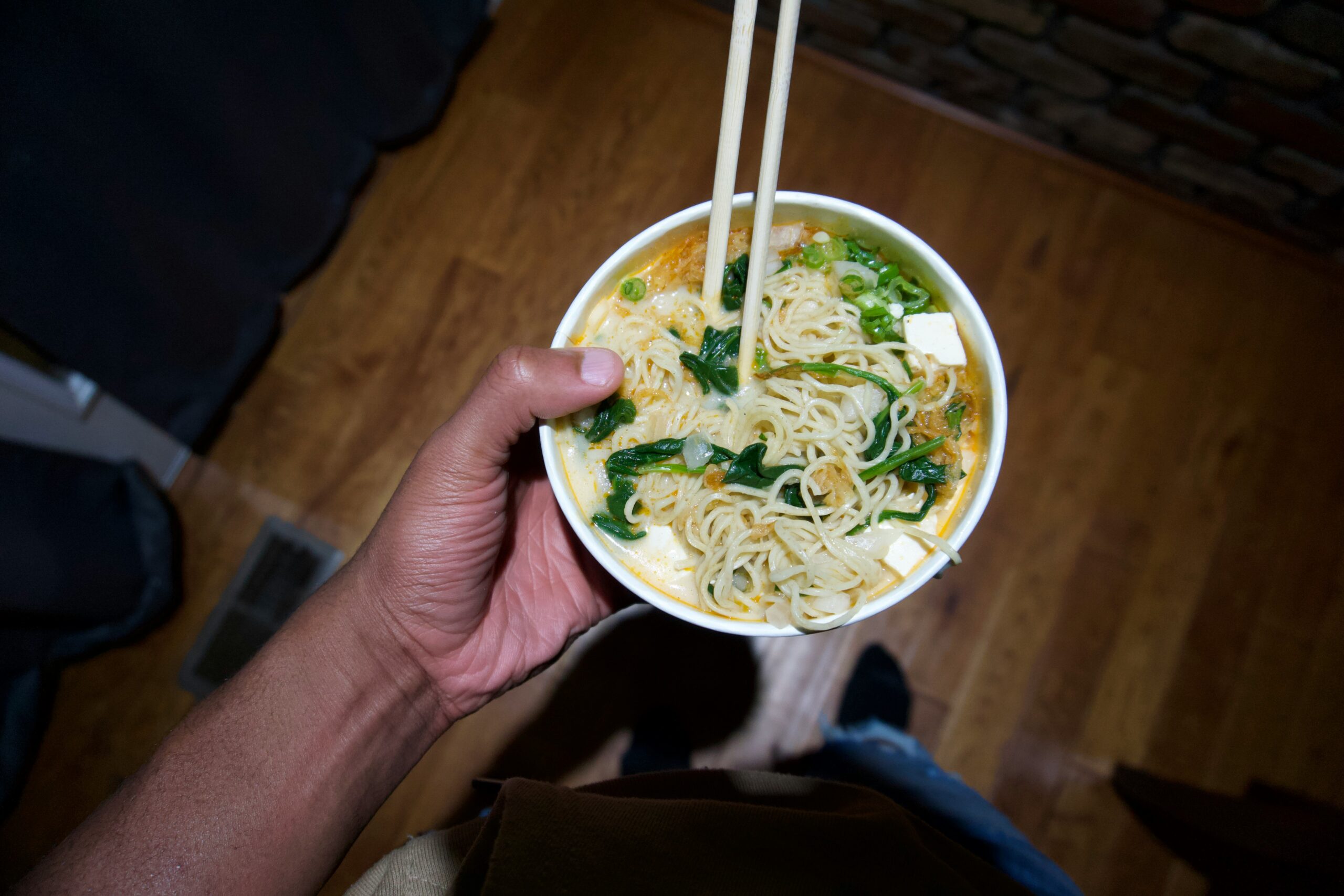
Since the regulation specifically addresses vegetable farming, the supply of noodles is not affected. Initially, only the demand changes. From part (c), both the substitution effect and income effect lead to increased demand for noodles, thus shifting the noodle demand curve to the right. With the supply curve for noodles remaining unchanged, this results in higher equilibrium prices and quantities. Consequently, consumers purchase more noodles at elevated prices.
It is worth noting a feedback effect: as noodle prices rise, they become less appealing compared to their initial position post-demand shift. To the extent that these two products serve as substitutes, a higher noodle price can elevate the demand for vegetables, counterbalancing the leftward pressure from part (c). Although this moderates the adjustment, it does not reverse it: the original shock to vegetable supply persists, causing vegetables to remain pricier and less consumed than prior to the regulation, unless there are strong reasons to believe the feedback effect overwhelms the initial shock.
(e) Unintended Consequences
The unintended consequence follows logically from price theory. A regulation intended to restrict a chemical used in vegetable farming heightens production costs for vegetables. This leads to reduced supply, increased prices, and lower consumption levels. Given limited household budgets, elevated prices reduce real purchasing power, prompting consumers to substitute cheaper inferior goods, including instant noodles.
Thus, a policy aimed at one specific aspect can lead to adverse outcomes in another area. By raising the prices of fresh vegetables, such regulations may result in decreased vegetable intake and increased consumption of processed, less nutritious alternatives. This outcome stems from the constraints on budgets, the relative prices, and the adjustment margins households experience, rather than from any specific intentions.

