Welcome! Today, we delve into pressing concerns affecting our digital lives and personal freedoms. With the rapid integration of AI into various sectors and its implications, it’s crucial to be informed about both surveillance practices and the unauthorized use of original content by AI firms. This article offers insights and guidance on how to mitigate these issues.
By Thomas Neuburger. Originally published at God’s Spies
It’s evident that artificial intelligence (AI) is becoming a central part of our everyday lives.
For instance, many doctor’s offices are now employing AI to replace human scribes, resulting in the recording of entire visits. But how long will this information be kept? The duration can vary, and soon AI could determine whether someone is too disabled to drive (for further details, read here).
This accelerated push towards AI—often driven by the desire to boost stock prices while reducing workforce numbers—has created a barrier between individuals and the organizations that govern numerous aspects of their lives. AI now plays a role in determining your eligibility for a new job or a loan.
AI has also infiltrated your interactions with governmental bodies. Will you face an audit this year? AI determines that. How will your Social Security issues be managed? AI is set to replace the human agents who handle these matters. Moreover, AI in policing is already a reality.
AI isn’t merely “altering the essence of humanity.” For average individuals, it has replaced human interaction entirely in both corporate and governmental contexts—despite the potential for significant errors that such systems can produce.
And this barely scratches the surface regarding the implications of AI in warfare, which many in power are eager to expand.

AI and Gmail
Now, let’s examine AI’s impact on our digital interactions, particularly regarding Gmail.
Recent versions of Gmail, a widely used web-based email client, come with AI mail scanning and analysis enabled by default. If this oversight doesn’t concern you, feel free to keep it active. However, if you wish to limit AI’s presence in your Gmail account, follow these steps. The information was sourced from this Twitter account. The thread begins as follows (with minor edits):
If you have a Gmail account, you should read this.
Google’s AI scans your emails and attachments—including bank statements, tax files, and medical documents. This feature is enabled by default, and there is currently a class-action lawsuit regarding how this was implemented. […]
In late 2025, Google activated AI features in Gmail, Chat, and Meet for numerous users. These features read your emails, messages, and attachments to generate summaries and suggestions.
Although Google claims your emails do not train its AI, many users argue they never explicitly consented to have these features enabled. As long as you do not deactivate them, AI may still analyze your inbox for these functions.
This thread suggests several steps, and as I navigated through them, I made some modifications based on my experience.
Adjust Your Gmail Settings
To limit AI features, alter your main Gmail and Google Workspace settings as follows:
- Access ⚙ Settings → See all settings.
- In your browser’s search bar (Ctrl-F), search for the term “smart” (without quotes).

- Turn off every instance of “smart” that appears in the settings. In my version of Gmail, this included Grammar, Spelling, Autocorrect, Smart Compose, Smart Compose personalization, and Smart Reply. Your options might vary.
- Ensure the Smart Features checkbox, which is a significant option, is unchecked (see below).
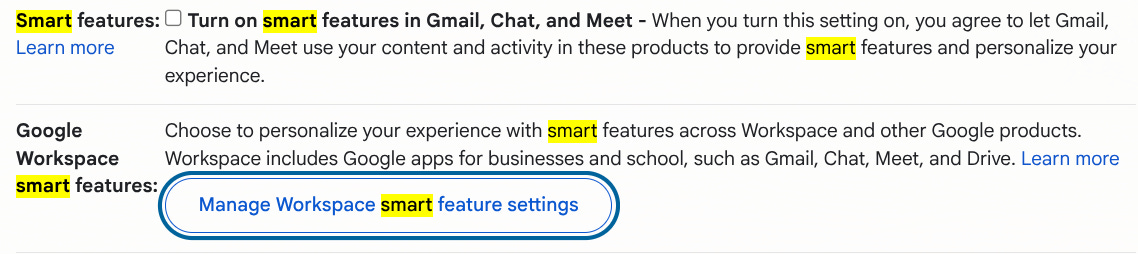
- Navigate to Google Workspace smart features and click on the Manage Workplace smart features settings button (located above).
- On the subsequent screen, toggle all settings off and click Save.
- Scroll to the bottom of the main settings page and click Save Changes (essential).
Examine Your Phone Settings. Clear Your Gemini History.
The author also recommends the following steps:
Your Phone. Settings don’t always sync between devices, so ensure you check the Gmail app separately.
Gmail app → Menu (☰) → Settings → Choose your account → Disable “Smart features and personalization” → Confirm.
If you’ve previously used Gemini:
Remove Gemini History. If you’ve engaged with Gemini before, your chats might be stored and reviewed by humans.
Visit http://myactivity.google.com/product/gemini → Disable Gemini Apps Activity → Delete Activity → All Time.
This process permanently clears your past Gemini chat history and prevents future conversations from being saved.
While I had no Gemini history, that may not apply to everyone.
Can You Stop Google From Monitoring You?
Essentially, Google’s business model relies on surveillance: analyzing user behavior to sell ads and manage user profiles. This is how they generate substantial revenue.
However, as of now, turning off smart features in your Gmail and Google Workspace accounts seems to limit AI’s involvement in those functionalities. Furthermore, currently, Google asserts that Gmail smart features are not a covert means to train its AI. For the time being, at least.
Will this remain true indefinitely? It’s uncertain, but it appears to be the case for now. If this is a concern for you, I recommend taking the steps mentioned.


