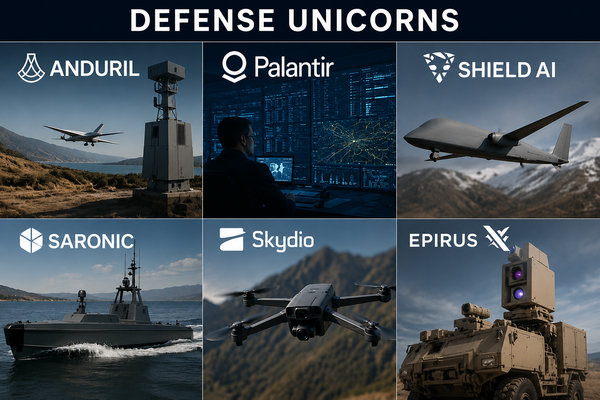
There’s an increasing sentiment among Silicon Valley entrepreneurs, venture capitalists, and tech enthusiasts that the American defense sector is due for significant change. A wave of defense technology startups, backed by venture capital, has emerged to seize this opportunity. These companies aim to deliver the same speed, innovation, and energy that have revolutionized various commercial sectors, such as retail, transport, communications, and finance. They tout advancements in artificial intelligence, autonomous systems, sophisticated software, and agile development methods as potential remedies for a Pentagon procurement system often criticized for its bureaucracy, overruns, and stagnation.
This narrative holds strong appeal. Many groundbreaking technologies of the past few decades originated not from government labs or traditional defense contractors but from innovative startups thriving in competitive markets. If these startups can disrupt various civilian industries, why shouldn’t they be able to do the same for national defense?
However, this assumption misreads the nature of the U.S. defense establishment. The so-called Silicon Valley unicorns are not merely taking on a group of inefficient companies that have evaded the rigors of competition. Instead, they are up against one of the most enduring institutional ecosystems ever created. The defense sector has weathered wars, scandals, budget cuts, acquisition reforms, and waves of technological change, all while fending off repeated predictions of its downfall. Like an evolving ecosystem, it continuously adapts while maintaining its fundamental structure. While these new ventures may yield valuable technologies, they are unlikely to overhaul the U.S. defense framework.
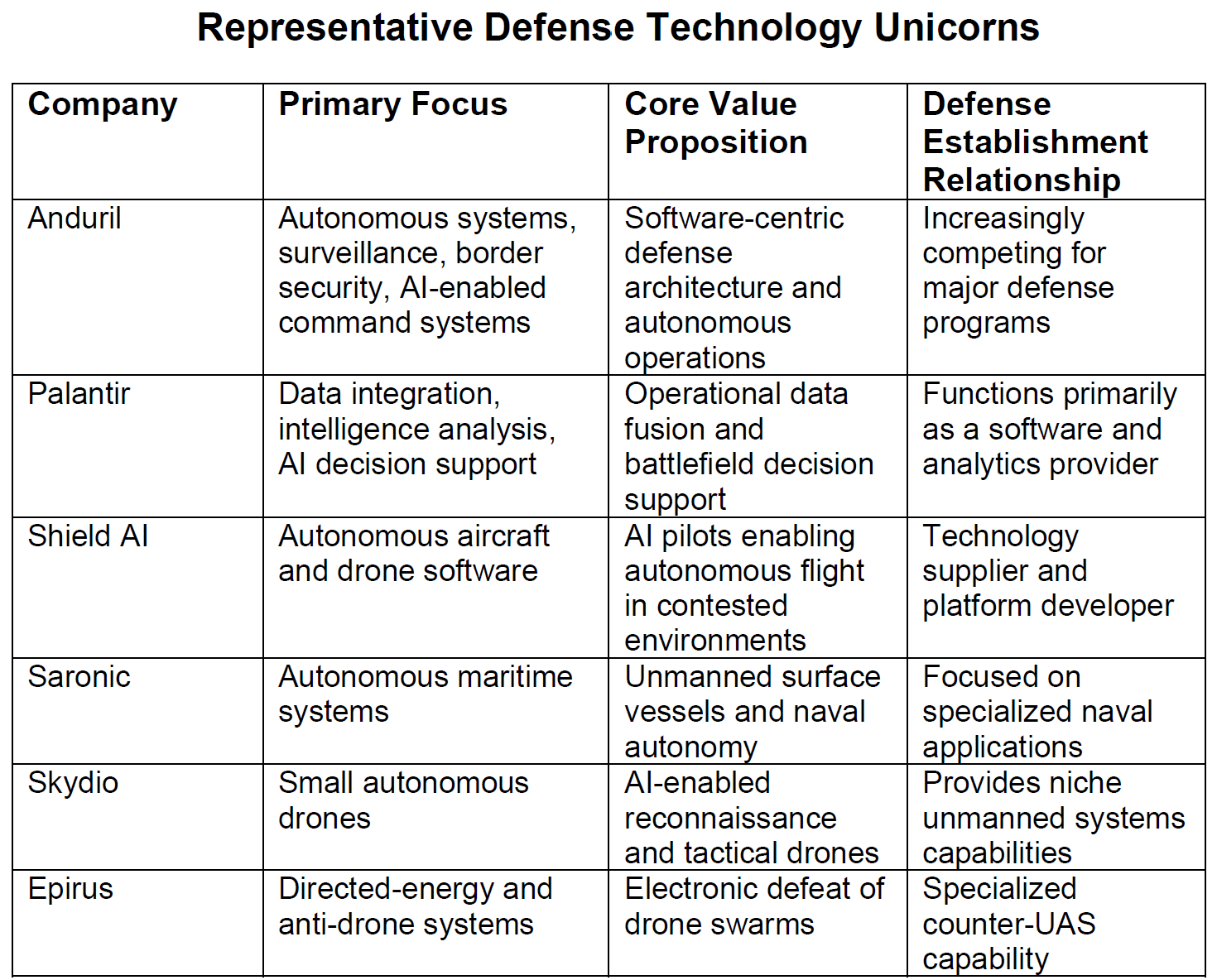
The Promise of the Defense Unicorns
The Silicon Valley mindset is deeply rooted in a compelling historical context. Entrepreneurial firms have consistently overturned established players through superior technology and management practices. As a result, the startup community often views institutional resistance as a sign of failure and disruption as a marker of progress.
This view is further reinforced by the successful PR surrounding transformative commercial technologies. Smartphones, cloud computing, social media, and AI have dramatically changed everyday life at an astonishing pace. Consequently, it can be tempting to believe that these same principles can be applied to military organizations.
Yet, this belief overlooks a fundamental truth: military institutions function under a completely different set of incentives and constraints than commercial enterprises. As management theorist Peter Drucker famously stated, culture eats strategy for breakfast. The defense establishment has cultivated a deeply ingrained culture over decades, shaped by operational experience, bureaucratic adaptation, political connections, and collective learning. This resilient ecosystem is far more complex than many advocates of disruption realize.
Military organizations rank among the most culture-bound institutions in modern society. They develop shared norms regarding risk, authority, discipline, procurement, logistics, and combat effectiveness. These norms are reinforced through professional education, promotion systems, operational experience, and institutional memory. While technologies can be bought, organizational cultures shift at a much slower pace.
Capitalism and Government Optimize Differently
The central flaw in the disruption narrative is the assumption that the U.S. defense establishment operates like a poorly managed corporation. Startups tend to optimize for speed, growth, innovation, and efficiency. Failures are often considered a necessary aspect of market discipline. Investors anticipate risk-taking, experimentation, and occasional collapse.
In contrast, government institutions focus on stability, continuity, legitimacy, accountability, and reliability. Military organizations, in particular, must operate under conditions where failures can have dire consequences. A failed startup may disappoint its backers, but a failed weapon system could result in loss of life, defeat in battle, or diminished deterrence.
Thus, the defense sector does not represent a malfunctioning version of capitalism; it is an entirely different optimization framework. Many characteristics criticized by reformers—extensive testing, redundancy, documentation requirements, compliance, and risk aversion—may appear inefficient from a commercial viewpoint, but often exist to prevent catastrophic failures. This difference in optimization elucidates the enduring disconnect between Silicon Valley’s expectations and the realities of defense.
The Strengths of the Dinosaurs
Major defense contractors are frequently depicted as sluggish dinosaurs, surviving solely through political clout and bureaucratic inertia. This oversimplification misses the nuanced evolution of these organizations. The defense industrial base operates as a complex ecosystem, linking contractors, military services, congressional committees, regulators, think tanks, analysts, lobbyists, and procurement officials. These intricate relationships have developed over decades, creating a form of institutional resilience that newcomers find hard to emulate.
More importantly, these “dinosaurs” are not set in their ways. They have endured Vietnam, the post-Cold War reductions, acquisition reforms, the Revolution in Military Affairs, network-centric warfare, counterinsurgency campaigns, and waves of digital transformation. They have consistently adapted to technological advancements while maintaining their status within the broader ecosystem. This adaptability is perhaps their greatest strength.
Many practices that may seem less than optimal from a business perspective serve crucial survival functions within the political and bureaucratic landscape of defense procurement. These organizations have evolved not only to create weapons but also to navigate the intricate institutional landscape where those weapons are funded, developed, and deployed.
The Fragmentation Problem
Defense startups excel at achieving specific technical goals. Most unicorns concentrate on niche capabilities like autonomous drones, AI-powered targeting systems, software platforms, sensors, and logistics applications. This specialization fosters rapid innovation, particularly when software is a key driver.
However, military organizations do not engage in warfare with standalone components; they operate through comprehensive systems. A drone or software algorithm may effectively address a technical challenge, but it does not necessarily solve a military one. Military value arises from the integration and coordination of various assets, not merely from individual innovations. Successful military capabilities require seamless harmonization of doctrine, training, logistics, intelligence, command structures, and operational planning. While individual technologies are important, their value ultimately hinges on how well they operate within the framework of larger military systems.
This creates a fragmentation issue. Startups may be adept at innovating individual high-tech components but often struggle to integrate those elements into cohesive military capabilities. The established defense contractors possess the breadth of experience and resources necessary to tackle these integration challenges.
The Scale Problem
Silicon Valley is proficient in generating software, sensors, algorithms, and other high-value technical components that can confer significant military advantages. However, these elements alone do not equate to military might. Nations go to war not with apps but with integrated systems supported by extensive industrial and logistical infrastructures.

Boeing B17 WWII mass production
The modern military relies on the capacity to design, produce, deploy, sustain, and replace complex equipment at scale. Aircraft carriers, fighter jets, submarines, satellites, armored vehicles, munitions stockpiles, logistics networks, maintenance facilities, and training organizations require industrial capacities that far exceed those needed for software development. The challenge lies not just in inventing capabilities but in producing and maintaining them under wartime conditions. Being able to manufacture sufficient quantities of drones, missiles, or vehicles to compensate for attrition is often as critical as the sophistication of the individual weapons. The effectiveness of systems that cannot be replaced becomes irrelevant.
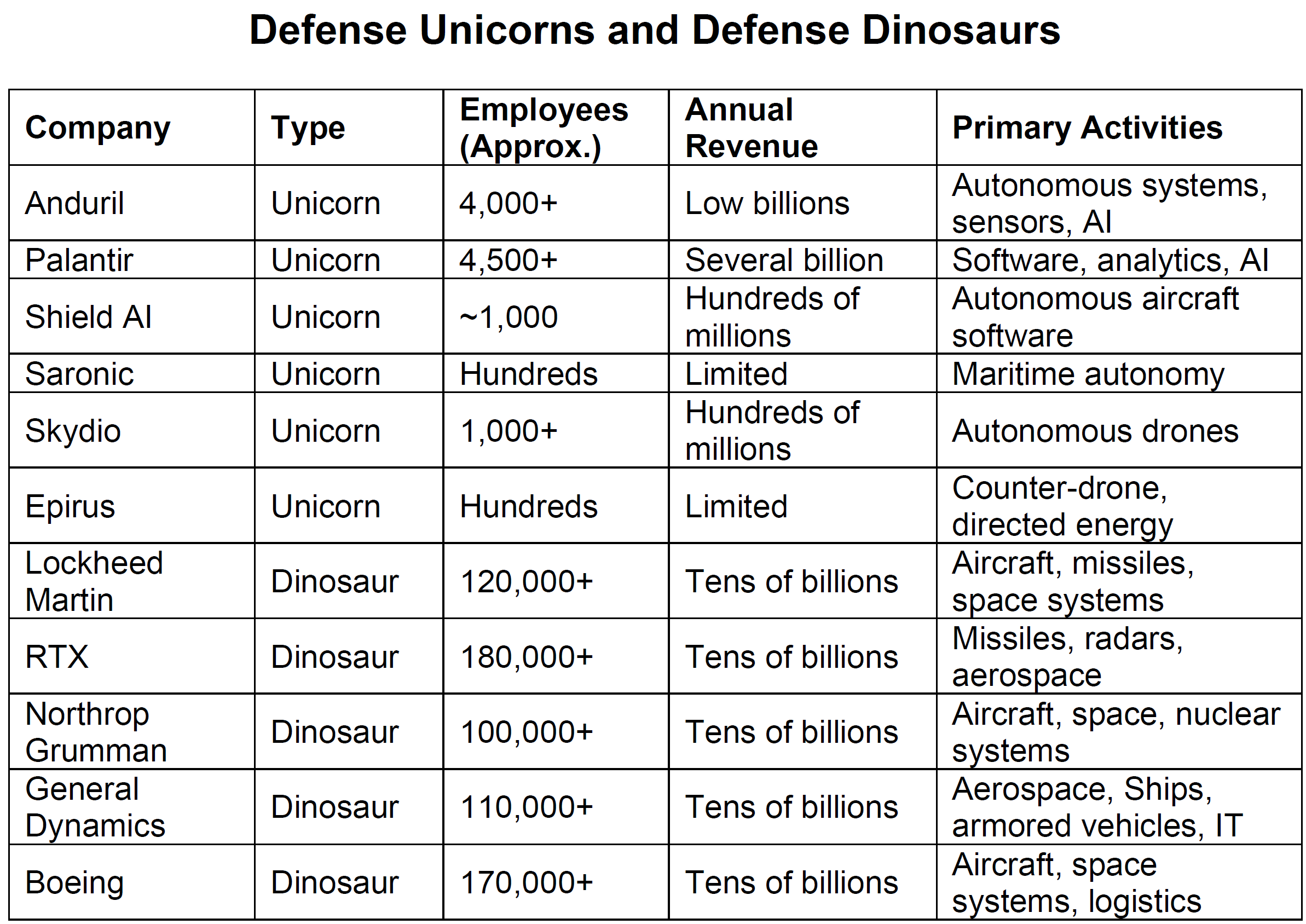
This distinction is often overlooked by proponents of disruption. Building a successful software firm differs significantly from establishing a military production entity. A startup might develop an exceptional autonomous targeting algorithm, but transforming that innovation into thousands of deployable systems, supported by maintenance personnel, supply chains, spare parts inventories, training programs, and operational doctrine, represents a far more significant undertaking.
The established defense contractors have cultivated these large-scale capabilities over decades. Their value to the defense establishment stems not just from engineering know-how but also from their proficiency in managing intricate production networks, regulatory requirements, logistics systems, and long-term sustainment responsibilities. These capabilities are costly and challenging to replicate, often remaining hidden from external scrutiny.
For many defense unicorns, the most considerable challenge lies not in invention but in scaling up. Developing a promising technology is only the beginning; transforming that technology into an enduring military capability necessitates entering a realm dominated by scale, integration, and sustainment. In this environment, the “dinosaurs” possess advantages that are hard to replicate.
Speed Versus Integration
The primary advantage held by startups is their speed. They embrace iterative development, accept high levels of technical and financial risk, and can operate swiftly due to their control over relatively small systems with limited integration requirements.
On the other hand, military organizations face distinct challenges. The more complex a military system becomes, the more interconnected it is. Aircraft, satellites, sensors, logistics networks, command systems, intelligence assets, and weapons platforms must coordinate effectively under demanding operational conditions.
This leads to what could be termed an “integration tax.” Every new capability introduces additional training requirements, logistical burdens, maintenance demands, interoperability concerns, and operational risks. The integration process inevitably slows development speed and reduces organizational flexibility. Consequently, innovation can often outpace the ability of military organizations to absorb it. The issue is not technological stagnation; rather, it is that the rate of innovation can exceed the pace of integration.
The Stealth Precedent
Proponents of defense disruption often depict the latest emerging technologies as groundbreaking, but history paints a different picture. Stealth technology, for instance, represented a significant military innovation in modern times, yet its institutional impact on the defense ecosystem was relatively minimal.
While stealth fundamentally transformed the dynamics between aircraft and air defenses, providing notable operational advantages, it did not revolutionize the defense establishment itself. Instead, the establishment absorbed and adapted to it. Initial exploitation was swift through specialized programs like the F-117 strike aircraft. However, broader implementation was far slower, costlier, and more complex than anticipated. The evolution eventually led to significant acquisition programs like the B-2 and F-35, accompanied by many well-known institutional challenges such as budget overruns, schedule delays, and contentious oversight disputes.
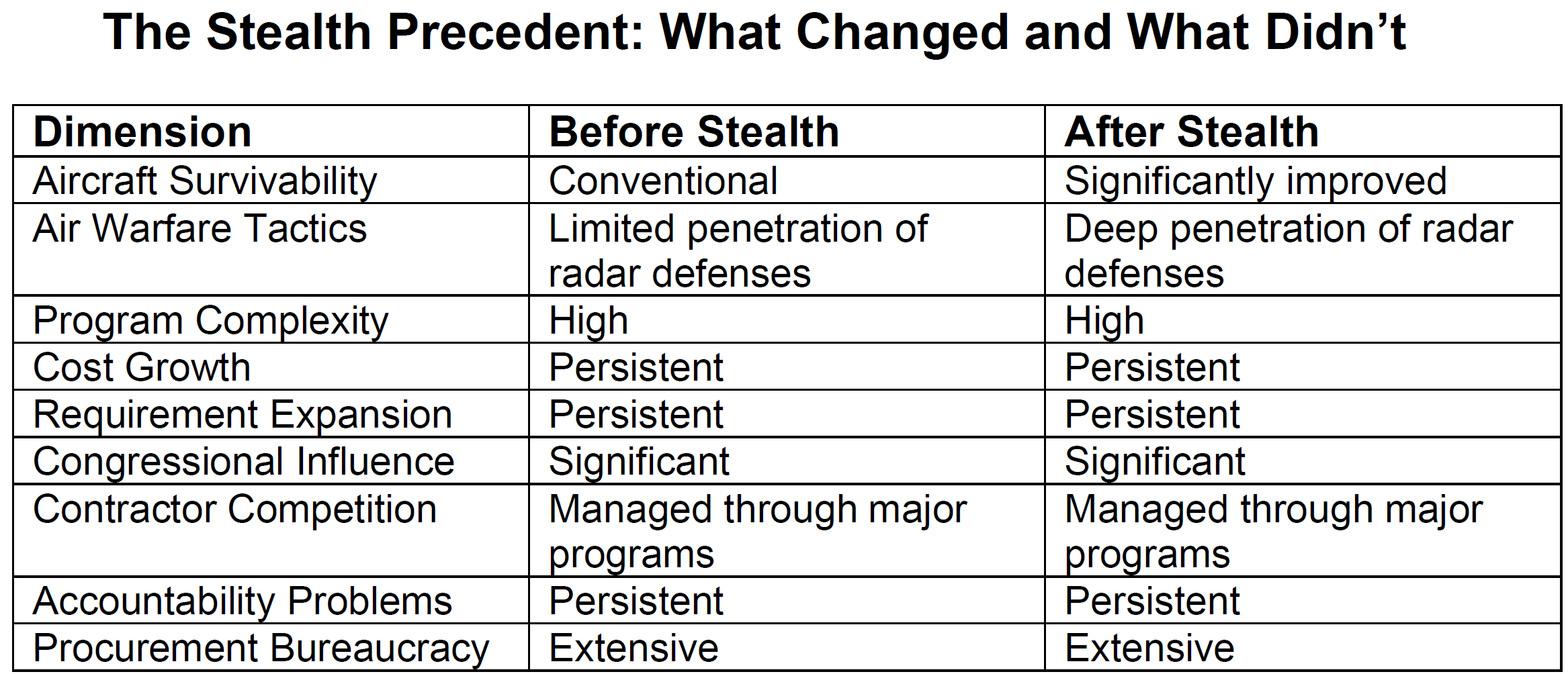
The lesson here is not that stealth technology failed, but that revolutionary innovations do not obliterate institutional dynamics; rather, they become subject to them. A similar trajectory is likely for AI, autonomy, and directed energy technologies currently promoted by defense startups. Stealth did not fundamentally alter the major defense contractors; it became part of new acquisition programs managed by the existing ecosystem.
The Wartime Technology Transformation Exception
One notable exception to this gradual assimilation trend occurs during wartime. World War II witnessed remarkable rates of technological innovation and adoption, with advancements in radar, nuclear weapons, jet aircraft, and more occurring at a breakneck pace. The key driver was not technology itself but the heightened incentives for rapid adaptation.
Existential threats can significantly shift institutional behavior, allowing greater risk tolerance and less bureaucratic restraint. Experimentation accelerates, and rapid adaptation becomes a strategic imperative, often leading to the success of startups and unconventional organizations.
However, history shows that such periods of rapid change are typically temporary. After World War II, the innovative flexibility showcased by organizations like the German V2 rocket program, the MIT Radiation Laboratory, and the Manhattan Project gradually receded as traditional procurement processes were reinstated. Once the urgency of wartime passes, organizations typically revert to equilibrium. Stability, accountability, and procedural controls regain prominence, and the extraordinary receptiveness to innovation observed during wartime seldom lingers into peacetime.
This wartime exception underscores a broader pattern. Transformational innovation can flourish when conventional institutional incentives are suspended, but it does not imply that those incentives vanish permanently.
Why Unicorns Become Dinosaurs
The irony of defense disruption is that successful unicorns often evolve into the very entities they once critiqued. As these firms grow, they become subject to procurement regulations, compliance obligations, congressional oversight, and the pressures of the political landscape. They develop government relations teams, hire former officials, and learn to navigate the intricacies of appropriations processes and acquisition regulations.
The defense establishment tends to reward firms that can reliably meet institutional demands. A startup may initially distinguish itself through technical innovation and nimbleness, but as it expands, its success increasingly hinges on understanding and maneuvering through the bureaucratic and operational realities of defense procurement. Winning contracts necessitates a familiarity with acquisition protocols, while program expansions require congressional backing. Long-term sustainability depends on compliance, reporting, testing, certification, and cultivating strong customer relationships.
The evolutionary trajectory is remarkably consistent:
Disruptive Reformer → Established Contractor → Entrenched Incumbent
Innovative firms eventually accumulate large workforces, expansive facilities, regulatory commitments, government relations teams, and enduring contractual obligations. The accompanying organizational priorities naturally shift, with a growing emphasis on stability over disruption and predictability over experimentation.
Preserving existing programs begins to compete with the development of new ones. In many cases, successful unicorns are not only redefined by the ecosystem—they are absorbed by it. Larger defense contractors frequently acquire promising firms to obtain valuable technologies, talent, intellectual property, or access to markets. While the startup continues to exist, it does so as a part of a larger organization whose incentives are molded by the overarching institutional landscape. In essence, the dinosaur swallows the unicorn.
This pattern repeats itself: new participants enter the market claiming to bring transformative change. Some fail, some succeed, and a few become significant contractors. Over time, the ecosystem assimilates each wave of innovators while preserving its core identity. Names, technologies, and participants may change, but the ecosystem remains robust.
The Dysfunctions That Will Persist
This assimilation process elucidates why the challenges of defense procurement persist across generations of technology. Issues like program bloat, cost overruns, schedule delays, and weak accountability are not merely technical failings; they are institutional dilemmas.
Cost overruns illustrate this point well. Defense initiatives often encounter escalating expenses, not due to a lack of technical capability, but because requirements shift continuously during the development cycle. Military branches desire enhanced capabilities, Congress seeks industrial benefits for local districts, and contractors pursue contract growth. The result is a predictable broadening of project scope, which few stakeholders have the incentive to oppose.
Schedule delays emerge from analogous dynamics. Advanced military systems must navigate a multitude of operational, technical, regulatory, budgetary, and political requirements simultaneously. Stakeholders consistently introduce new demands, but few are incentivized to simplify projects. Consequently, complexity builds faster than it can be managed.
Accountability suffers for similar reasons. Major acquisition initiatives frequently involve thousands of players from various government agencies, military branches, contractors, subcontractors, and legislative bodies, leading to diffuse responsibility. When failures occur, the process’s intricacy complicates the identification of accountable parties.
Even technological obsolescence is shaped by institutional realities. Major military platform development cycles can span decades. By the time a system is ready for deployment, parts of its technology may already be outdated. This situation stems from the scale, complexity, and bureaucratic scrutiny present in modern defense procurement.
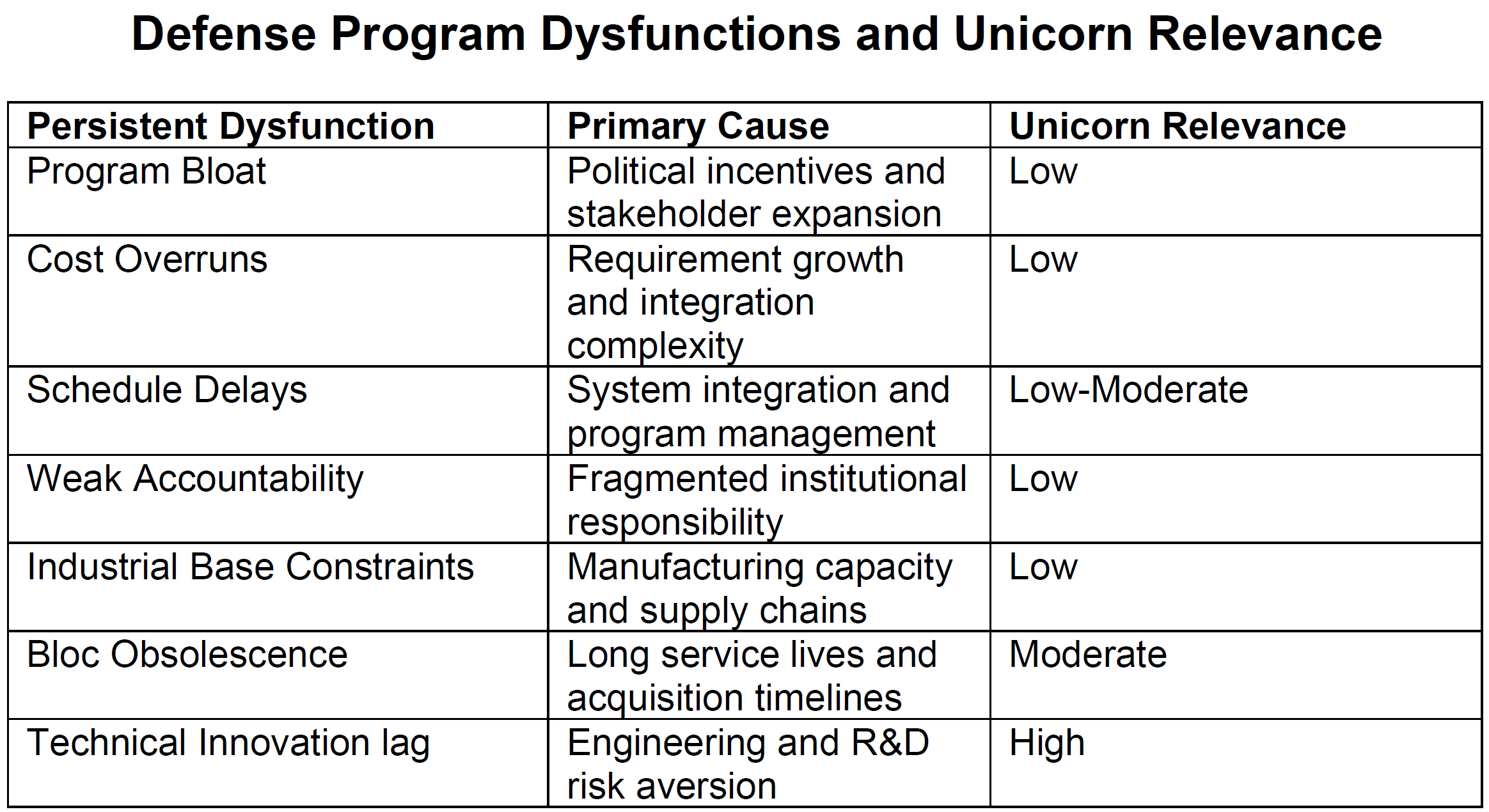
The entry of defense unicorns is unlikely to change these underlying dynamics. Startups must eventually navigate the same procurement regulations, congressional oversight, testing requirements, budget cycles, operational demands, and political constraints that define incumbent contractors. Yes, technologies may change, companies may evolve, but the institutional incentives generating procurement issues will remain intact.
The Leopard Principle
Giuseppe Tomasi di Lampedusa adeptly summarized a recurring issue in political transformations in his novel, The Leopard: “If we want things to remain the same, things will have to change.” In his narrative, the change involves incorporating affluent middle-class individuals into the governing elite to maintain the existing power dynamics.
In the context of the U.S. defense establishment, new technological advancements will likely be integrated to preserve the system’s character. The defense ecosystem continues to evolve dynamically, with new technologies emerging and new organizations forming, alongside fresh doctrines and security priorities. However, the system’s foundational structure remains surprisingly stable, governed by the intersecting interests of corporations, military leaders, and politicians.
Conclusion
While defense unicorns are likely to introduce valuable technologies and some may develop into major contractors, they are not positioned to fundamentally alter the overarching ecosystem. The entrenched forces influencing defense outcomes are rooted in cultural, political, bureaucratic, and economic layers. Innovations exist within these structures rather than displacing them.
The enduring defense dinosaurs will persist not from a refusal to adapt, but by adjusting adequately to thrive within their ecosystem. Although many unicorns may be swallowed up by these dinosaurs, it will not disrupt their habitat. The U.S. defense system has historically survived myriad technological upheavals by minimally adapting to absorb them. Thus, there is little reason to expect the impact of defense unicorns will differ in any significant way. Real reform of the U.S. defense establishment will only arise from comprehensive institutional changes that fundamentally reshape the environment of this system.