In the midst of ongoing tensions between the United States and Iran, fresh developments continue to unfold in the Middle East. This article seeks to unravel the implications of recent military exchanges and the political narratives surrounding them.
Initially, there were hopes that a pause in hostilities might occur following recent strikes between Iran and Israel. However, the situation escalated when President Trump used the downing of an Apache helicopter, which Iran informally claimed was not due to an attack, as justification for new strikes against Iran. This prompted an immediate response from Iran.
The significance of these recent confrontations transcends the physical exchanges of fire.
Firstly, it indicates that Trump perceives Iran as the weakest link in the current geopolitical standoff, believing he can sway them more easily than he can Israel. A secondary motivation could be his desire to maintain news coverage portraying U.S. supremacy in the region.
Secondly, Trump maintains the belief that relentless military pressure will force Iran into submission, yet historical patterns reveal that such tactics have typically resulted in losses for the U.S. The U.S. expends valuable resources while Iran retaliates using cheaper, more accessible weaponry.
Thirdly, despite the dramatic rhetoric, the recent military actions turned out to be less impactful than anticipated. For example, while the strikes on civilian infrastructure, such as a water facility serving 20,000 people, have raised serious ethical concerns, reports indicate that Iran swiftly repaired the damage.
Finally, Iran showcased its ability to control escalation, notably by closing the Strait of Hormuz once again.
After analyzing these exchanges, we will also delve into insights from Robert Barnes, a former ally of Trump, regarding concerns over Trump’s mental acuity and his capacity to negotiate a deal with Iran. Furthermore, Trump has made claims regarding the U.S. allegedly acquiring 100 million barrels of Iranian oil, a statement that has faced skepticism from experts and even his own energy secretary. This assertion seems to be an attempt to counter growing concerns about a looming oil supply crisis.

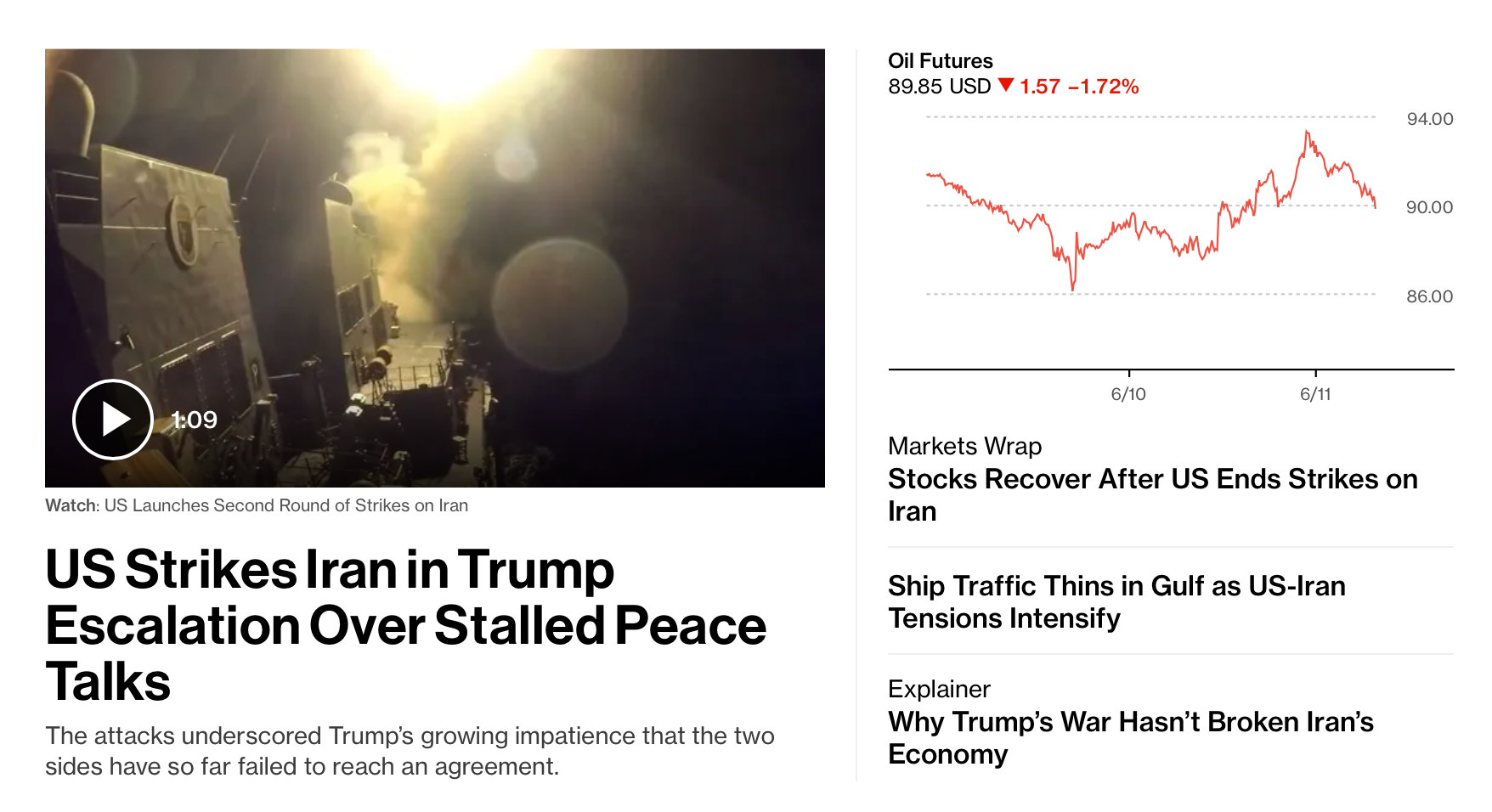
The Bloomberg report centers on U.S. military actions, downplaying Iranian responses. It summarized the situation as follows:
- The U.S. military carried out strikes on multiple targets in Iran for the second consecutive day, following accusations from President Trump that Iran was stalling peace negotiations.
- U.S. Central Command reported the initiation of “additional self-defense strikes” at 5:15 p.m. New York time, targeting air defense sites and communications networks.
- During a Fox News interview, Trump claimed that Iranian officials had requested a halt to the bombings but implied further U.S. action would follow if an agreement was not reached.
In contrast, Aljazeera’s live feed was less comprehensive but highlighted ongoing Israeli assaults on Lebanon, including Baalbek and Nabatieh, raising the stakes in the conflict.

Alongside this, Hindustan Times reported on Iran’s claims of damage inflicted upon U.S. military targets in response.
Further sources, including the Hormuz Letter, reported that Iran’s IRGC claimed to have targeted numerous U.S. military positions across five bases during extensive missile and drone operations. This included successful strikes against advanced aircraft hangars and radar systems.
From Tasnim News, there was an account of an alleged incursion by a U.S. F-16 into Iranian airspace, which was said to have fled after an Iranian missile attack.
“After the enemy F-16 violated the airspace of the Persian Gulf, the IRGC air defense system fired a missile at it, causing the aggressor fighter jet to retreat,” indicated an IRGC spokesperson.
In addition, reports revealed that Iran conducted a detailed intelligence operation as part of its strikes, claiming significant damage to U.S. military bases throughout the region.
🔺 Iran Claims Detailed Intelligence Operation Behind Strikes on U.S. Bases
Fars News cited a source saying Iran carried out a “complex intelligence and operational plan” in its early Thursday strikes on U.S. military bases across the region, claiming significant damage to… https://t.co/4eoMEScrxw
— Drop Site (@DropSiteNews) June 11, 2026
In related news, the IAEA passed a resolution demanding that Tehran report the whereabouts of its enriched uranium stockpiles. This move faced criticism from Iran, which labeled it politically motivated and lacking in professionalism.
The International Atomic Energy Agency (IAEA) Board of Governors passed a resolution on June 10 demanding that Tehran declare the fate of its enriched uranium stockpiles and allow inspectors to verify them.
The text submitted by Washington, the UK, France, and Germany passed with 21 votes in favor, three against, and 10 abstentions, according to diplomats cited by Reuters.
Tehran condemned the vote, calling it a politically motivated measure “devoid of professionalism.”
Next, we turn to insights from Robert Barnes, who shared alarming observations about Trump’s decision-making process leading up to the Iran conflict. Barnes described a shift in Trump’s cognitive abilities and emotional control over time, suggesting that he is no longer capable of negotiating effectively.
During a discussion, he noted that Trump’s previously strategic mind has gradually eroded, resulting in impulsive decision-making driven by emotional reactions rather than rational assessments. This decline has raised serious concerns about U.S. foreign policy under his leadership.
Napolitano: Do we know how Trump came to decide to invade Iran?
Barnes: Yeah, from the people that I’ve talked to… the president that used to be art of the deal… that president, the president who was uber rational and hardcore in making practical and tactical decisions was mostly gone by the late winter of 2025.
In the same dialogue, Barnes asserted that the current direction of U.S. foreign policy is predominantly influenced by the Israel lobby and Trump’s personal emotional whims.
Barnes also elaborated on why certain figures, such as Tulsi Gabbard, remained in the political arena longer than expected. He speculated that they were hoping to complete important reports despite increasing challenges.
As Trump continues to make bold assertions regarding Iranian oil claims from the Strait of Hormuz, skepticism remains rampant. Claims of recovering significant volumes of oil have been met with scrutiny, particularly when contrasted against the realities of international oil markets.

Many analysts question the authenticity of Trump’s claims about covert oil operations, suggesting they could be a tactic to manipulate markets and distract from serious concerns about supply shortages.
The consequences of these unfolding events are profound, shaping not only the geopolitical landscape but also impacting global oil markets and diplomatic relations. As tensions continue to mount, the call for a reassessment of U.S. foreign policy grows ever louder.

