Buffer zones have long been a staple of military strategy, as nations aim to distance themselves from ongoing threats. Throughout history, various geographic features—such as rivers, mountains, and fortified borders—have been utilized to offer warning signs, absorb attacks, and enhance defense. This article delves into how these zones function within Israel’s security framework, their effectiveness, and the emerging challenges they face in contemporary warfare.
Israel’s security strategy epitomizes the need for buffer zones more than most modern countries. Since its inception, Israel has established numerous security buffers in regions like Sinai, Gaza, Lebanon, and Syria, serving to mitigate military threats, terrorist activities, and insurgent violence. Given its limited geographic depth and densely populated areas, Israel has fostered a culture focused on intelligence superiority, quick mobilization, preemptive action, and strategic threat management. By creating buffer zones, Israel aims to extend warning time, improve defensive capabilities, complicate enemy operations, and protect its citizens.
However, tactical achievements do not automatically guarantee strategic success. Israeli buffer zones now confront three interrelated threats: the proximity of formidable regional powers, the persistent resurgence of hostile forces within these buffers, and the rising effectiveness of affordable long-range weapons. Under these circumstances, initiatives intended to fortify security may yield a range of military, political, and diplomatic repercussions. This article explores how Israel’s dependence on buffer zones has increasingly conflicted with its long-term security goals.
The Logic of Territorial Buffer Security
Israel’s quest for strategic depth stems from its geography and historical context. The country’s narrow shape creates vulnerabilities that any military planner would find concerning. Throughout history, hostile forces needed only minimal advances to threaten civilian populations or crucial infrastructure.
This situation has led to a robust security doctrine that extends beyond conventional military tactics. Israel employs intelligence agencies, surveillance systems, missile defense, special operations, cyber capabilities, border controls, and preemptive strikes as part of a comprehensive security framework aimed at identifying and neutralizing threats before they escalate.
As new threats emerge, the cycle of insecurity intensifies. Each successful attack prompts calls for enhanced security measures, and every identified threat fuels demands for earlier warnings and stronger defenses. This creates a self-reinforcing cycle, making Israel’s pursuit of security depth a rational response to ongoing dangers. The challenge arises when these tactical measures begin to contradict broader strategic goals.
The following maps illustrate the current northern and southern Israeli security buffer zones.
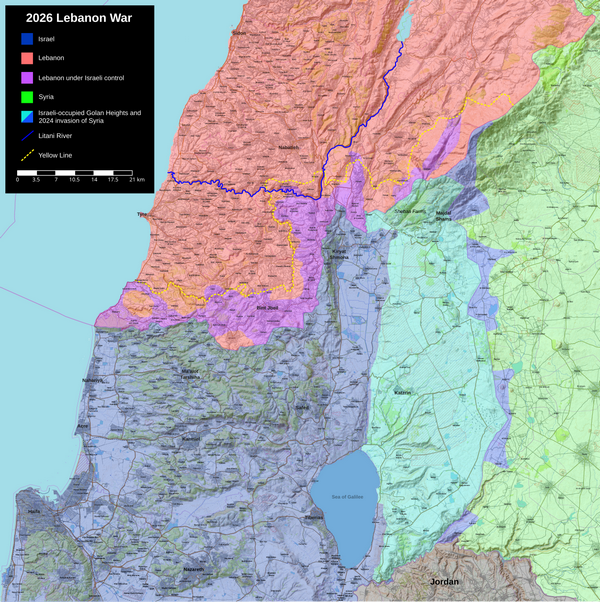
Current Israeli northern buffer zones
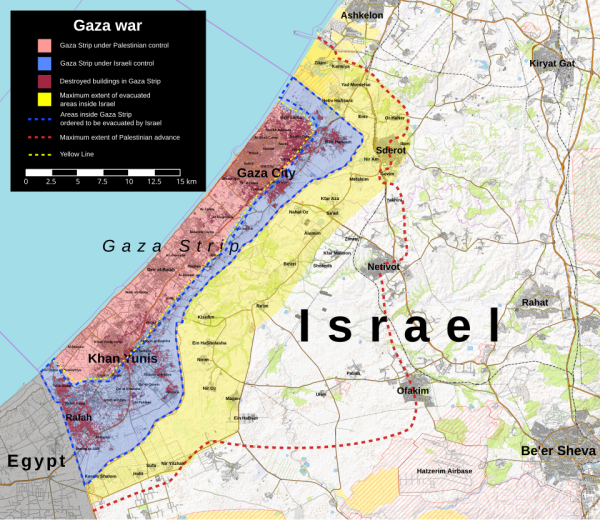
Current Israeli Gaza buffer zones
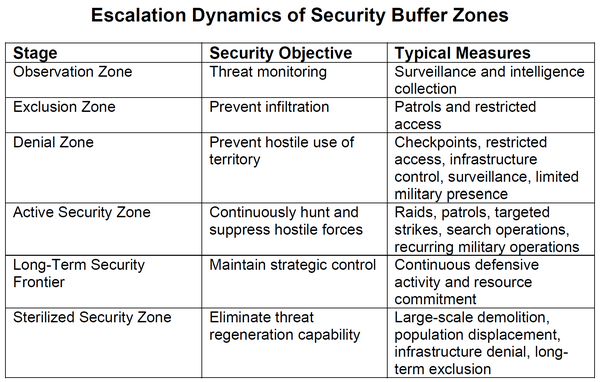
The Escalation of Security Buffer Tactics
Security buffers seldom remain unchanged. Adversaries evolve their strategies, finding new methods to infiltrate. With advancements in weaponry, intelligence, and tactics, pressure mounts to reinforce these protective barriers.
Observation zones can swiftly turn into exclusion zones. As threats grow, exclusion zones may evolve into denial zones requiring constant surveillance, infrastructure control, military mobility, and restrictions on civilian activities. Initially temporary measures often develop into permanent fixtures of security policy as planners strive to maintain their effectiveness.
This incremental logic manifests as pressures mount: if hostile forces exploit roads, those roads must be monitored; if they utilize buildings, those structures become targets. Each measure may seem valid in isolation, yet cumulatively they can create an expanding system of control as adversaries adapt.
As threats to buffers arise, so too do new methodologies to preserve security. This can trigger an escalating cycle that compels more aggressive interventions over time, and the financial and political burdens of maintaining a buffer may eventually eclipse its defensive benefits.
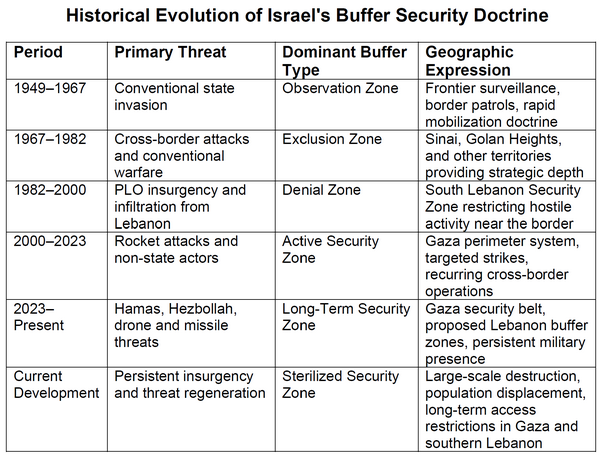
The Regeneration of Hostile Forces
Each established buffer zone creates a new tactical frontier. When a threat is pushed back, the old boundary recedes, and a new one arises. This reflects a fundamental vulnerability of territorial buffer strategies: while boundaries shift, the inherent strategic dilemmas persist. Hostile actors may simply relocate beyond these new frontiers, enabling them to infiltrate the expanded buffer zones again. New operational needs and threats continuously emerge, prompting the security apparatus to evolve correspondingly.
Insurgent and militant groups share a notable characteristic: they can recuperate even after severe military defeats. Organizations may lose leaders, resources, and territory, yet new groups swiftly arise to fill the void. While the players may change, the essential conflict often remains constant. Israel has contended with this issue in its conflicts with Hamas in Gaza and Hezbollah in Lebanon. Thus, the effectiveness of buffer defense becomes increasingly questionable. The fundamental assumption that pushing adversaries further away yields lasting security may not hold, especially when they reconstitute beyond and within the latest frontiers.
The ongoing insurgency exacerbates this issue. As hostile organizations re-emerge within buffer regions, pressure mounts to implement more comprehensive suppression tactics. Military operations initially aimed at armed groups tend to broaden their scope to include the denial of access to resources, transportation, communication, and civilian support systems.
This approach is understandable; when hostile forces perpetually reappear, military planners will seek to modify that environment. Yet such a process can trigger a cycle of escalation, necessitating increasingly aggressive measures to maintain the buffer. Recent military actions in Gaza and southern Lebanon exemplify this trend, showcasing large-scale demolitions and displacement of civilians, which, while aimed at diminishing insurgent capabilities, also draw significant international scrutiny.
The reputational fallout can have far-reaching implications. Israel’s security hinges not only on military efficacy but also on its diplomatic relationships, intelligence-sharing, economic partnerships, and political backing from allies. Actions deemed necessary for domestic security may be perceived internationally as excessive or punitive. As criticism mounts, Israel risks undermining vital sources of strategic support.
This creates a core dilemma within the buffer strategy: persistent insurgencies prompt increasingly harsh responses to maintain security, yet the political and diplomatic ramifications of such actions can outweigh the intended security benefits. The challenge is not that buffer-related military operations fail—many achieve their immediate objectives. Rather, the concern is that repeated tactical successes could create a cycle whereby security measures demand progressively larger political, diplomatic, and reputational sacrifices to be sustained.
The Erosion of Protective Distance
Buffer defense fundamentally hinges on one key assumption: distance fosters security. For much of military history, this notion has held true. Distance slowed down armies, and supply chains imposed operational constraints. Geographic barriers restricted offensives, ensuring additional space between adversaries provided tangible defensive advantages.
However, modern advancements in weaponry are rapidly diminishing these benefits. Missiles, drones, precision-guided munitions, satellite navigation, and evolving autonomous technologies allow hostile actors to project power across distances that were once considered secure. Capabilities now accessible to smaller states and militant groups were previously the domain of major powers.
This technological shift significantly impacts buffer strategies. If hostile forces can launch attacks from considerable distances, the incremental security gained from additional territorial depth starts to diminish. While moving borders outward may retain tactical importance, it no longer guarantees the same level of protection as in past conflicts.
The economic landscape of contemporary warfare further reinforces this trend. Offensive capabilities are often becoming less costly, while defensive systems climb in price. Relatively inexpensive drones and missiles pressure defenders to deploy complex and expensive interception measures. This results in an escalating disparity between the costs associated with offense compared to defense.
In this context, buffer zones increasingly face technological realities they were never designed to withstand. While territorial depth remains useful, its effectiveness is eroding as modern weapons grow more accurate, affordable, and long-ranged. A strategy heavily reliant on geographical separation must adapt to a shifting technological landscape in which distance is progressively losing its military significance.
The Perspective of Neighboring States
Security policies are interpreted not just by their creators, but also by nearby nations and populations whose interests may be impacted. From Israel’s viewpoint, buffer zones serve as necessary defenses against continual threats. However, regional actors may interpret these measures as land grabs, coercive tactics, or aggressive posturing.
Such perceptions are crucial, as they shape the long-term consequences of expanding buffer territories. Misunderstandings need not be based on truth, only widespread belief. Over time, the implications of these perceptions grow. While local militant groups may initially drive the establishment of buffer zones, it is full-fledged states that ultimately influence regional power dynamics. Measures perceived as manageable against fragmented non-state actors can evolve into significant geopolitical concerns when seen through the lens of more robust powers with substantial economic and military resources.
A buffer zone viewed as a temporary security mechanism by one party may be seen by another as the beginning of a more permanent strategic foothold. Such interpretations can influence military strategies, diplomatic ties, defense funding, and regional security dynamics long before direct confrontations arise. History demonstrates that states routinely respond not just to current capabilities but also to perceived future intentions.
Confusion regarding these intentions can exacerbate such fears. If political leaders and military officials deliver mixed signals about the future of buffer zones, neighboring states have little reason to adopt a benign interpretation. Various political factions in Israel have described operations in Gaza and southern Lebanon as temporary security measures, long-term restricted areas, or future settlement spaces. Faced with these contradictions, regional powers are likely to prepare for the worst-case scenario rather than the most benign possibilities. In strategic matters, uncertainty breeds caution, and caution often inclines toward worst-case assumptions.
Expanding security boundaries may prompt neighboring states to adjust their military planning, diplomatic approach, and strategic alignments in reaction to what they perceive as a security threat. The most significant repercussions of buffer expansions may not occur within the confines of the buffer itself but in the responses of more influential powers beyond its borders.
The Rise of Turkey and Egypt
The strategic implications of expanding security frontiers gain prominence when assessed against long-term regional shifts. For much of Israel’s existence, immediate security concerns have centered on fragmented militant groups and localized threats. However, the Middle East is not stagnant; demographic, economic, and military influences are in flux.
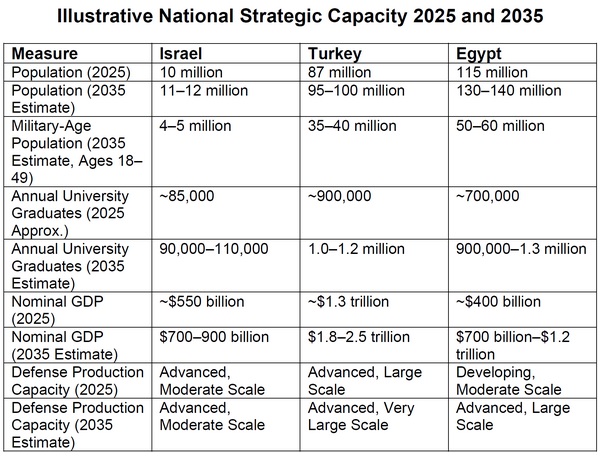
Two countries warrant particular attention: Turkey and Egypt. Both possess considerably larger populations than Israel, extensive industrial capabilities, and expanding domestic defense industries. They have also displayed escalating skills in drone warfare, missile production, electronic warfare, and military manufacturing. Although Israel’s current focus may lie elsewhere, Turkey and Egypt represent potential adversaries whose future significance may amplify as regional dynamics evolve.
Turkey has emerged as a prominent defense exporter; its drone systems have impacted conflicts across Libya, Ukraine, and the Caucasus. Concurrently, Egypt is bolstering its military in a crucial geographic role that connects North Africa with the Mediterranean, Red Sea, and Sinai.
While neither nation currently poses an immediate military threat, strategic foresight must consider not only present realities but also future possibilities. Growth in demographics, industry, technology, and military modernization can shift regional power dynamics over decades. The strategic challenges posed by confronting these nations would be fundamentally distinct from those presented by the localized militant factions that initially spurred the expansion of Israel’s security perimeter.
Historical trends illustrate that the growth of one nation often triggers balancing behavior from others. States that might compete with each other may discover mutual interests when faced with the rising power of a potentially aggressive neighbor. These responses need not manifest as formal alliances; incremental military modernization, intelligence sharing, diplomatic alignments, and strategic coordination against Israel could emerge over time if its buffer zones expand.
The long-term repercussions of Israel’s buffer doctrine will thus hinge not only on effects on militant groups operating adjacent to its borders but also on how larger regional powers react to the ongoing expansion of Israeli security boundaries.
Conclusion
The core question lies not in the tactical effectiveness of buffer zones but in whether the conditions for their sustained success still exist. Israel’s buffer strategy was conceived in a time when territorial depth conferred notable defensive advantages, when adversaries had limited means of projecting power, and when localized threats could be distinctly separated from broader regional dynamics. However, these circumstances are shifting.
Hostile organizations continually regenerate beyond the last frontier, transforming buffer zones into recurring security challenges instead of lasting solutions. Simultaneously, advancements in weaponry—missiles, drones, and precision-guided systems—are steadily diminishing the protective value of distance. Each additional mile of security now offers less protection than in the past.
The geopolitical landscape is also undergoing change. As Israel extends and reinforces its security boundaries, it risks generating conflict not only with local adversaries but also with regional powers that have greater populations, robust economies, and growing military capabilities. The strategic outcomes of such competition may ultimately outweigh the localized threats that initially justified the expansion of buffer zones.
In summary, the fundamental flaw in Israel’s buffer defense is less about tactical failures and more about the waning conditions necessary for its long-term success. What was once an effective means to enhance security is becoming less efficient, more costly, and strategically burdensome. Israel’s next major security challenge may arise not from the collapse of buffer zones but from their perceived effectiveness amidst evolving geopolitical realities.