The U.S. is fabricating misleading narratives to rationalize its increasing punitive measures against Cuba and its latest encroachment in Argentina.
In a troubling display of political doublespeak, the U.S. State Department seems to have forgotten the lessons of Orwellian language. As the Trump administration intensifies its embargo against the island nation, Secretary of State Marco Rubio, in a recent statement, redirected responsibility for Cuba’s escalating humanitarian crisis away from the U.S. blockade and onto the Cuban government.
In a brief video message aimed at the Cuban populace (though primarily designed for American voters), Rubio stated:
“The reason you are forced to survive 22 hours a day without electricity is not because of an oil blockade by the United States…[but] because those who control your country have looted billions of dollars.”
This political hypocrisy is striking, even by Washington’s standards. As noted by Ben Rhodes, a former correspondent for the New York Times and a veteran of the Obama administration, Rubio serves under a president who has personally profited more from corrupt dealings than even the most dishonest officials in Cuba.
Rubio now full Orwellian: the total blockade that we have put on your country after decades of an embargo has nothing to do with the scarcity in your lives or the fact that we are intentionally starving your children. https://t.co/OLLHJfyo3E
— Ben Rhodes (@brhodes) May 20, 2026
To spare readers the need to sift through the entirety of Rubio’s remarks, CODEPINK has provided a succinct translation and summary:
Translation:
After suffocating your economy for decades, we’re offering you neoliberal privatization and billionaire colonization to dismantle your hospitals, schools, and social services. Overthrow your government so we don’t have to. https://t.co/OW8ngmem4E— CODEPINK (@codepink) May 20, 2026
The recent communications from the Trump administration regarding Cuba have been so distorted that even hosts on NEWSMAX appear skeptical.
NEWSMAX: This Cuba thing — people struggle with how this is America first when gas is $4.55 a gallon
COMER: Cuba has always been a security threat
NEWSMAX: Really?
COMER: If some country went in and loaded Cuba with the same drones Iran had, yes I think it could be a threat… pic.twitter.com/Q6dr50bOPi
— Aaron Rupar (@atrupar) May 21, 2026
Meanwhile, accusations against 95-year-old former president Raul Castro, which serve as a facade for potential military action, have shed light on the questionable activities of the CIA-backed network known as Brothers to the Rescue. This group is notorious for its role in the 1976 bombing of a Cuban airliner, resulting in 73 deaths, as well as various attacks on civilian targets.
Max Blumenthal recently discussed on Judging Freedom how the Brothers to the Rescue intentionally violated Cuban airspace prior to their planes being shot down by Cuban defenses in 1996.
The Trump admin indicts Raul Castro for deterring CIA-backed terror network@MaxBlumenthal reacts to the Department of Justice’s indictment of former Cuban President Raul Castro for shooting down a pair of planes from a CIA-backed network of Miami Cubans, Brothers to the Rescue,… pic.twitter.com/bX0Bi8lQRY
— The Grayzone (@TheGrayzoneNews) May 21, 2026
Colonel Larry Wilkerson further suggests that the Brothers to the Rescue may have deliberately sought to provoke Cuban authorities into shooting down their planes:
The Brothers to the Rescue actually saw that their flights, during which they occasionally dropped items like weapons on Cuba, were ineffective. They felt that generating a sensational incident was necessary to achieve the impact they desired, which they believed would then be blamed on Cuba.
“The first act of terrorism I witnessed — because I took part — was a request to bring explosives into Cuba.” Behind the humanitarian image, Brothers to the Rescue was a CIA-trained exile operation built to sabotage infrastructure and arm unrest inside Cuba. pic.twitter.com/ZFsPWTWKhO
— COMBATE |🇵🇷 (@upholdreality) May 21, 2026
The challenge for the Trump administration is that even prior to its recent propaganda on Cuba, a substantial majority of the American public, weary of war and economically strained, opposed military action. Rubio’s rhetoric is unlikely to sway many. Recent polling data from YouGov shows that:
Sixty-four percent of Americans are against a war with Cuba, while only 15 percent support it, and 21 percent remain undecided. Among those who have a definitive opinion, 81 percent oppose a conflict.
Mark Weisbrot, Senior Economist and Co-Director of the Center for Economic and Policy Research, remarked, “This should make President Trump think twice about another ‘war of choice.’” He further noted that “experts on Cuba would laugh at the idea of Cuba being a security threat to the United States.”
As Caitlin Johnstone aptly states, a notable risk for Cuba lies in potential easing tensions between the U.S. and Iran, suggesting that the U.S. may shift its focus onto Cuba shortly thereafter.
If things cool down with Iran then it’s a safe bet they’re going in for the kill shot on Cuba.
The US empire never makes peace; it just moves the crosshairs of its war machinery from nation to nation.
Yay! The troops are leaving Afghanistan — oh, now it’s proxy war in Ukraine.…
— Caitlin Johnstone (@caitoz)
Meanwhile, the Cuban media collective Aguaje Films has created a satirical, animated short parodying what it perceives as the current U.S. regime-change strategy. In a style reminiscent of Iran’s Explosive Media, the video is accompanied by a catchy rap tune and characterizes Rubio humorously.
🎞️ 🇨🇺 A satirical animated short from Cuban media collective Aguaje Films mocks what it portrays as the modern U.S. regime-change playbook: cutting off fuel through sanctions, allowing blackouts and civilian suffering to deepen public anger, then reentering with “humanitarian… https://t.co/qdHySNBCnX pic.twitter.com/GJvOIvllMy
— Drop Site (@DropSiteNews) May 21, 2026
“Protecting the Global Commons” in the South Atlantic
The U.S. administration is not only engaged in deceptive narratives regarding Cuba; it has also initiated controversial maneuvers in Argentina. Recently, the U.S. Embassy in Argentina announced a partnership with the Javier Milei government aimed at patrolling Argentina’s “maritime zone” for five years.
The official intent of this program is to bolster regional security and combat maritime challenges, including illegal fishing and other illicit activities within the South Atlantic. Initially, the project is modest, but it aims for rapid expansion. According to reports from La Nación:
The collaboration begins with the transfer of a specialized camera aboard an aircraft designated for patrolling the Argentine maritime zone.
This initiative will grow in scale over the next five years, incorporating advanced technology, specialized training, and support for intercepting maritime threats.
The most striking aspect of this initiative is its branding as “Protecting the Global Commons.” This name is particularly disingenuous, as Argentina’s territorial waters are a sovereign asset, not part of any so-called global commons. This has not escaped the attention of some opposition lawmakers, who have voiced their concerns regarding potential U.S. interference in maritime surveillance.
Furthermore, it seems hypocritical for the Trump administration to claim a commitment to protecting global commons while simultaneously seeking to exploit the Western Hemisphere’s vast resources for the benefit of U.S.-aligned corporations. Consequences of such actions typically include environmental degradation and community displacement.
In reality, the U.S. has shown little regard for global commons and has historically taken measures to undermine public ownership of common goods both domestically and abroad. Worryingly, Wall Street is leading efforts to financialize and commodify natural resources, as reported by Whitney Webb in her 2023 article, “Wall Street’s Takeover of Nature Advances with Launch of New Asset Class.”
The natural asset company, or NAC, model will facilitate the creation of specialized corporations that control the rights to ecosystem services on specific land parcels, which may include services like carbon absorption and clean water. These NACs will then manage and monetize these natural assets, with the ultimate goal of maximizing profits, under the guise of “sustainability” and “conservation.”
In summary, this initiative has little to do with preserving global commons and everything to do with projecting U.S. power, particularly over crucial international shipping routes. As previously reported, the U.S. is making significant moves throughout Latin America’s Southern Cone:
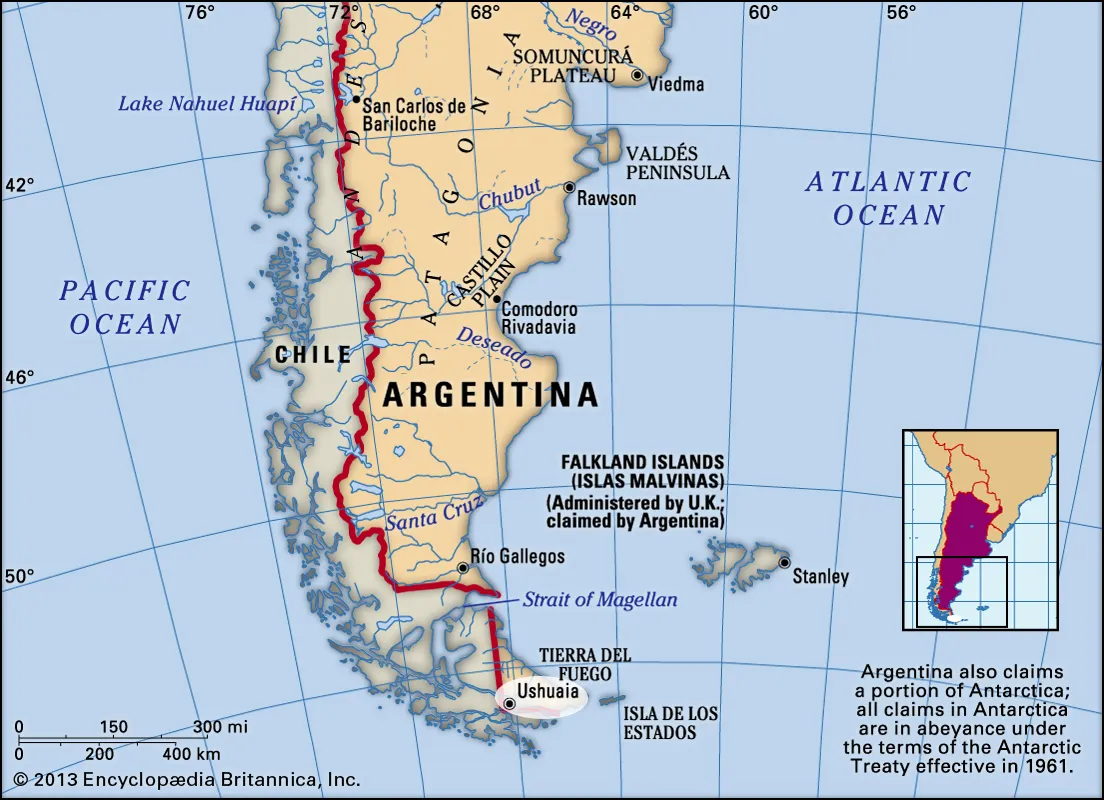
On Sunday (January 25), a U.S. Air Force Boeing C-40 Clipper landed in Ushuaia, Argentina’s southernmost city, cloaked in secrecy. Argentina’s Ministry of Foreign Affairs remained silent, and local government officials were left uninformed.
Moreover, during that same day, at least two private flights departed Buenos Aires’ San Fernando Airport bound for Ushuaia without any disclosed details. This information blackout has triggered considerable concern among local authorities, especially given that it coincided with the Milei administration’s announcement of a 12-month administrative takeover of the Ushuaia port, citing financial discrepancies.
The strategic relevance of Ushuaia remains indisputable:
Ushuaia sits at the gateway to Antarctica, which is rich in untapped resources, including the largest freshwater reserves in the world. Additionally, it is adjacent to the Drake Passage, which serves as a vital link between the Atlantic and Pacific Oceans. Control over both the Drake Passage and the Panama Canal would endow the U.S. with significant leverage over maritime trade routes in the Americas.
Furthermore, control over Cuba would grant the U.S. influence over another critical geopolitical zone: the Gulf of Mexico. As the Mexican politician José Cuauhtémoc Cervantes indicates, Cuba’s location opposite one of the continent’s vital trade and energy pathways positions it strategically for monitoring and potential manipulation of maritime traffic.
U.S. Treasury Secretary Scott Bessent has characterized Argentina as a cornerstone of U.S. strategy in Latin America. Since Milei assumed office in December 2023, Ushuaia has hosted two U.S. Southern Command commanders. Milei himself traveled over 3,000 kilometers to meet General Richardson to announce the establishment of a joint naval base that would grant the U.S. and Argentina control over this key entryway to Antarctica.
Should the U.S. successfully construct a modern military base with comprehensive air, land, and naval capabilities in close proximity to Antarctica, it would further consolidate American control over essential maritime routes and resources, thereby jeopardizing Argentina’s neutrality toward Russia and China.
Under Milei’s leadership, Argentina is aligning itself strategically with U.S. military interests, particularly concerning access to Antarctica and the Strait of Magellan.
Critics have voiced concerns that a U.S. base could strain relations with both China and Russia, while also alienating regional allies like Brazil and Chile. Additionally, there are apprehensions about bypassing constitutional requirements for congressional approval regarding foreign military deployments, which could extend to U.S. submarines stationed in Ushuaia.
However, the U.S. interest in Argentina doesn’t end with its southern port. In its final days in office, the government of Alberto Fernández signed an agreement with the U.S. Army Corps of Engineers to study and manage the Paraná River, which handles 80% of Argentina’s exports. One of Milei’s first actions was to endorse that memorandum.
The Paraná River represents a major trade corridor for raw materials across five countries (Brazil, Bolivia, Paraguay, Argentina, and Uruguay), comprising 3,400 kilometers of navigable waterways, with the longest stretch situated in Argentina.
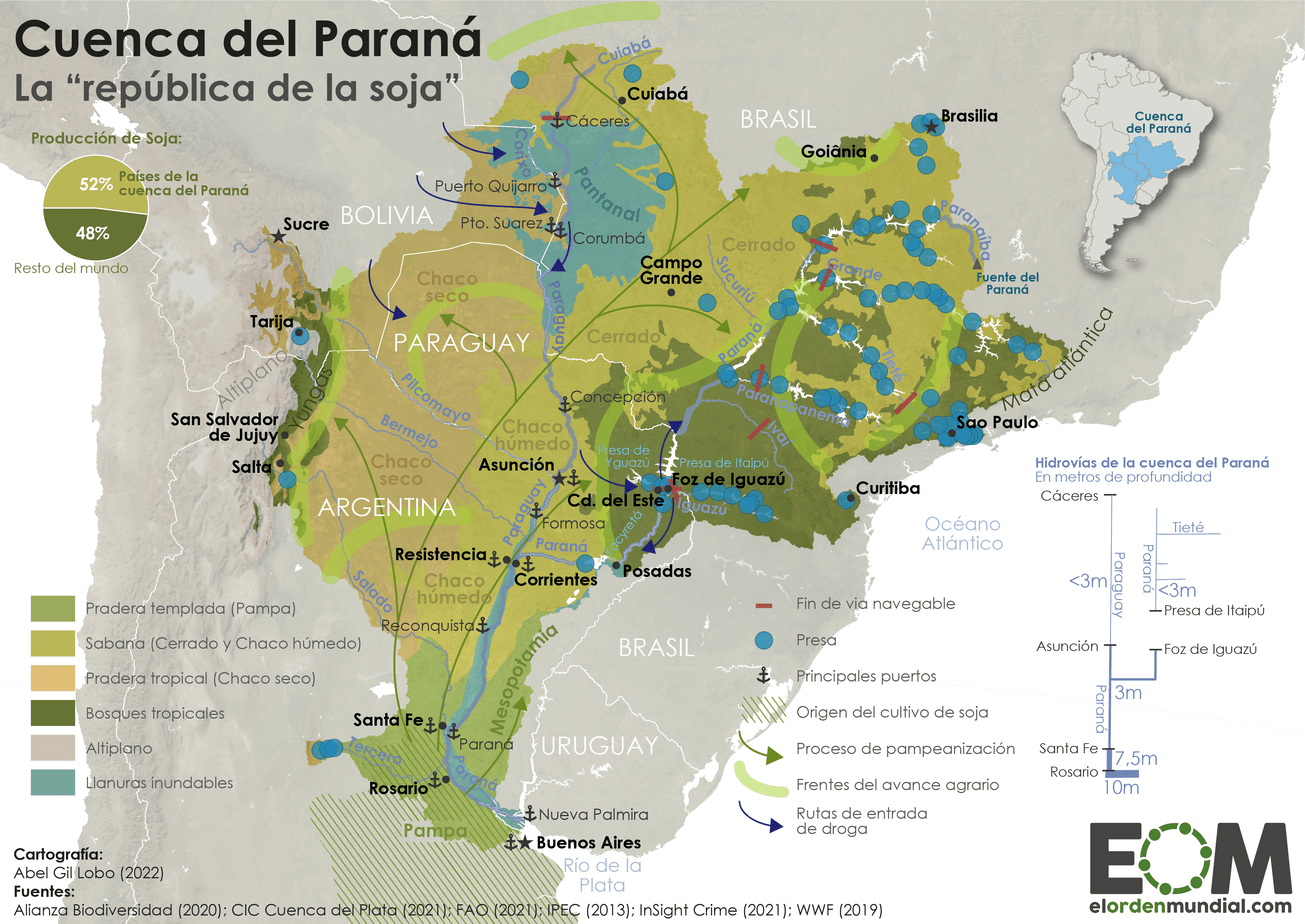
The Milei government is advancing a megaproject to dredge and deepen the river, which would allow larger vessels to navigate its waters. However, activists have warned that this could have catastrophic effects on local communities dependent on the Paraná, Paraguay, and La Plata river basin, including Buenos Aires, and violate the Escazú Agreement, an international environmental treaty signed by 24 Latin American and Caribbean nations.
This approach aligns with Milei’s deeply extractive economic model, aimed at maximizing exploitation of Argentina’s primary resources (oil, natural gas, lithium, and industrial agriculture), while neglecting the national industrial sector. Argentina has recently reported the poorest industrial performance globally, alongside Hungary.
“The re-primarization of the economy is resulting in the dismantling of its industry, education, and science, paired with severe environmental ramifications,” explains Enrique Viale, president of the Argentine Association of Environmental Lawyers, in an interview with El Salto.
This trajectory reflects an updated version of the Trump doctrine, echoing the earlier Roosevelt corollary. If successful, the remaining nations of the American continent — all 34, plus Greenland — would primarily serve the interests of the U.S. empire.
Thus, it is crucial for Washington to control the Paraguay-Paraná waterway, which serves as South America’s primary economic artery for bulk transport (despite official narratives focusing on combating “narco-terrorism” and “Islamist terrorism,” particularly in the form of Hezbollah).
The management and future of South America’s most vital trading waterway currently hangs in the balance. Both Jan de Nul and the Deme Group, with ties to major U.S. dredging firms, have submitted bids for a 25-year contract to manage the Paraná River, with terms explicitly prohibiting bids from state-owned enterprises and excluding Chinese participation. The U.S. House Foreign Affairs Committee has expressed concerns regarding potential Chinese influence in the bidding process.
Should the U.S. exert pressure successfully, it would not merely be involved in patrolling Argentina’s maritime waters but would also gain substantial influence over South America’s key commercial waterways, ostensibly in the name of global commons protection.
Local sentiments reflect a different perspective on these developments. At a recent meeting in Argentina’s Chamber of Deputies, Hugo Godoy, the Secretary-General of the Argentine Workers’ Central Union, highlighted the potential dangers linked with both the Paraná waterway tender and the plans for a U.S. military base in Ushuaia.
“The nation’s sovereignty and interests are at stake. We cannot separate the discussion of U.S. maritime patrols from that of the Paraná waterway, the U.S. intervention at Ushuaia port, or the federal government’s actions in Buenos Aires,” Godoy stated, as reported by La Nación.
He further noted that there are evident geopolitical motives driving the U.S.’ plans to control not just Argentine territory but also to fragment the nation. This echoes similar observations made by numerous Mexican commentators, notably the geopolitical analyst Alfredo Jalife, who asserts that the U.S. aims to dominate Mexico by dividing it into smaller factions. This issue deserves further exploration.


