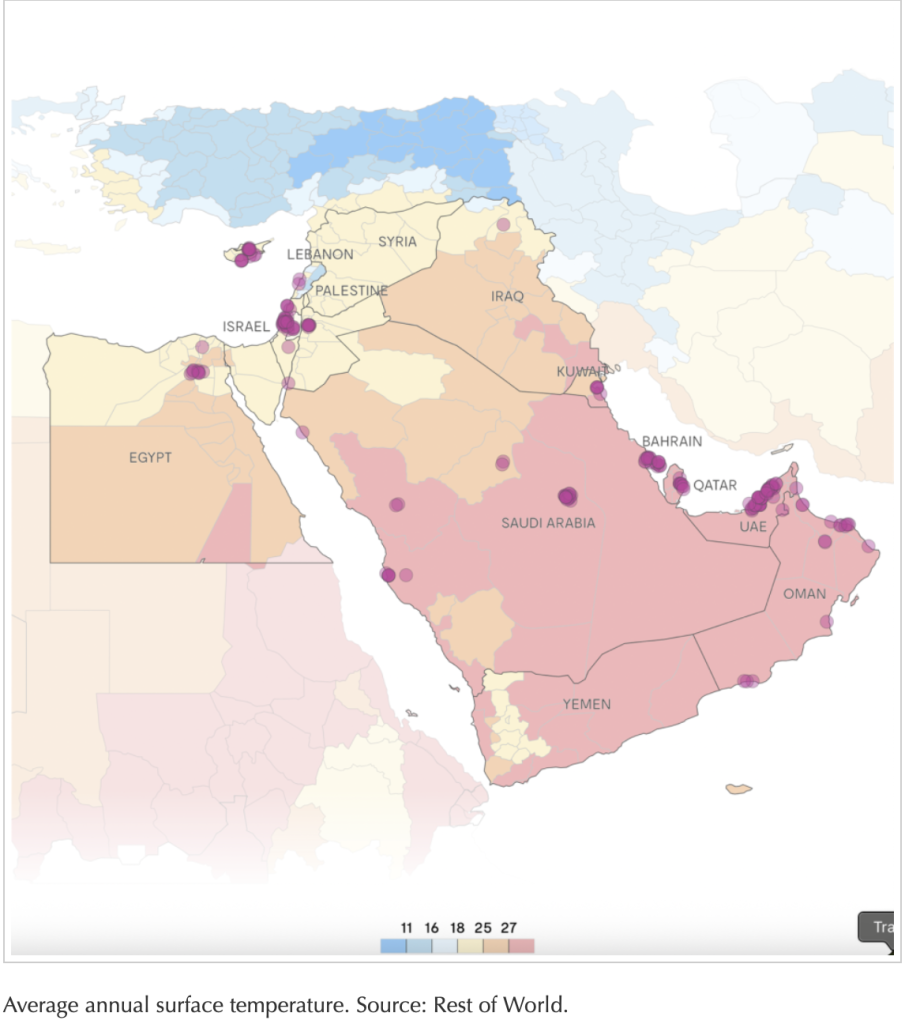
The ambitious trillion-dollar AI initiative in the Middle East promised great things. With boundless energy resources, it envisioned extensive data centers emerging from the desert, a strategic move that would bolster US technological dominance in an energy-rich region. It also set the stage for significant opportunities for corruption.
However, the dream seems to be unraveling.
Let’s rewind a few years to the unveiling of the India-Middle East-Europe Economic Corridor (IMEC) during the September 2023 G20 Summit in New Delhi. This proposed network of railroads, ship-to-rail connections, road routes, energy pipelines, and high-speed data cables was intended to link South Asia, the Gulf, and Europe, providing an alternative to China’s Belt and Road Initiative (BRI). Unfortunately, its logistics model seemed implausible—cargo would have to travel by ship from India to the UAE, be transferred to trains traversing the UAE, Saudi Arabia, Jordan, and Israel, and then ship back out from Israel to Europe.
However, the Trump administration shifted gears from prioritizing logistics to exploiting the IMEC’s potential as a hub for American digital dominance, with Israel taking a central role. The move brought promises of AI advancements alongside hefty profits for American officials, entangled in corruption. But now, as conflicts flare up in the Persian Gulf—on which this strategy relied—the entire plan is faltering.
Let’s delve into how the Persian Gulf compute corridor was envisioned versus the stark reality unfolding today.
The US began sharing technology with Gulf nations like Saudi Arabia and the UAE, contingent on agreements that AI-generated exports utilizing American chips would be billed and paid for in dollars or stablecoins tied to the dollar. The Gulf was expected to supply capital, land, and an abundance of energy for data centers, enabling the flow of American computational power while facilitating considerable financial kickbacks to American officials.
Before the outbreak of hostilities, plans called for over 3.3 gigawatts of AI-related compute power across the Gulf. Even if only a fraction of that was constructed, it positioned the Gulf monarchies, in the words of Guy Laron:
…as a sovereign compute corridor: a region where energy systems, capital flows, chip diplomacy, and model training capacity are boldly interlinked. The United States, despite its technological innovations, lacks the capability to train models at a planetary scale without overwhelming its grid. The Gulf, however, serves as the essential framework.
In 2025, when the US authorized the export of up to 70,000 advanced Nvidia chips to the UAE and Saudi Arabia, the Trump administration proclaimed that this deal would “promote sustained American AI dominance and global technological leadership.”
Yet, it served other purposes as well. According to a report by the New York Times last year, digital assets constituted one of the most significant income streams for the Trump family. Eric Trump’s World Liberty Financial struck a $2 billion deal with the Emirati government’s AI investment firm MGX, with rights to the Trump-backed stablecoin USD1. This partnership facilitated billions in transactions on Binance, an exchange notorious for regulatory transgressions, where its founder, Changpeng Zhao, received a pardon from Trump after a guilty plea related to failures in preventing money laundering in 2023.
While US geopolitics have often been aligned with blatant corruption, the scale of Trump’s dealings might be unprecedented yet displayed some semblance of strategy. Edward Ongweso, Jr. elaborated on the rationale behind this imperialistic approach to the computing stack:
In Europe, the cost is $0.29 per kWh, in the US it’s about $0.17, but in the Gulf, it averages $0.10 per kWh for unsubsidized power. Through centralized planning, the GCC can rapidly build power infrastructure; the Kingdom plans to add 42 GW of gas capacity by 2030, outpacing the United States by 40 percent.
Moreover, geographically, the Gulf sits at the intersection of three continents with a vast submarine cable network, allowing it to service four billion internet users with a latency of under 100 milliseconds, ideal for AI applications. Additionally, the region boasts the world’s largest desalination facilities, ensuring sufficient water supply to cool power-intensive AI data centers as demand grows.
Financially, the presence of nearly $5 trillion in sovereign wealth funds offers a level of patience that starkly contrasts the frantic demands of Western lenders.
However, recent months have been detrimental for this ambitious project.
Things Fall Apart
The challenges faced by these Persian Gulf data centers included not only the need for energy-heavy cooling:

And the requirement for energy-intensive desalination:

But they were also being constructed in a region where impending conflict was becoming increasingly evident. The situation escalated as follows:
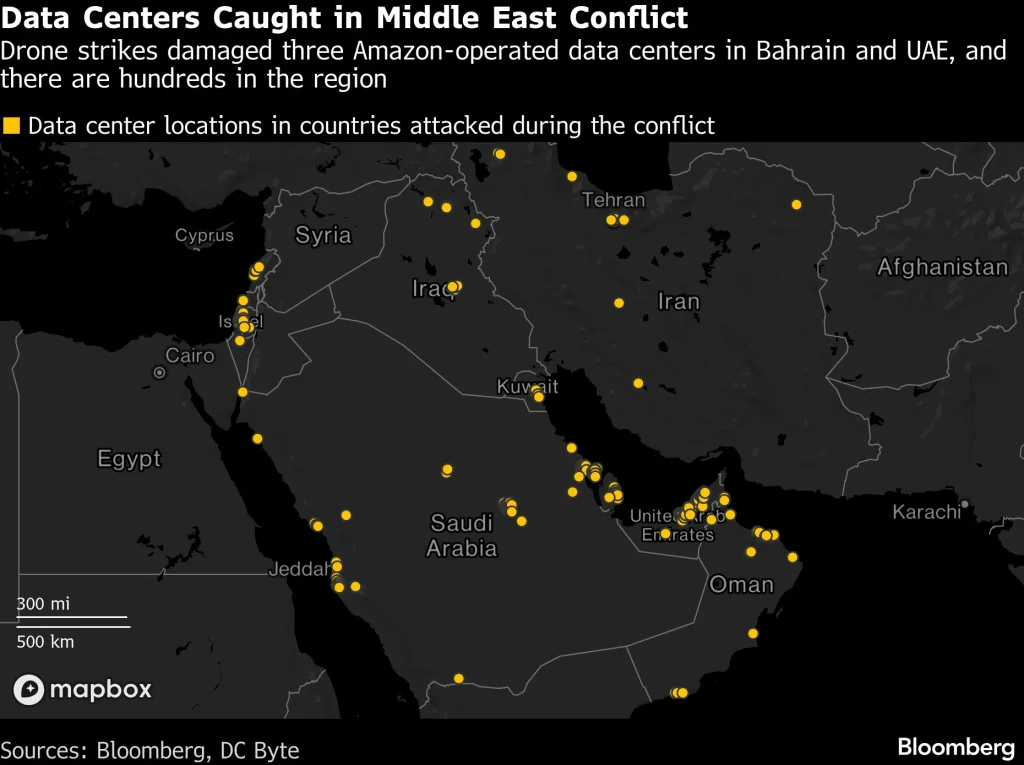
March 1: Iranian Shahed drones targeted two Amazon Web Services data centers in the UAE. A third facility in Bahrain was also attacked.
March 11: A US-Israel operation targeted an Iranian bank’s data center. Iran’s Revolutionary Guard Corps issued threats of retaliation against US companies with Israeli affiliations, implicating tech giants like Google, Microsoft, Palantir, IBM, Nvidia, and Oracle.
March 31: Iran reiterated threats against tech firms.
April 2: Iran struck an Oracle data center in Dubai.
If the US-Israel conflict reignites, the massive $30 billion Stargate project spearheaded by OpenAI in the UAE, along with other data centers, could face significant risk. The targets are plentiful:
Embedded Military Tech
Despite claims that targeting data centers equates to striking “civilian” infrastructure, these Silicon Valley enterprises often serve military interests. While it is unclear whether every Persian Gulf data center aligns with US military operations, many DO directly support military efforts. Reports indicate that the Pentagon utilizes AI to strategize air operations, compile kill lists, and coordinate military interventions.
This integration blurs the lines between military and civilian frameworks, making these data centers similar to embedding weaponry within civilian infrastructure. As detailed by The Conversation:
The computing infrastructure powering models, such as Claude, often operates on secure Amazon Web Services clouds that house sensitive government data. Commercial data centers provide essential services that keep modern technology functioning, including AI systems. Disruptions in these centers can significantly impact national military capabilities and civilian life. When Iran targeted data centers in the UAE, it led to extensive disruptions in the local banking system.
Seeing Nothing, Hearing Nothing
The attacks on these data facilities have already inflicted economic damage, raising concerns about Silicon Valley’s continued involvement in the Gulf and the overall viability of America’s “computer hub” strategy.
Amazon now faces months of repairs, leaving banks and other sectors struggling with service interruptions. Future repairs and staffing could be complicated by shortages of both materials and labor. Key materials essential for AI infrastructure development have become scarce, and labor issues persist, with CNBC reporting on the following concerns:
Onsite workers are experiencing heightened safety risks, with Pure DC providing some support for its personnel in the Middle East. According to CEO Gary Wojtaszek, employees have the autonomy to decide on their involvement, while those continuing to work onsite will receive added comfort and perks, like flexible work arrangements and welfare packages for all staff.
Data center operators are now exploring ways to manage facilities remotely, leveraging technology to mitigate risks. A trend toward implementing a “hazard pay” in worker salaries may become more common as well, as noted by William Self, chief workforce strategist at Mercer.
How convenient for the privileged to continue working from home while blue-collar workers brave dangerous environments for meager additional compensation. History seems to be repeating itself.
Back to Amazon, which, according to The Register, waived customer fees in its Middle Eastern cloud sector throughout March, costing the company an estimated $150 million. As outlined by Tech Policy Press, these American firms face rising risks due to potential Iranian strikes:
Technology providers often invoke force majeure clauses, arguing that acts of war are unforeseeable events that relieve them from liability. However, regional legal frameworks put strict limitations on force majeure applications in active conflict zones. A critical triad of Dubai Court rulings established that providing contracted services constitutes an “obligation to achieve a result,” not merely an “obligation to show care.” Therefore, failure to deliver services puts the provider in breach of contract.
The courts scrutinized the foreseeability dimension of the force majeure defense rigorously; engaging in contracts in an active conflict zone means military disruptions are an operational risk. The Dubai Court of Cassation emphasized its ruling on the doctrine of impossibility, stipulating that if military actions hinder performance, contracts are automatically rescinded, shifting the risk burden entirely to the service provider.
This jurisprudence offers a stark warning for the ongoing conflict with Iran. If a data center is incapacitated by an attack, courts are likely to regard such events as foreseeable risks for companies operating in conflict areas. Without well-crafted military disruption clauses explicitly transferring financial risks to clients, service providers are legally obligated to absorb costs and potentially refund their customers.
So, will Silicon Valley and Washington reconsider their ambitions in the Persian Gulf? Not likely. Much like the AI bubble, the tech sector continues to deny reality.
The current situation with Iran underscores the growing risks of aligning closely with Washington and Tel Aviv while attempting to operate safely near Iranian territory. This trend is likely to persist in conflicts instigated by the US-Israel alliance.
Ironically, those promoting the UAE as a model for societal organization may find themselves adopting similar counterproductive strategies—including discussions about smaller, more decentralized facilities and acquiring anti-drone defense systems. If their AI technologies were as sophisticated as claimed, they might recognize the inherent flaws in their approach.

