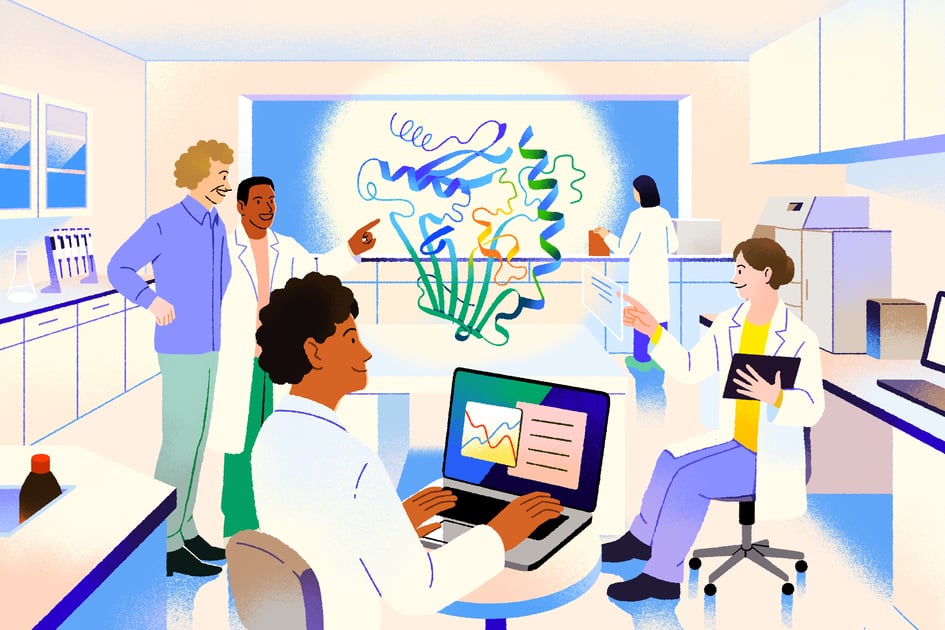
In 2020, researchers from Google DeepMind introduced AlphaFold2, an innovative AI model designed to address a significant scientific dilemma: can we deduce a protein’s structure solely from its constituent ingredients? Achieving this without resorting to lengthy and costly laboratory experiments promised to transform our understanding of biology while accelerating drug discovery.
At an annual competition where scientists strive to decode protein structures, AlphaFold2 became the first AI model to achieve results on par with traditional lab methods. In the years following its release, it successfully predicted the structures of over 200 million different proteins—an astonishing 1,500-fold increase compared to the number of proteins characterized through decades of laboratory research. In 2024, the model’s lead developers were honored with the Nobel Prize in Chemistry.
According to Ryan Hill, an assistant professor of strategy at Kellogg, AlphaFold2 and similar models have generated considerable excitement within the scientific community. Alongside Carolyn Stein from MIT, Hill aimed to quantify AlphaFold’s impact on biology, examining changes in the speed and focus of discoveries, and the nature of scientific work itself.
This research offers a glimpse into the rapid transformation AI can bring to specialized fields—an occurrence that may become increasingly commonplace as we move deeper into the AI era.
“Economists are facing numerous questions about AI’s role in our lives and the economy,” states Hill. “This situation serves as a fascinating microcosm to study these dynamics since it involves a robust AI tool performing a specific task that we can observe and quantify.”
An Overnight Transformation
Proteins, although numbering over 200 million, consist solely of 20 organic building blocks known as amino acids. Due to their ability to fold into intricate three-dimensional structures, determining which amino acids form a protein is akin to trying to envision a car from a collection of its disassembled parts. Ascertain its three-dimensional structure—and understand its functionality and potential control—was once a long, arduous task.
Using experimental methods to define the three-dimensional arrangement of proteins required years and incurred costs of approximately $100,000 for each resolved protein. Consequently, as of 2020, fewer than 0.1 percent of known proteins had their structures determined.
AlphaFold2 revolutionized this situation almost instantly, delivering millions of predicted structures with an accuracy comparable to those expensive experimental methods.
“Numerous individuals spent years mastering methods to solve experimental structures,” remarks Hill. “Then, seemingly overnight, Google DeepMind ran their algorithm on every known protein and made it publicly available.”
Enhancement, Not Replacement
Hill and Stein assessed the influence of AlphaFold’s rapid breakthrough on the scientific landscape by amalgamating various scientific databases focused on protein research. These resources are filled with data regarding the studies and publications surrounding every known protein, creating a historical record spanning decades.
This analysis enabled the researchers to explore how the significant impact of AlphaFold2 reshaped structural biology. At first glance, it seemed that the answer was unexpectedly minimal. Since the introduction of AlphaFold2, the number of journal articles utilizing traditional experimental methods for determining protein structures remained consistent.
“Structural biologists are largely continuing their previous practices,” observes Hill. “They’re publishing a similar volume of papers as before, and, surprisingly, they’re still featuring these works in top-tier scientific journals, even though parts of their work are now easily replicated by AI.”
However, digging deeper revealed that AlphaFold2 was enhancing, rather than displacing, the capabilities of experimentalists. Structural biologists began incorporating the AI model into their work, resulting in quicker and more accurate findings.
“There’s often valuable complementary insight,” Hill explains. “The AI isn’t infallible. There are instances where variations of a protein or specific structural segments present predictive challenges. Experimental methods can also yield inconsistencies. Merging insights from both the AI and experiments increases our confidence in confirming the correct protein structure, which can be crucial for subsequent research.”
A Floodlight for Science
Moreover, the deployment of AlphaFold2 seemed to broaden the spectrum of proteins studied by scientists. Many proteins that lacked defined structures prior to AlphaFold2 were not neglected out of indifference; they were often unmanageable through experimental methods or would have required more structural biologists than were available to meet demand.
Hill and Stein discovered that AlphaFold2 quickly widened the range of proteins under examination, describing this phenomenon as a “floodlight” effect.
For instance, researchers investigating reproduction in zebrafish had identified a crucial protein, yet their lab lacked the necessary expertise to ascertain its structure.
“These researchers would have had to wait and hope that someone else might achieve a breakthrough, which could then allow them to build upon it,” says Hill. “This scenario is not uncommon in many scientific areas.”
With the introduction of AlphaFold2, those researchers could obtain an AI-generated prediction of the protein’s structure, thus informing their subsequent experiments on its function. Their findings eventually appeared in Cell, a premier biology journal.
This pattern of activity increase was noted throughout the field, according to Hill and Stein.
“Within a few years of AlphaFold’s launch, we’ve observed significant upticks in activity related to previously unsolved proteins,” Hill explains. “Such shifts frequently accompany technological advancements. When a task becomes significantly more affordable due to automation, it enables people to pursue various new tasks that were previously inaccessible.”
One Bottleneck After Another
While producing striking three-dimensional visualizations of complex protein structures is impressive, the ultimate goal of the protein-folding challenge lies beyond aesthetics. Scientists aspire to leverage these structures to gain deeper insights into how essential proteins operate, ultimately aiming to influence their activity to develop new drugs that could cure diseases, slow aging, or enhance human health.
Hill and Stein sought to find evidence that AlphaFold2 was expediting those downstream discoveries as well. However, they did not observe a significant effect on drug development in the wake of the AI model’s introduction—at least not yet.
“Even with a highly capable machine-learning tool for structural analysis, it remains merely one segment of an extensive puzzle,” Hill clarifies. “Given the multitude of bottlenecks in the process, no single automated task can dramatically accelerate drug discovery.”
“The upside is that it reveals new opportunities, enabling us to direct our human resources toward resolving those bottlenecks, which should enhance our productivity,” he adds. “There will be advantages, but I wouldn’t anticipate instantaneous outcomes.”
A New Collaborator
The launch of AlphaFold2 coincided with a pivotal moment for AI—two years prior to the introduction of ChatGPT, which sparked widespread interest in generative AI models and their transformative potential. As these models evolve, anxieties have arisen regarding their capacity to replace even the most specialized human roles.
However, few professions are as specialized as that of a structural biologist. Thus, the narrative of AlphaFold2 may offer reassurance to skilled workers across various fields, according to Hill.
“Many new technologies have effectively taken over tasks previously handled by human workers, leading to concerns about potential negative consequences,” he notes. “Conversely, past instances of automation have typically resulted in the emergence of new opportunities within the economy, alongside shifts in the nature of available jobs. These tools tend to enhance human productivity.”
The story of a disruptive technology like AlphaFold2 enhancing—not replacing—the capacities of human experts serves as preliminary evidence for an optimistic vision of human-AI collaboration, both in science and beyond.
“If AI can participate more actively and boost scientists’ productivity or even generate ideas, the ripple effect across the economy could be immense, making more individuals and processes efficient,” asserts Hill. “That prospect is exciting. It opens the door to breakthroughs that might have been impossible without AI support.”