Recently, it was announced that Russia will cease transporting oil exports from Kazakhstan to Germany via the Druzhba pipeline, effective May 1. This decision poses a significant challenge for Germany, especially given the ongoing global supply chain disruptions stemming from the US-Israel conflict over Iran.
The Kazakh oil that Russia supplies constitutes about 17 percent of the Schwedt refinery’s total output, which is pivotal for providing diesel, petrol, and heating oil to Eastern Germany, including the capital, Berlin.
In 2022, the Schwedt facility was confiscated from the Russian oil company Rosneft, leaving Germany in a precarious position as it seeks alternative routes for Kazakh oil. This latest development serves as a stark reminder of the complexities and consequences of Germany’s conflict with Russia. Meanwhile, the media perpetuates narratives filled with inaccuracies, omissions, and misinformation. Politico’s Weekly Berlin Bulletin not only reflects a distorted reality perceived by the German ruling class but also, when carefully scrutinized, highlights the predicament in which Germany currently finds itself:
VLADIMIR THE OPPORTUNIST: Amid a new energy crisis ignited by the war in Iran, Russian President Vladimir Putin seems poised to seize the moment.
The Kazakh factor: This week, Moscow confirmed it would halt the flow of Kazakh oil to Germany via the Druzhba pipeline starting May 1. Russian Deputy Prime Minister Alexander Novak stated that this decision “is related to technical capabilities to date.”
Remaining leverage: However, many experts and some German politicians doubt that explanation holds much water. After the Kremlin’s full-scale invasion of Ukraine in 2022, Germany attempted to lessen its dependency on Russian natural gas and oil. Nonetheless, it still receives a limited amount of Kazakh oil through a segment of the Druzhba pipeline that traverses Russia, granting the Kremlin ongoing leverage over Germany.
Every bit counts: Although the Kazakh oil flow isn’t substantial, its absence exacerbates an energy shortage that is hitting the German economy hard. This week, the government was compelled to revise its growth forecasts downward. As first reported by Reuters, the cessation of Kazakh oil shipments comes at a time when Chancellor Friedrich Merz is under rising pressure to manage surging fuel prices, suggesting the Kremlin might aim to intensify Germany’s difficulties.
Multiple motives: Kazakh oil expert Sergey Vakulenko noted, “It’s an opportune moment to worsen the situation for the refineries.” He mentioned another possibility: redirecting Kazakh oil to Germany would necessitate passage through Russian Baltic ports like Ust-Luga or Primorsk, which are currently under increasing assault from Ukrainian forces aiming to undermine Moscow’s oil revenue for its war efforts.
‘Shield’ for Moscow: Following intensified Ukrainian attacks on Russian oil export infrastructure, particularly the Baltic ports, there is concern that Germany’s reliance on these venues for Kazakh oil could inadvertently shield Moscow from further scrutiny. Vakulenko suggested that if Germany depended on these ports, it might influence the Ukrainians to curb their attacks.
Let’s analyze the situation:
Key Omission: Why Is Russia Halting Deliveries?
The specific reasons remain unclear, but Kazakhstan’s Energy Minister, Yerlan Akkenzhenov, indicated that it likely stems from recent assaults on Russian infrastructure.
Ukrainian attacks, supported by Germany, persist against a variety of Russian energy installations. While Western media often claims these actions cripple Russia, they react with outrage when such incidents impede German imports. Additionally, attention is frequently diverted from obvious sabotage that affects energy channels used for Russian resources, as demonstrated by the recent repair disputes regarding the southern segment of the Druzhba pipeline supplying oil to Hungary and Slovakia.
Ukrainian President Zelensky stated that the damages were a result of a Russian assault. However, repairs were ultimately completed just before a crucial €90 billion EU loan was finalized.
Zelensky notably remarked, “No one can guarantee that Russian attacks on the oil pipeline infrastructure won’t occur again…” Vulnerability was promptly illustrated when Ukrainian drones reportedly targeted a Druzhba pipeline station crucial for export-grade oil production.
Amusingly, Germany is now gearing up to receive Kazakh oil via Russian ports—the Caspian Pipeline Consortium terminal on the Black Sea and Ust-Luga on the Baltic Sea—both of which remain under threat from Ukrainian drone attacks, possibly launched from Baltic states.
Correction: Germany Has NOT ‘Weaned Itself Off’ Russian Natural Gas and Oil.
According to the Clean Energy Wire:
The energy industry group BDEW indicates that Norway has overtaken as Germany’s primary gas supplier, accounting for approximately 45 percent of imports by 2025, with some gas arriving in liquefied form via four coastal import terminals. Additionally, much of the remaining gas arriving in Germany has complex origins, including contributions from the US, Algeria, and Russia. Even now, Russian LNG arriving at ports in Spain, France, and Belgium can still infiltrate Germany’s gas grid, despite a halt in direct imports. BDEW estimates approximately one-third of Germany’s gas imports in 2025 will stem from the US, factoring in the US’s share of imports from its bordering countries.
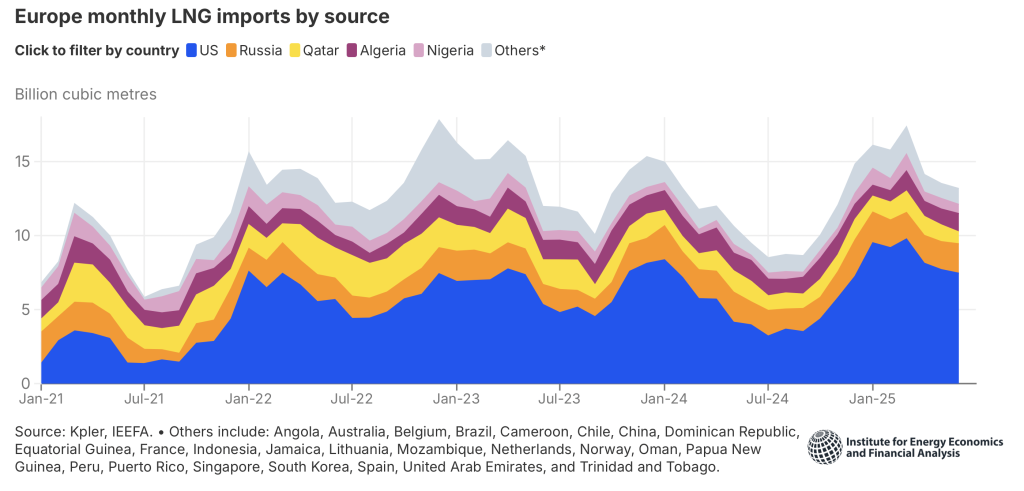
While the US has emerged as a dominant supplier, Russia continues to export significant amounts of LNG to the EU:

It is dismissive to assert it’s difficult to trace gas sourced from neighboring regions. The following visuals help clarify:

Nearly 78 percent of Russia’s LNG exports to the EU are sent to countries adjacent to Germany (France, Belgium, and the Netherlands). Absent a mechanism to segregate Russian gas from other imports before it reaches Germany, the country cannot genuinely claim to have severed ties with Russian energy.
The situation regarding oil mirrors this reality. Germany’s assertion of cutting off Russian oil appears unfounded.
Moreover, Kazakh oil transported through the Druzhba pipeline—the longest oil pipeline in the world—likely gets blended with Russian oil. Some argue that since payments are made to Kazakhstan, Germany effectively ceases financing Russian oil. However, this logic is flawed as well.
Much of the Kazakh oil originates from consortiums that involve Russian stakeholders such as Lukoil, despite Kazakhstan’s attempts to acquire Lukoil’s assets. Consequently, Russia still earns transit fees on this oil.
Furthermore, tracking crude oil on global markets is notoriously challenging due to the mixing and blending processes involved. Despite numerous attempts by Western authorities to sever ties with Russian oil, it remains an integral component of international trade.
Countries like Azerbaijan have increased their oil and gas supply to the EU while receiving additional supplies from Russia to meet domestic needs, leading to potential mixing with exports. Meanwhile, Turkey has heightened its oil imports from Russia while simultaneously increasing exports to the EU.
The EU sanctions package introduced earlier this year aims to prevent the import of refined petroleum products derived from Russian crude. Still, ample loopholes exist. According to RFE/RL:
Critics have raised alerts that many refineries might find ways to disguise the origins of the crude oil in their products to bypass EU sanctions. Exemptions for specific countries, including the UK or Serbia, create avenues for Russian crude-refined products to resurface in the EU.
Analyst Isaac Levi noted that refineries could exploit individual country loopholes, especially since the bans pertain to ports and refineries engaging with Russian crude.
For instance, the Kulevi refinery on the Black Sea procures Russian crude, refines it, and could possibly ship those refined products from another port entirely.
Why Fuel Your Enemy?
Politico’s coverage of the Kazakh oil situation, like many reports in the Western media, neglects essential context. Notably, this situation unfolds as Germany is indirectly facilitating continuous assaults inside Russia. The nation seems to be fueling a conflict that is resulting in significant Russian casualties, increasingly integrating weapon manufacturing with Ukraine, and even transitioning production lines traditionally used for automobiles to weapons manufacturing. Germany has bold ambitions to emerge as the strongest military presence in Europe (a modest aspiration), primarily aimed against Russia.
In this context, one might argue that Moscow’s response has been restrained.
One Accuracy: It Is Impeccably Timed
If halting Kazakh oil is indeed a voluntary choice by Moscow rather than a reaction to Ukrainian attacks, the timing is certainly strategic. As reported by DW:
The refinery is likely equipped with alternative sources to maintain much of its supply; however, this news arrives at a time when Europe grapples with one of the most significant energy crises in decades.
The ongoing conflict in Iran and the concurrent closure of the Strait of Hormuz has drastically reduced oil flows to Europe and Asia, driving up prices. Currently, kerosene—a vital component of jet fuel and a key product from the PCK refinery—is in particularly short supply due to this crisis. Airlines globally are being forced to scale back operations, as evidenced by Lufthansa eliminating 20,000 flights from its schedule between May and October.
The prevailing narrative in elite circles in Europe insists that Russia is “weaponizing” energy exports, and the proposed solution is to amplify efforts to sever ties. Ironically, these same sources express shock at the increasing popularity of the Alternative for Germany (AfD) party. Labeled as “far right,” the discussion surrounding the party is layered with complexity. While some internal opinions risk veering into more extreme ideologies, the party is predominantly composed of conservatives who oppose open borders, endorse anti-EU nationalism, and advocate for free-market principles.
Regardless of how one interprets the rise of the AfD—whether as a foreboding shift or opportunistic politics—the party has recently surged in polls, capitalizing on rising living costs and advocating for renewed energy relationships with Russia. Many Germans, alarmed by the party’s controversial stances, nonetheless pose the question: “How much worse could things become?”
As elections approach this Fall, the prospect of the AfD gaining a plurality of votes in Saxony-Anhalt and Mecklenburg-Vorpommern appears increasingly plausible. Whether triggered before or after those elections, Germany might plunge deeper into uncertainty should the establishment choose to suppress the party, a worrying trend in a democratic society.