

Research led by UT Southwestern highlights how effectively the body transitions its metabolism after fasting could be crucial for enhancing health.
For years, reduced calorie intake has been correlated with increased lifespan, with intermittent fasting proving to be more effective than maintaining a continuous diet. Despite this, scientists have faced challenges in pinpointing the exact reasons for these effects.
Recent studies conducted at UT Southwestern Medical Center, featured in Nature Communications, indicate that the pivotal factor may not be the duration of fasting itself, but rather how the body recalibrates its metabolism upon reintroducing food. This research, conducted on the roundworm Caenorhabditis elegans, offers potential insights that could enhance human health.
“Our findings redirect the focus toward a largely overlooked aspect of metabolism: the refeeding phase. The beneficial impacts of intermittent fasting are not simply outcomes of the fast but depend significantly on how the metabolic system recalibrates when transitioning back to a fed state,” stated study leader Peter Douglas, Ph.D., an Associate Professor of Molecular Biology and a member of the Hamon Center for Regenerative Science and Medicine at UT Southwestern. Dr. Douglas co-led the study with Lexus Tatge, Ph.D., a former member of the Douglas Lab.

Metabolic switch enhances fasting benefits
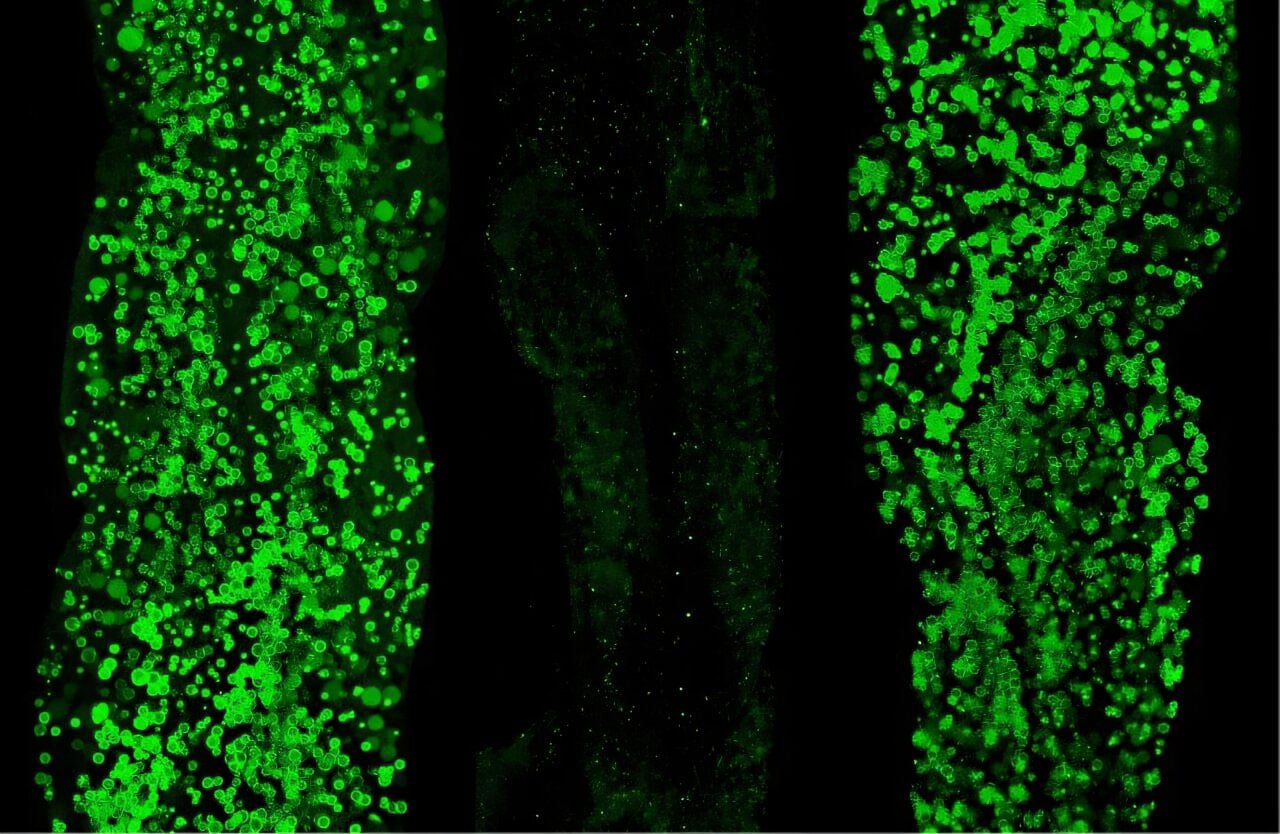
During fasting, cells rapidly deplete their limited glucose stores and transition to breaking down stored fats for energy. This process, known as catabolism, is regulated by a protein called NHR-49. As glucose levels decline, NHR-49 becomes active and prompts fat breakdown. Once food is available, NHR-49 deactivates, halting fat breakdown and allowing cells to restore their energy reserves. Previous research by Dr. Douglas and his colleagues in 2022 indicated that NHR-49 also regulates lipid levels within cells and helps prevent starvation as these reserves dwindle.
To determine if NHR-49 is a key factor in the lifespan benefits associated with fasting, Dr. Douglas and his team removed the gene responsible for this protein in C. elegans and conducted a 24-hour fasting experiment. The results were surprising; the deletion of NHR-49 did not diminish the lifespan advantages. The fasted worms continued to live approximately 41 percent longer on average and exhibited more youthful behaviors, including increased mobility, akin to worms with normal NHR-49 function.
Refeeding response influences longevity
The research team then focused on the events that transpire after the fasting period ends, particularly regarding the inactivation of NHR-49.
To comprehend this process, the team analyzed how NHR-49 is normally deactivated. Investigations led by Vincent Tagliabracci, Ph.D., alongside Victor Lopez, Ph.D., a postdoctoral researcher, revealed that an enzyme called protein kinase CK1 alpha 1 (KIN-19) modifies NHR-49 through phosphorylation. When Dr. Douglas and the team altered this mechanism so that NHR-49 remained active even post-feeding, lipid breakdown persisted, negating the lifespan-extending benefits of fasting.
Modulating metabolism may enhance longevity
In summary, the ability to effectively deactivate NHR-49 after fasting is essential for extending lifespan through calorie restriction. Modifying this mechanism could provide a pathway to enjoy the benefits of fasting without adhering to rigid dietary restrictions.
“Our findings bridge the divide between lipid metabolism and aging studies,” Dr. Douglas remarked. “By targeting aging, the foremost risk factor for human diseases, we are shifting from treating isolated ailments to a preventative healthcare model that enhances overall quality of life.”
Reference: “Silencing lipid catabolism determines longevity in response to fasting” by Lexus Tatge, Juhee Kim, Rene Solano Fonseca, Kyle Feola, Jordan M. Wall, Gupse Otuzoglu, Ann C. Johnson, Kielen R. Zuurbier, Jaeyoung Oh, Shaghayegh T. Beheshti, Victor A. Lopez, Anthony J. Daley, Emma G. Werner, Patrick Metang, Sonja L. B. Arneaud, Abigail Watterson, Jeffrey G. McDonald, Vincent S. Tagliabracci, Michael E. French and Peter M. Douglas, 22 January 2026, Nature Communications.
DOI: 10.1038/s41467-026-68764-y
This study received funding from the Clayton Foundation for Research, The Welch Foundation (I-2061-20210327), the American Federation of Aging Research (AFAR 2023), and the National Institutes of Health (R01AG076529, R01GM15385).
Never miss a breakthrough: Join the SciTechDaily newsletter.
Follow us on Google and Google News.