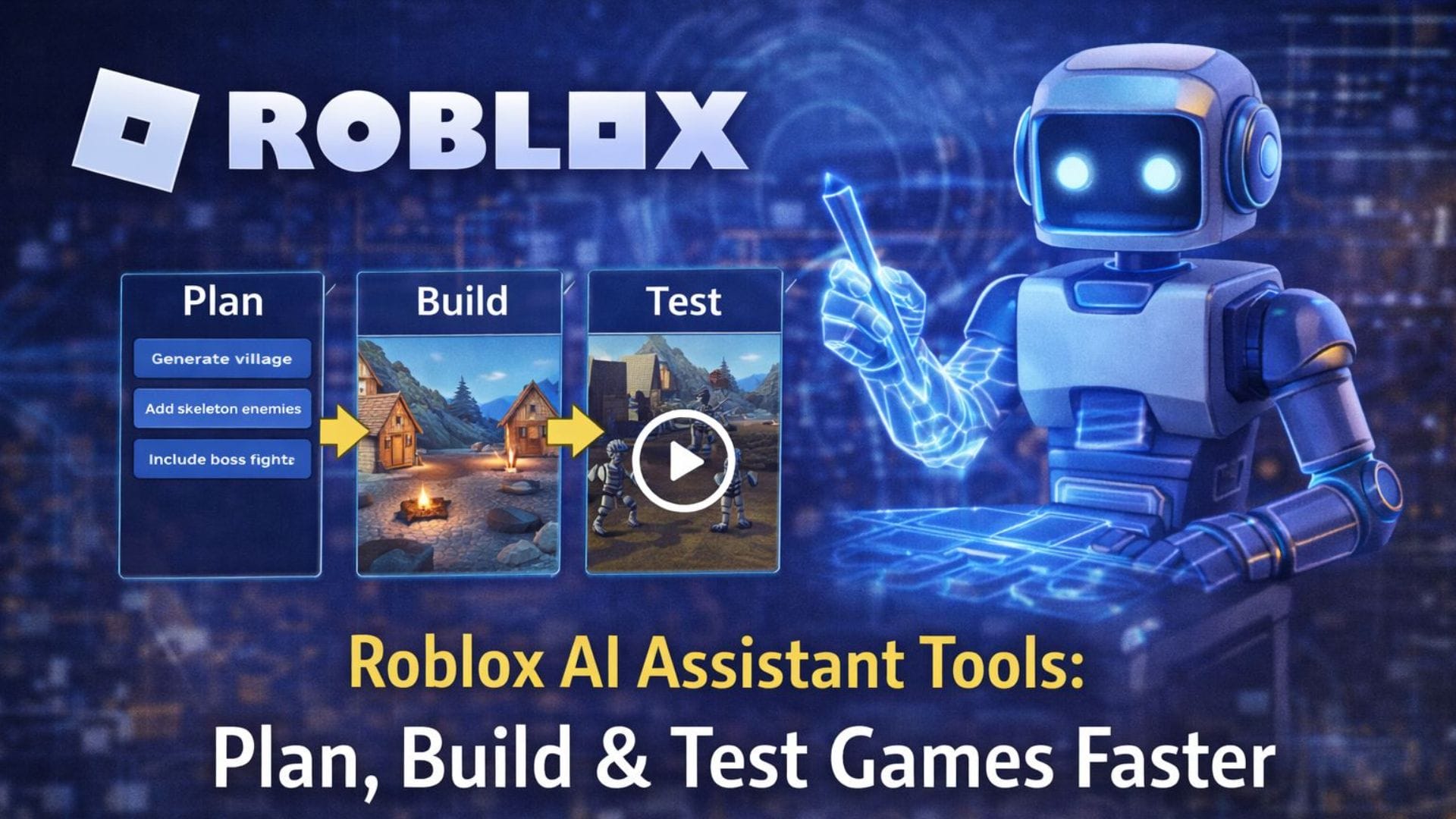
Roblox has rolled out a suite of innovative agent-based artificial intelligence features aimed at streamlining the game development experience for creators on its platform. Among the most significant updates is a revitalized version of Roblox Assistant, a user-friendly AI tool designed to support developers throughout their creative journey.
The revamped assistant aims to go beyond basic prompt responses, which often yield singular outputs without a deep understanding of a creator’s intentions. The new tools transform the assistant into a collaborative partner, capable of analyzing project data, asking relevant follow-up questions, and guiding developers through organized workflows.
Planning Mode Revamps the Development Workflow
At the heart of the update is an advanced feature called Planning Mode. This allows the assistant to scrutinize a game’s code and data model prior to formulating a comprehensive action plan. Rather than jumping straight to results, the assistant first poses clarifying questions to better grasp the creator’s objectives and artistic direction.
This method ensures the final product closely aligns with the developer’s initial vision. Creators can assess the proposed plan, fine-tune specific components, and provide additional context before any actual development begins. This systematic approach aims to minimize errors and prevent unnecessary revisions later in the production cycle.
For example, if a developer envisions a park-themed mini-game with a fountain and greenery for players to collect coins, the assistant may inquire about the desired visual style—options might include cartoonish, realistic, or fantasy elements. It might also seek clarity on asset creation methods, offering choices such as building from scratch, utilizing existing models from the Creator Store, or merging both approaches.
Once a plan is finalized, the assistant employs other integrated AI tools to execute the development tasks. This enables creators to maintain oversight while the system handles repetitive or technically intensive aspects, potentially shortening the timeline from concept to a playable game.
In addition to Planning Mode, Roblox has unveiled two more tools designed to expedite the creation of 3D assets: Mesh Generation and Procedural Model Generation. These features aim to streamline the early stages of development, during which placeholder assets are typically used to test gameplay concepts.
Mesh Generation empowers developers to create fully textured 3D objects within the game environment. Instead of relying on simplistic placeholder shapes, creators can craft detailed models that better embody their intended designs. This enhances the ability to assess player interactions in a more realistic context from the very beginning.
For instance, a developer could direct the assistant to generate a campfire object, enhance it with lighting effects for realism, and set the ambiance to nighttime. By producing more polished assets early on, the system helps to lessen the need for repeated revisions down the line.
Roblox has also announced plans to introduce Procedural Models, enabling developers to generate editable 3D structures through code and natural language prompts. Since the assistant comprehends spatial relationships and object placements, creators can specify how items should be positioned or scaled relative to one another.
This feature allows for dynamic modifications to certain attributes. For instance, the number of shelves in a bookcase or the height of a staircase can be adjusted instantly, yielding flexible components that can be reused throughout various sections of a game. The company asserts that these reusable elements will enhance efficiency and promote uniform design standards.
Nick Tornow, Senior Vice President of Engineering at Roblox, expressed that the new tools signify a transformative shift in how games can be created on the platform. “With the launch of our agentic features in Roblox Studio, we are reducing barriers between creative vision and execution,” he stated. “Utilizing Planning Mode and our Procedural Generation tools allows creators to effectively convert their concepts into gameplay. The Assistant acts as a collaborative, multi-step development partner—accelerating the stages of planning, building, and testing, so creators can bring their ideas to life more swiftly.”
Automated Testing and Future Multi-Agent Workflows
The upgraded assistant also introduces advanced testing capabilities aimed at identifying issues during development. As Planning Mode performs its tasks, it employs integrated playtesting tools to assess performance and pinpoint potential complications.
These tools analyze output logs, capture screenshots, and simulate player inputs using peripherals like keyboards and mice. By observing gameplay interactions in real-time, the assistant can detect bugs or design flaws and suggest corrective measures. In certain instances, it can automatically implement fixes without requiring developer intervention.
Roblox explained that these functionalities depend on agentic loops—a cycle where the system continually tests different elements, evaluates outcomes, and incorporates enhancements into subsequent iterations. This feedback loop enables the assistant to improve its accuracy and reliability over time.
“With enhanced capabilities in planning, building, and testing, Assistant excels at utilizing agentic loops to explore various aspects of the game, provide suggested solutions, and refine future planning, creating a self-correcting system that grows increasingly precise,” the company stated in a blog post.
Looking to the future, Roblox confirmed it is working on additional features that will enable multiple AI agents to collaborate simultaneously. These agents are expected to manage complex workflows within cloud environments, tackling tasks such as coding, testing, and creating more lifelike in-game characters.
Moreover, the company plans to bolster compatibility with third-party development tools. Upcoming updates aim to facilitate seamless integration with external systems like Claude, Cursor, and Codex, allowing developers to continue utilizing familiar workflows alongside Roblox Studio.
As competition within the game development landscape intensifies, the introduction of agent-based AI tools illustrates a mounting shift towards automation and enhanced collaboration between human creators and intelligent systems. Roblox’s recent updates indicate its commitment to establishing a more accessible and efficient platform for both seasoned developers and newcomers eager to realize their creative visions.