
In his seminal work, An Inquiry into the Nature and Causes of the Wealth of Nations (WN), Adam Smith provides a vivid exploration of various economic, political, religious, and military contexts from both ancient and contemporary times. His observations were deeply rooted in the realities of his era, allowing him to comment on the economic conditions of numerous nations.
However, Smith’s references to different countries were not uniform. The chart below illustrates the frequency with which Smith mentions various European nations in WN. While some countries receive extensive commentary, others are scarcely acknowledged. Notably, the frequency of mentions does not necessarily correlate with the economic, political, or military strength of these nations.
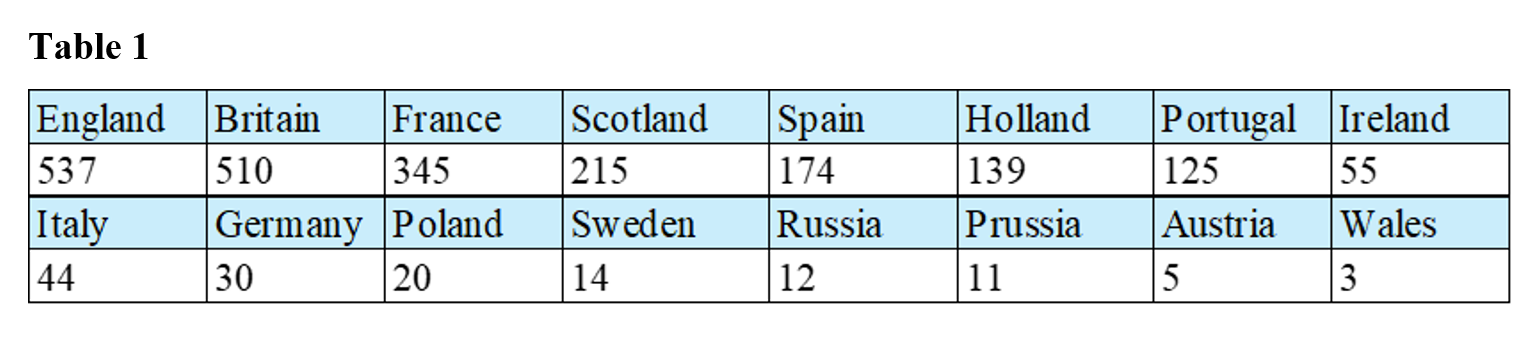
The frequency counts for various modern European countries were based on a mix of the country’s name, demonyms, and various spelling variants. For example, the tally for “Spain” includes “Spain,” “Spanish,” and “Spaniard,” while “Portugal” covers “Portugal,” “Portuguese,” and “Portugueze.” Smith only refers to “Netherlands” once, using the term “United Provinces” predominantly; therefore, I will consistently refer to “Holland” as per Smith’s terminology throughout this discussion.
It’s important to note that my analysis focuses on national identities and omits Smith’s references to cities. For instance, he mentions Amsterdam eleven times in Chapter II of Book IV, specifically in the Digression concerning Banks of Deposit, particularly concerning that of Amsterdam, but uses the terms included in my count only twice.
WN is particularly rich in references to England, Britain, and Scotland. It serves not merely as an economic treatise but also as a politically charged document advocating for certain legal frameworks while critiquing others. Given that Smith’s primary audience was British, it is unsurprising that he emphasizes British legislation and practices. He lauds the Scottish free-banking system, advocates for the practice of students compensating their educators, and champions religious freedoms. Conversely, he critiques Britain’s mercantilist activities concerning its American colonies, condemns the corn laws, and points out inefficiencies with the herring buss bounty.
France also appears frequently, reflecting its status as Britain’s chief rival during Smith’s lifetime. The nation possessed a colossal economy and wielded significant military and political influence. Interestingly, while Spain, Holland, and Portugal are mentioned more often than Russia, Prussia, and Austria, it is noteworthy that the former were viewed as diminished powers at the time, whereas the latter represented some of Europe’s foremost authorities alongside Britain and France.
Despite their status as diminished powers, Spain, Portugal, and Holland provide valuable illustrations in Smith’s discussions of monetary economics, colonization, international trade, and banking. References to Spain and Portugal predominantly relate to their colonization efforts and the economic impact of their silver and gold mines. In Volume I, Spain is most often mentioned in Chapter XI’s digression on silver and in the Of Bounties section in Chapter V of Book IV; these sections make up 60% of the references to Spain in this volume, despite constituting just 16% of its total pages.
Portugal also features significantly, with over half (53%) of its mentions arising from the digression on silver and Of Bounties in Volume I. In Volume II, most references pertain to Of Treaties of Commerce and Of Colonies, where Smith employs the famous Methuen Treaty between England and Portugal as a prime example of a commercial agreement.
The references to the Dutch are more spread out than those related to Spain and Portugal. A substantial portion (78%) appears in Book IV and Chapter II of Book V, where Smith casts the Dutch in an overwhelmingly positive light. He portrays them as the quintessential trading nation, celebrated for their wealth and entrepreneurial spirit. Smith does critique the exclusive company they employed for colonial ventures, contrasting with their otherwise liberal trade practices. However, his outlook on Dutch banks is generally favorable, indicating an appreciation for their contributions to the banking sector.
Smith’s analysis in WN draws from a multitude of concrete examples designed to shed light on various economic issues. His references are not dictated by the prestige of the nations involved; for instance, while Russia, Prussia, and Austria were significant European players, they receive scant attention in his work. Instead, Smith focuses on the unique economic characteristics of nations that provide meaningful insights, such as Spain and Portugal’s precious metals and Holland’s dynamic trade. This masterful use of real-world examples contributes to the ongoing relevance and engagement of WN.