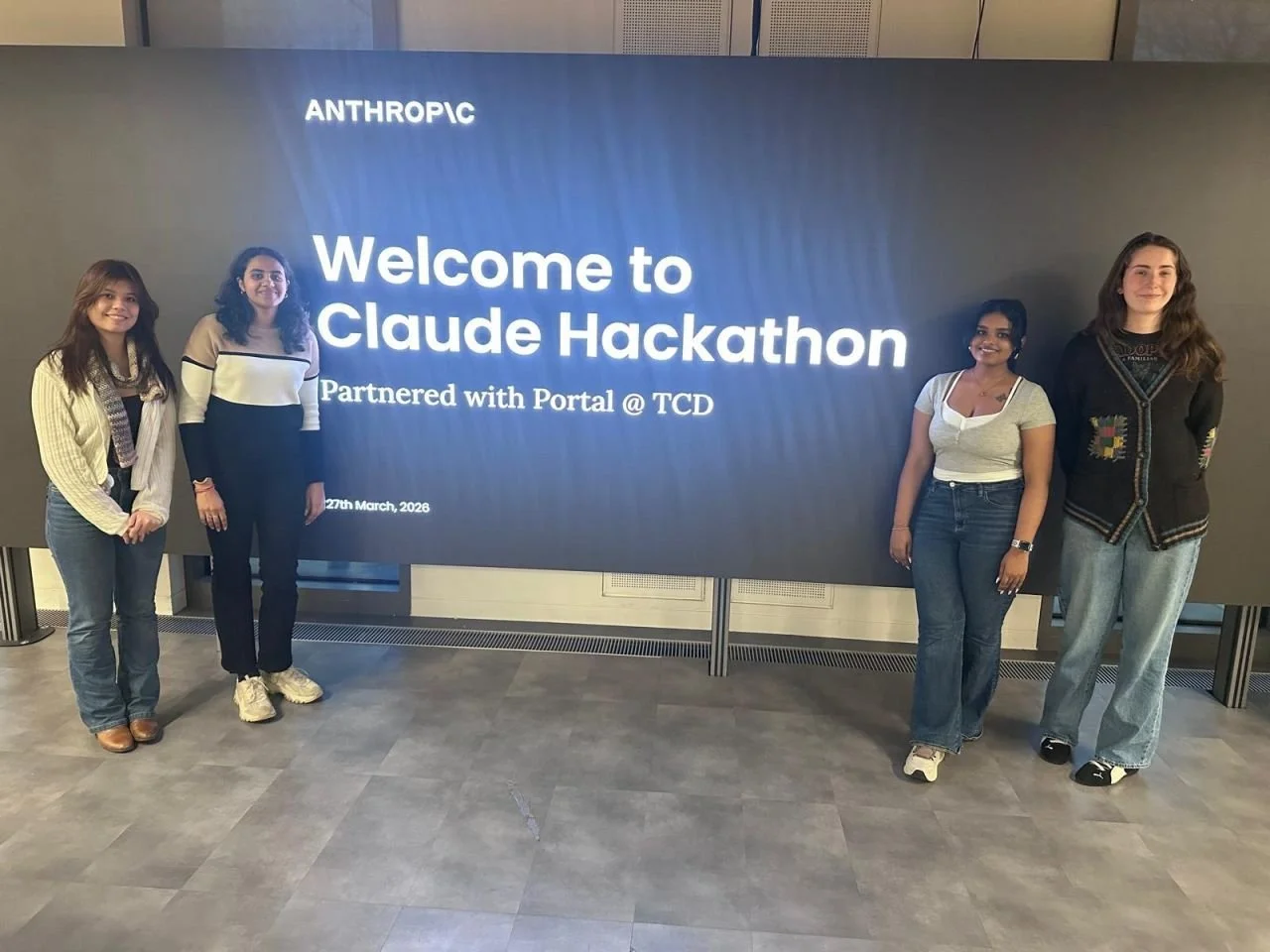
At a recent hackathon hosted by Trinity College Dublin, students showcased innovative projects leveraging AI technology to address real-world challenges. One standout project, Clarity, reimagines municipal budget data in a way that is easily understandable for the average citizen. According to Kush Voorakkara, a Computer Science student, “Our project simplifies complex financial information into plain-language, address-specific breakdowns showing where local funds are allocated.”
Clarity triumphed in the Economic Empowerment & Education track, exemplifying the aim of making intricate systems more accessible through artificial intelligence.
Another notable project, Voxify, tackles the challenge of real-time feedback mechanisms for educational institutions. Aman Bansal, an MSc Business Analytics student, explained, “Students often have valuable insights but lack: a safe way to express their opinions, a quick method to be heard, and a actionable feedback system.”
He added, “Voxify aims to fill this gap by creating a system that makes feedback: anonymous, real-time, and easy to participate in.”
These projects underscore how students are harnessing AI tools to bridge communication gaps and enhance accessibility in educational environments.
Healthcare and cognitive tools developed using AI models
Healthcare-related applications were also prominent at the hackathon, with an innovative project aimed at early-stage Parkinson’s Disease screening.
Atharva Kocharekar, a Machine Learning Engineer and student, shared, “We developed a screening tool—not a diagnostic tool—but one designed to capture initial signals.”
He elaborated, “At its foundation, the tool utilizes an XGBoost model with strong benchmarking metrics operational during inference, supported by three layers of analysis.”
The system evaluates various indicators such as gait, finger-tapping, and voice patterns, prioritizing explainability and early detection.
Another innovative project, WatchWise, analyzed video content to gauge cognitive load in children. It incorporated multiple AI agents to evaluate factors such as pacing, sensory intensity, and reward mechanisms.
Hackathons provide an environment for rapid AI prototyping
Several projects extended into civic and global applications. Notably, AidAtlas was developed to enhance humanitarian responses by mapping areas of need and connecting them with volunteer interests and coordination.
Sinclair Philandrianos, a student at Trinity College Dublin, stated, “This platform is not just about displaying problems; it’s also about forging a path from: need ➔ visibility ➔ volunteer interest ➔ organized action.”
Throughout the event, participants highlighted the rapid pace of development that allowed them to shift from concept to functioning prototype in a matter of hours.
Attendees also noted the collaborative and hands-on nature of the hackathon. Milan Varghese, a Computer Science student, described it as an experience of “brainstorming exciting concepts and bringing them to life in a short timeframe.”
The Claude Builder Club @ TCD is a student-led community dedicated to building and experimenting with large language models, benefiting from support by Anthropic.
The array of projects presented at the hackathon offers a glimpse into how students are applying AI tools in practical settings, focusing on usability, accessibility, and addressing real-world problems.