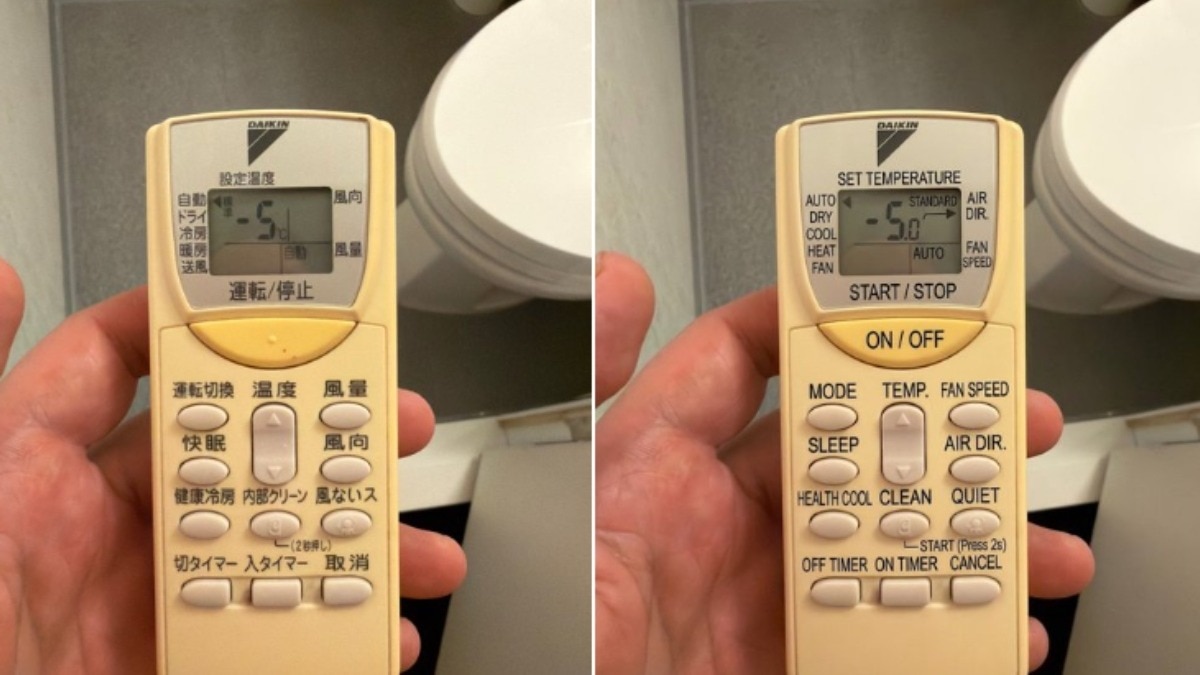
In an amusing late-night incident in Japan, a U.S. traveler found himself in a familiar predicament — struggling with an unhelpful hotel air conditioner remote. This experience, however, turned into a charming showcase of how technology, particularly artificial intelligence, is continuously transforming travel. The story, shared by Michael S. Galpert online, quickly went viral as he revealed how he used an AI tool to navigate the situation at 4 a.m.
Galpert recounted how he was abruptly awoken by the heat of his hotel room, only to be greeted by a remote control labeled entirely in Japanese. The buttons were a source of frustration, as he found himself unable to decipher their functions.
Rather than struggle with the remote, Galpert turned to an AI tool. Utilizing Google Gemini Nano Banana, he generated an English translation of the remote’s controls. His post featured two images: one of the original remote and the other showcasing the translated labels in English.
“I was woken up at 4 a.m. because it was too hot in the hotel room. The Nano Banana gods saved the day,” he humorously shared, noting that his prompt was quite straightforward: “Create an image in English.”
See the post:
The translated remote allowed him to quickly adjust the temperature, transforming a potentially sleepless night into a clever example of tech innovation at work.
Users on social media found the hack to be both relatable and ingenious. One user remarked, “This is actually genius; I never thought of doing this while traveling.” Another added, “AI is becoming the ultimate travel hack at this point,” while a third noted, “Waking up at 4 a.m. and still figuring this out deserves respect.”
This viral moment emphasizes how AI is increasingly stepping in to tackle minor, everyday challenges, often at the most inconvenient times.
– Ends