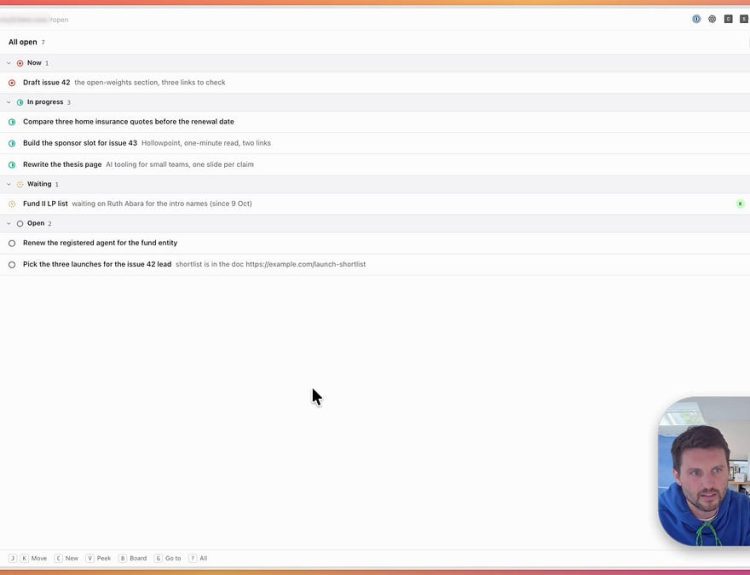
In early February, Matt Schumer, the founder of OthersideAI and creator of the AI writing tool HyperWrite, released a lengthy 5,000-word essay titled “Something Big Is Happening.” This article offers chilling insights into the capability of AI to generate additional AI, positing that the societal disruption caused by AI will be “much bigger” than the impact of COVID-19, and it is occurring right now. The essay garnered over 60 million views within just two days, sparking waves of commentary, reporting, and online discussions in the weeks following its release.
Shortly thereafter, Mrinank Sharma, head of Anthropic’s Safeguards Research team, submitted his resignation via a public letter that warned “the world is in peril.” He highlighted not only AI risks but a multitude of interconnected crises, announcing his intention to leave the field entirely for a new life studying poetry in the UK … presumably until an algorithm-driven apocalypse occurs. Around the same time, OpenAI researcher Zoe Hitzig resigned due to concerns about potential manipulations stemming from ChatGPT’s introduction of advertising.
Congressional hearings are characterized by ominous predictions regarding autonomous weapons. Headlines are filled with discussions of existential threats and machines that could end civilization. The relentless use of catastrophic language is, frankly, exhausting.
This is what many seem to overlook: This wave of anxiety benefits no one and actively hinders our ability to strategize about AI and formulate effective policies.
A world in unexplained peril
One thing that stands out in all these alarming predictions, doomsday resignation letters, and distressing posts: a lack of specificity. Sharma sounds the alarm stating “the world is in peril” but fails to clarify what that peril truly encompasses or how it might manifest. Schumer likens AI to the COVID-19 pandemic yet struggles to explain the nature of the harm beyond job displacement. His comparison to the initial stages of COVID disintegrates; he mentions that almost no one was discussing COVID before it dramatically altered society, while AI risk is a ubiquitous topic today. At this moment, there are at least three bestselling books dedicated to it. One of them even bears the ominous subtitle “Why Superhuman AI Would Kill Us All.” Each of these works, much like Sharma’s resignation letter, is steeped in vague apocalyptic language, leaving us questioning the tangible ways AI could lead to disaster.
Another troubling aspect of this discourse is the inherent narcissism. These warnings elevate AI developers to the status of pivotal figures, suggesting they alone have created these data-driven powers. They are likened to modern-day Oppenheimers, destined for major cinematic portrayals that examine their mastery, motivations, and regrets. This narrative casts them as both heroes and harbingers, crucial to both the creation and control of this imminent threat.
However, if the threat is as immediate and severe as claimed, why can’t they elucidate what it entails? Nuclear weapons annihilate cities. Pandemics sweep through populations, resulting in exponential fatalities. What, precisely, does an AI-induced apocalypse look like? Furthermore, if AI possesses the capability to end civilization, what can AI companies do to mitigate this risk that governments and established institutions would not?
During the White House Office of Science and Technology Policy’s listening sessions on AI policy last year, the primary challenge was not identifying risks but differentiating genuine technical challenges from science fiction. This distinction is vital for agencies needing to allocate limited oversight resources effectively.
The dire language creates a misleading binary: AI either destroys everything or saves everything. Perhaps both perspectives are misguided and hinder the development of nuanced, sector-specific regulations that might actually be effective. There may still be room for autonomy as we navigate the AI landscape.
Disruption isn’t apocalypse
While AI is indeed advancing swiftly—being utilized by human resources departments for resume screening, hiring, and onboarding—this shift does not equate to societal collapse. AI is even conducting job interviews. This has led to a frustrating job application process, where countless candidates are rejected based on arbitrary factors like zip codes or resume length. Nevertheless, this trend saves companies significant amounts of time by lightening the workload of their HR teams.
So, while disruption is undeniably occurring on a large scale, it is essential to understand that disruption—even if it is rapid and extensive—does not equal existential collapse. The introduction of desktop computers in the 1980s did not obliterate federal employment; rather, it transformed the nature of the work performed. The shift towards digital services did not render government obsolete; instead, it made it more accessible.
Interestingly, Anthropic CEO Dario Amodei—Sharma’s former superior—offered a more moderate perspective in an essay last month where he counters “doomerism.” While he acknowledges real risks that necessitate serious consideration, Amodei explicitly warns against “viewing AI risks in a quasi-religious manner,” advocating instead for sober, fact-based evaluations over sensationalized accounts circulating on social media.
The crux of the policy discussion is not whether AI will change work and replace many jobs that involve human data entry—this will happen. The critical question is whether we will navigate this transformation in a manner that serves the public good or permit market forces to dictate outcomes.
AI can’t police itself
Should federal agencies incorporate safeguards into AI procurement processes? Absolutely. However, these safeguards should not be created exclusively by AI companies without independent oversight.
AI systems face real technical hurdles, including unexpected behaviors in edge cases, susceptibility to adversarial attacks, and biases that can escalate. The National Institute of Standards and Technology has thoroughly documented these risks in its AI Risk Management Framework, firmly rooted in serious research rather than mere speculation.
Nevertheless, these challenges represent engineering and governance issues, not unchangeable realities. We can address them through strict testing protocols, external audits, and clear regulatory standards, akin to the procedures outlined in the Federal Acquisition Regulation for other critical technologies.
The assertion that AI is too complicated for conventional oversight is self-serving nonsense. Aviation safety regulators don’t need to construct planes, and financial regulators aren’t required to operate banks. Efficient oversight calls for technical understanding, not business capture.
We’ve done this before
After World War II, the world encountered genuinely apocalyptic technology in the form of nuclear weapons. The appropriate response was not panic or stagnation but robust governance.
The Atomic Energy Act of 1946 established civilian oversight, while in 1974, the Nuclear Regulatory Commission set safety standards. International treaties were implemented to curb proliferation. While these measures did not erase all risk, they effectively managed a technology capable of terminating civilization.
AI—powerful as it may be—is much more manageable. It operates without agency and does not develop goals autonomously. The risks associated with AI stem from human misuse, insufficient testing, and market dynamics misaligned with public welfare. These issues can be rectified through the regulatory frameworks we already possess.
What real regulation looks like
Instead of engaging in panic, federal agencies require clear authorities and allocated resources. To begin with, there should be mandatory pre-deployment testing for high-risk AI systems in federal procurement, similar to the security assessments already mandated for IT systems. The GSA’s AI Center of Excellence should hold the authority to reject systems that do not meet transparency or bias audit requirements.
Next, sector-specific oversight from agencies that possess domain expertise is essential. The Department of Transportation should oversee autonomous vehicles, the Department of Health and Human Services should regulate medical AI, and the Securities and Exchange Commission should monitor algorithmic trading. Implementing a one-size-fits-all AI regulation is as illogical as having a single agency supervise both aircraft and pharmaceuticals.
Furthermore, international coordination via existing frameworks is crucial. The Organization for Economic Cooperation and Development has already established AI principles, and the International Organization for Standardization is currently developing technical standards. We do not need new institutions; we need to appropriately fund and empower the ones we already have.
Lastly, transparency requirements should be in place that allow independent researchers to audit systems without compromising proprietary assets. Such a model exists: Financial services companies manage to safeguard their proprietary trading algorithms while still undergoing regulatory review.
This represents detailed, technical, and often unglamorous work. However, it is the only approach that can genuinely improve outcomes.
Why catastrophizing backfires
Exaggerating that AI will inevitably lead to the end of civilization does tangible damage. It undermines rational discussions on policy by conflating uncertainty with certainty. It makes it impossible for Congress to formulate effective legislation when testimonies fluctuate between “AI will cure cancer” and “AI will lead to our demise.”
This panic about AI rapidly proliferates, additionally fueling public fear rather than fostering informed dialogue, leaving citizens feeling helpless instead of empowered to hold companies accountable.
Moreover, it provides a convenient excuse for corporations to resist oversight. If only AI developers claim to understand AI, then they alone can regulate it. This narrative conveniently consolidates power and profit within a select group.
The solution is not to inflate perceived risks. Rather, it is to confront real concerns through evidence-based governance.
Choose governance, not panic
AI presents significant risks capable of reshaping the global economy and disrupting substantial portions of the workforce. Such changes may occur—but they will unfold over time. This impending risk calls for thoughtful consideration and strategy. It demands effective management through established institutions. It does not spell inevitable doom, nor does it imply that traditional regulatory measures cannot be effective.
Federal agencies can oversee AI development without relinquishing control to self-regulatory industry bodies. They can implement testing mandates, enforce transparency, and facilitate international collaboration. They have successfully done this with technologies far more perilous than software.
Ultimately, the choice confronting policymakers is not one between destruction and paradise. It is a choice between thoughtful governance using tried-and-true regulatory frameworks and surrendering to market dynamics and industry pledges.
This is a moment for governance, not panic.
Joe Buccino is a retired U.S. Army Colonel.
Copyright © 2026 Federal News Network. All rights reserved. This website is not intended for users located within the European Economic Area.