Essential AI Tools for Startups in 2026
Startups in 2026 operate at an astonishing pace. In this rapidly evolving landscape, markets can shift in mere weeks—making it crucial for businesses to stay agile. Falling behind means conceding victory to competitors, so integrating AI tools has become essential for efficiency and productivity. With small teams needing to maximize output without expanding headcount, the advantages brought by AI are undeniable.
In this article, we’ll explore several key advantages that AI offers to startups: speed, efficiency, and insights. You’ll find practical applications tailored to enhance productivity, marketing, development, operations, and customer support. Each tool will be detailed with user-friendly explanations, highlighting features, pros, and cons, making it easy for founders to determine the right fit for their startup. By the end, you’ll have a clear understanding of which tools can facilitate growth while alleviating stress. Let’s dive into the essentials!
Top 13 AI Tools for Startups in 2026
Choosing the right AI tools can significantly influence a startup’s trajectory. The tools listed below address common challenges faced by founders, streamlining everything from task management to content creation and workflow enhancement. Each tool is designed to help teams execute tasks faster, collaborate more effectively, and make informed decisions.
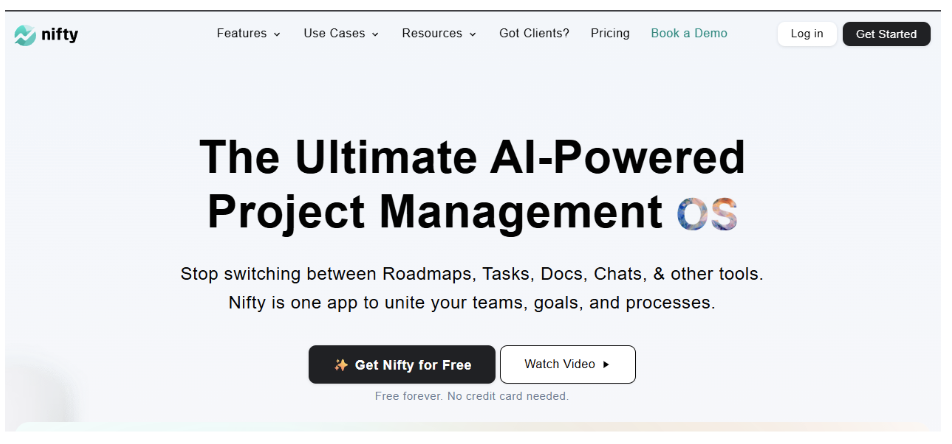
1. Nifty: AI-Powered Project Management with Built-In Collaboration
Nifty is a project management platform that integrates tasks, milestones, documents, and discussions into a cohesive workspace. This centralized approach allows startups to oversee their projects smoothly from inception to execution, eliminating the need to switch between different applications.
Startups often lose clarity when project details are spread across emails, Slack channels, and various disconnected tools. Nifty centralizes all information—roadmaps, tasks, files, and communications—creating a single source of truth.
Its AI assistant simplifies project management by generating updates, summarizing discussions, and identifying project blockers, ensuring everyone stays aligned without the hassle of manual updates.
With visual timelines, milestone tracking, and built-in documentation features, Nifty enhances context and collaboration directly within the workflow.
Key Features:
- AI project assistant for generating reports and task breakdowns.
- Milestone tracking with visual timelines for project oversight.
- Integrated documentation and discussions to keep context accessible.
- Workflow automation for repetitive updates and notifications.
- Portfolio view to manage multiple projects and monitor team capacity.
Pricing:
- Free
- Starter – $39/month
- Business – $124/month
- Unlimited – $399/month
2. Typeface: End-to-End Campaign Orchestration
Startups often waste time and resources when content creation is scattered across multiple platforms. Typeface addresses this by centralizing the entire content workflow, generating copy, designing images, and creating campaign assets—all while applying brand guidelines consistently.
Using Typeface’s AI-powered agents, teams can automate the entire marketing workflow, from content briefs and SEO drafts to generating visuals and social media posts in one seamless run. Its Brand Hub centralizes all brand assets, ensuring consistency as the startup scales.
Key Features:
- AI agents for managing the full marketing lifecycle.
- Brand Hub for centralized asset management and visual references.
- A unified workspace to coordinate the entire content lifecycle.
- Multimodal AI to generate both written and visual content.
- Integrations with popular tools to ensure seamless workflows.
Pricing:
NA
3. ClickUp: AI-Powered Project Management for Startups
ClickUp offers a comprehensive project management solution tailored for startups to plan, track, and execute tasks efficiently. By combining task management with documents, goal tracking, and AI assistance, it streamlines workflows into one user-friendly system.
Startups benefit from improved visibility over tasks and responsibilities, reducing the risk of communication breakdowns and missed deadlines. ClickUp’s AI assistant can generate summaries, write task descriptions, and suggest workflow improvements, saving valuable planning time.
Key Features:
- Real-time AI writing assistance for drafting tasks and updates.
- Task automation to streamline repetitive workflows.
- Goal tracking to connect tasks to overarching objectives.
- Custom dashboards to visualize performance metrics.
- Collaboration tools integrated into the workspace.
Pricing:
- Free forever
- Unlimited – $7/user/month
- Business – $12/user/month
- Enterprise – Custom quote
4. Deevid AI: AI Video Creation for Startup Marketing
Deevid AI simplifies the creation of marketing videos for startups without requiring extensive production resources. With video content being a key driver for traffic and trust, this tool transforms scripts or ideas into publish-ready videos in mere minutes.
Founders can produce product demos, informative clips, and social media ads effortlessly, significantly decreasing production timelines. Deevid AI’s capabilities also allow for quick testing of video variations, facilitating informed marketing decisions.
Key Features:
- Text-to-video generation for seamless video production.
- AI voiceovers in various languages for natural narration.
- Auto subtitles to enhance viewer engagement.
- A library of templates for different video styles.
- Simple editing tools for quick adjustments.
Pricing:
- Lite – $10/month
- Pro – $25/month
- Premium – $119/month
5. GrammarlyGO: AI Writing Support for Business Communication
GrammarlyGO is an essential writing aid that enhances clarity and professionalism in communication for startups. Fast-paced environments can lead to hastily composed emails and content, but this tool helps elevate the quality of written materials.
Not only does it provide real-time grammar and spelling checks, but GrammarlyGO also offers suggestions for improving tone and structure based on your intent. Teams can refine drafts quickly, ensuring polished, effective communication across emails, proposals, social media posts, and more.
Key Features:
- Instant grammar correction for immediate feedback.
- Suggestions for tone adjustments to fit various contexts.
- Assistance with rewriting for clarity and brevity.
- Browser integration for minimal workflow disruption.
- Plagiarism detection to maintain originality.
Pricing:
NA
6. Zovoro AI: All-in-One AI Platform for Everything
Zovoro AI consolidates numerous disconnected tools into a singular AI-driven system focusing on growth and creativity. By unifying workflows related to marketing, branding, social media, and outreach, it proves invaluable for early-stage teams.
Whether generating written content, creating visuals, or producing music, Zovoro AI covers all bases within a single platform, reducing costs and execution time. This all-in-one approach is particularly beneficial for startups without dedicated design resources.
Key Features:
- Multimedia creation for images, videos, and music.
- Content generation for blogs, ads, and product descriptions.
- Structured marketing workflows for campaign planning.
- Content repurposing to optimize existing material.
- Cost efficiency by replacing multiple tools with one platform.
Pricing:
- Free
- Lite – $9/month
- Pro – $19/month
- Business – $39/month
7. Tagshop AI
Tagshop AI simplifies the creation of high-performing video ads, allowing brands to generate impactful content without the reliance on large creative teams. This tool efficiently transforms product details and scripts into ready-to-publish video ads.
Businesses can create various ad formats for platforms like Meta, TikTok, and YouTube in minutes, reducing production time and costs. Tagshop AI also facilitates rapid A/B testing to identify the most effective ad versions, making it easier to scale campaigns effectively.
Key Features:
- AI video ad generation from scripts or product details.
- AI Twin for creating digital spokespersons in video content.
- Quick versioning with different avatars and layouts.
- High-quality product visuals generated without physical shoots.
- AI script generation for seamless ad creation.
Pricing:
- Free
- $29/month
- $99/month
- $249/month
8. Canva Magic Studio: AI Design Tool for Startup Branding
Canva Magic Studio empowers startups to create stunning visual content without the need for in-house design teams. The platform offers a range of AI-assisted design tools, enabling users to produce branding materials, ads, presentations, and social media posts easily.
With features like text-to-image generation and background removal, Canva facilitates speedy content creation. Templates ensure brand consistency, while intuitive controls allow teams to produce marketing materials on demand.
Key Features:
- Text-to-image generation to create visuals from prompts.
- Magic resize feature for adapting designs to various formats.
- Background removal for cleaning up product images.
- A template library for ready-to-use layouts.
- Brand kit for storing logos, fonts, and color palettes.
Pricing:
- Free
- Pro – $12.99/month
- Teams – $14.99/month
9. GitHub Copilot: AI Coding Assistant for Faster Development
GitHub Copilot accelerates the coding process for startups by offering real-time code suggestions within development environments. For small engineering teams facing tight deadlines, this tool is invaluable.
Copilot predicts and suggests code as developers work, reducing repetitive tasks and allowing engineers to focus on solving essential problems rather than re-writing common patterns.
Key Features:
- Real-time code suggestions to assist development.
- Comment-to-code generation that transforms instructions into functional code.
- Support for multiple programming languages.
- Integration into common IDEs for a streamlined experience.
- Context-aware suggestions based on the project files.
Pricing:
- Free
- Pro – $10/month
- Pro+ – $39/month
10. Make: AI Automation for Startup Workflows
Make is an automation platform that connects various applications, eliminating tedious data entry tasks for startups. In an environment where numerous tools are utilized daily, Make helps to streamline workflows.
With its visual editor, users can create automated workflows to handle repetitive tasks, improving efficiency. This means less need for manual data management and fewer errors, giving teams more time to focus on innovation.
Key Features:
- Visual workflow builder for easy automation design.
- Integration with hundreds of business tools.
- Conditional logic for intelligent workflows based on triggers.
- Real-time data synchronization to keep systems updated.
- Error handling tools to ensure proper function of automations.
Pricing:
- Free
- Make plan – $9/month
11. Jobma: AI Video Interviewing for Faster, Smarter Hiring
Jobma streamlines the hiring process for startups, addressing one of the biggest bottlenecks in growth. With AI-powered video interviewing, startups can accelerate hiring without bloating their HR teams.
Rather than scheduling multiple rounds of interviews, founders can request one-way video responses from candidates, maximizing efficiency and simplifying candidate evaluation. This is particularly useful for specialized roles.
Key Features:
- Asynchronous video interviews to speed up the screening process.
- Support for live interviews and skill assessments.
- Integrations with popular ATS platforms for organized candidate management.
- Automated workflows for candidate communication.
Pricing:
NA
12. Testlify: AI-Powered Talent Assessments for Skills-First Hiring
Finding the right talent is crucial, and Testlify helps by providing AI-powered assessments that focus on candidates’ skills. This platform allows recruiters to send tailored assessments, making evaluations more objective and efficient.
Candidates can take role-specific tests online, and recruiters are provided with detailed analytics to aid in decision-making. With an integrated one-way video interviewing feature, Testlify also streamlines the evaluation process.
Key Features:
- Structured tests for evaluating various skills.
- One-way video interviews for screening communication skills.
- Automated scoring and analytics for quick comparisons.
- Integration with popular ATS platforms for streamlined workflows.
Pricing:
NA
13. ReferralCandy: AI-Powered Referral & Affiliate Programs
ReferralCandy simplifies the creation of referral programs for startups, allowing happy customers to become brand advocates easily. By automating the tracking of referrals and rewards, startups can scale word-of-mouth marketing efforts rapidly.
It integrates seamlessly with eCommerce platforms, allowing businesses to reward their customers instantly whenever a referred friend makes a purchase.
Key Features:
- Automated tracking of referrals and rewards.
- Customizable reward structures to fit your business model.
- Branded referral pages and emails to enhance brand visibility.
- Fraud detection tools to ensure integrity in the referral process.
Pricing:
- Basic – $39/month
- Grow – $79/month
- Scale – $249/month
- Enterprise – $799/month
How to Pick the Right Tools
Selecting AI tools isn’t about choosing the most popular options; it’s about finding those that align with your startup’s current stage and objectives.
Match Tools to Your Startup Stage
Early-stage startups prioritize speed and validation; therefore, tools that facilitate quick launches and testing, such as ChatGPT or Canva Magic Studio, are instrumental. Growth-stage startups, on the other hand, should focus on automation and structured systems, making platforms like Make and CRM tools more relevant.
Team Size and Skill Level
Smaller teams should look for intuitive tools that require minimal setup, while developer-oriented groups might benefit from more sophisticated options like Copilot and Make.
Budget and ROI Priorities
It’s essential for startups to track expenditures closely. Always evaluate a tool’s potential to save time or generate revenue—if this value isn’t clear, reassess its importance. Start with core tools that directly influence sales, product development, or customer service.
Integration with Existing Stack
Ensure any chosen tool integrates smoothly with your existing systems. Poor integration can lead to data silos and other inefficiencies. A well-chosen tool stack should feel cohesive and solve distinct problems without overwhelming your processes.
A balanced combination of tools—like Apollo for lead generation, Tidio for customer interaction, and Notion AI for documentation—can work harmoniously together to enhance your startup’s productivity.
Conclusion
The integration of AI tools has become integral to startup operations. By reducing manual tasks, enhancing speed, and promoting informed decision-making, these tools enable startups to thrive in a competitive marketplace. In 2026, leveraging AI effectively can set successful startups apart from the rest. Begin with small, focused implementations—choose tools that address specific challenges while monitoring outcomes. Remember, the ultimate goal is not merely automation, but refined focus, allowing founders and teams to prioritize strategy, product, and customer engagement.
FAQs
Are AI tools expensive for startups?
Many AI tools offer free or starter plans. Costs typically rise with increased usage, so it’s best to start with essential tools impacting revenue or productivity.
Can AI replace team members in a startup?
AI is designed to support teams, not replace human judgement. It alleviates repetitive tasks and accelerates processes.
How many AI tools should a startup use?
Limit your tool count to what is necessary. Overloading on tools can lead to confusion; focus on those that are well-integrated and solve real issues.
Is coding knowledge required to use AI tools?
Most AI tools are designed for no-code or low-code use. Developer-oriented tools like Copilot will require some coding knowledge, but many are accessible to non-technical users.
What is the biggest mistake startups make with AI tools?
One of the most common pitfalls is using too many tools without a clear strategy. Each tool should serve a distinct purpose and demonstrate measurable impact on your business.